Battle of the Bulge Facts

Quick facts on the Battle of the Bulge: background, the German offensive, Bastogne, the American counterattack, casualties, and why it matters.

The Battle of the Bulge was Germany's last major offensive on the Western Front in World War II, and its outcome helped determine how quickly the Allied forces could push into Germany itself. Understanding it means knowing how close Germany came to disrupting Allied supply lines and what it took for American forces to hold their ground and recover. This page collects the key facts across six topics so students can study or review the battle quickly and clearly. Related: Causes of World War II and European Theater of World War II.

Background

By late 1944, Allied forces had pushed German troops back across France and Belgium after the D-Day landings in June. Hitler believed a large surprise attack through the Ardennes forest could split the Allied lines, capture the port of Antwerp, and force a negotiated peace on the Western Front. The cards in this section show the conditions and decisions that made Germany willing to commit its last major reserves to that gamble.

World War IIStat
Facts that CrunchFactsthatCrunch
German casualties at the Battle of the Bulge

The German High Command's own official figure listed 84,834 German soldiers killed, wounded, or captured during the Battle of the Bulge from December 16th, 1944 to January 25th, 1945.

Other estimates put German losses between 60,000 and 100,000. Germany committed over 410,000 men to the attack, so the casualties represented a major share of its remaining fighting strength in the West. Unlike the Allies, Germany could not replace these losses, and most surviving units retreated to the Siegfried Line in a badly weakened state.

Source: Library of Congress© factsthatcrunch.comMore World War II Facts →
World War IIHead to Head
Facts that CrunchFactsthatCrunch
German Forces (Army Group B)VSU.S. Forces (First Army)
~200,000~83,000 (initial front)
Troops committed
~600~400
Tanks and assault guns
~60,000 to 100,000~75,000
Casualties (killed, wounded, captured)
~800~4,000 (Allied total, inc. RAF)
Aircraft available at battle's start
Dec. 16th to 26th, 1944Dec. 16th to 26th, 1944
Duration of offensive (German advance phase)
Source: National WWII Museum© factsthatcrunch.comMore World War II Facts →
World War IICause & Effect
Facts that CrunchFactsthatCrunch
Cause

By late 1944, Hitler believed the Western Allies would split politically if Germany dealt them a sudden, large defeat, so he ordered a massive surprise attack through the Ardennes forest to capture the key port of Antwerp and force a negotiated peace on the Western Front.

Effects
Germany committed roughly 200,000 soldiers and nearly all of its remaining armored reserves to the attack, leaving other fronts with far fewer resources.
The offensive temporarily pushed Allied lines back, creating a large bulge in Belgium, but Allied forces held the key road junction at Bastogne and stopped the German advance within weeks.
Germany's failure to reach Antwerp or split the Allies ended any realistic hope of a negotiated settlement with the Western powers.
The heavy losses of tanks, artillery, and trained soldiers in the Ardennes made it nearly impossible for Germany to mount a serious defense when Soviet and Allied forces advanced into Germany in early 1945.

Hitler launched the Ardennes offensive, later called the Battle of the Bulge, on December 16th, 1944. The political goal of forcing the Allies apart drove the decision, but the plan consumed resources Germany could not replace.

Source: UNESCO© factsthatcrunch.comMore World War II Facts →
Test Yourself
World War IIMultiple ChoiceInteractive
Facts that CrunchFactsthatCrunch

Which country launched the Battle of the Bulge, and what was its main goal?

Tap an option.
ExplanationGermany launched the offensive on December 16th, 1944, aiming to split the Allied lines and capture Antwerp, Belgium. Holding Antwerp would cut off Allied supply lines and force the Western Allies to negotiate, buying Germany time.
Source: Library of Congress© factsthatcrunch.comMore World War II Facts →
Explore More Topics

The German Offensive

Germany launched its attack on December 16th, 1944, sending more than 200,000 troops through a thinly held stretch of the Ardennes in Belgium and Luxembourg. The assault was designed to move fast, before Allied air power could respond, and bad winter weather grounded Allied aircraft in the opening days. The cards here cover the key moves Germany made to push the front line westward and create the bulge that gave the battle its name.

World War IICorkboard Timeline
Facts that CrunchFactsthatCrunch
Battle of the Bulge in World War II
Week by Week, December 1944 to January 1945
1944
Week 1: December 16th to 22nd, 1944
Germany launched roughly 200,000 troops and about 600 tanks through the Ardennes forest, pushing the Allied front line back and creating a large bulge in the American lines.
1944
Week 2: December 23rd to 29th, 1944
Skies cleared on December 23rd, allowing Allied aircraft to fly again; U.S. planes struck German supply columns and helped relieve pressure on the surrounded 101st Airborne Division at Bastogne.
1944
Week 3: December 30th, 1944 to January 5th, 1945
General George S. Patton's Third Army pushed north from the south, while German forces made their last serious attempt to break through to the Meuse River and failed to reach it.
1945
Week 4: January 6th to 13th, 1945
British forces under Field Marshal Bernard Montgomery attacked from the north near Hotton and Marche, while U.S. forces continued pressing from the south, squeezing the bulge from both sides.
1945
Week 5: January 14th to 25th, 1945
American units from the north and south linked up near Houffalize, Belgium, on January 16th, cutting off large numbers of German troops and collapsing the center of the bulge.
1945
Week 6: January 26th to 28th, 1945
The Allied line was fully restored to where it had stood on December 16th, 1944; Germany had lost roughly 67,000 to 100,000 soldiers killed, wounded, or captured, and could not replace them.
A timeline pinned to the board.
Source: National WWII Museum© factsthatcrunch.comMore World War II Facts →
World War IIDefinition
Facts that CrunchFactsthatCrunch
Panzer
German word meaning 'armor' or 'armored'

Panzer is a German term used in World War II to describe armored fighting vehicles, especially tanks, and the military units built around them. Germany organized its tanks into panzer divisions, which combined tanks, motorized infantry, artillery, and support troops into fast-moving strike forces. These divisions were designed to break through enemy lines quickly and keep moving before defenders could regroup.

"During the invasion of France in May 1940, German panzer divisions crossed the Ardennes region and reached the English Channel in less than two weeks, cutting off Allied forces in the north."
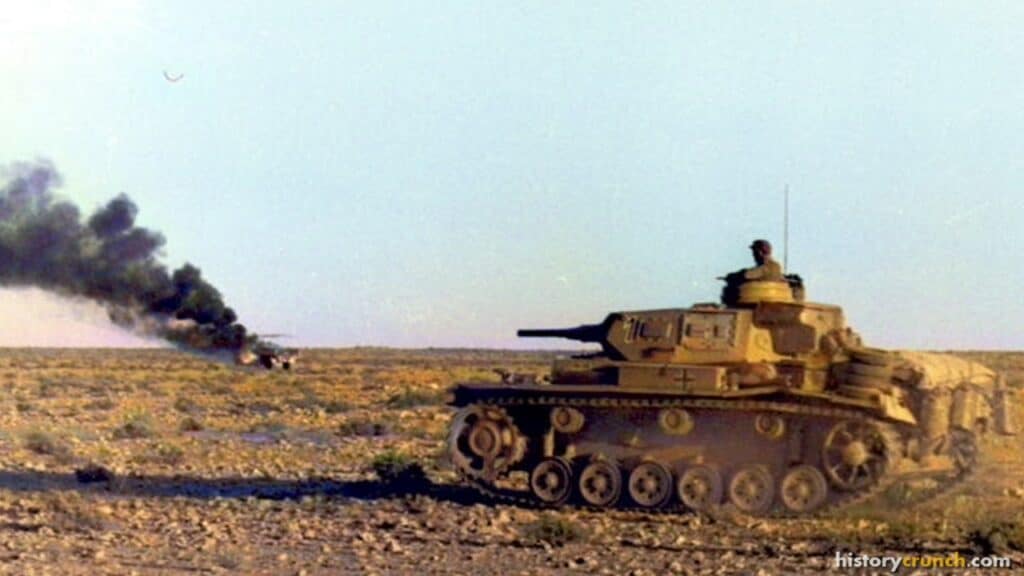
German Panzer during Operation Sonnenblume in April of 1941 in the North African Theater of World War II. (Colorized by historycrunch.com)
Source: Smithsonian Institution© factsthatcrunch.comMore World War II Facts →
World War IIDid You Know
Facts that CrunchFactsthatCrunch
Surprising fact

The term 'Battle of the Bulge' was coined not by generals or official military reports but by American war correspondent maps that showed a bulging westward dent in the Allied front line, and the U.S. Army never adopted it as a formal name.

When German forces launched their Ardennes offensive on December 16th, 1944, they pushed Allied lines outward in a shape that looked like a bulge on news maps printed back home. Reporters began using the phrase to describe that visual shape, and readers recognized it immediately. The official U.S. Army name for the campaign was the Ardennes-Alsace Campaign, a title almost no one uses today.
Source: UNESCO© factsthatcrunch.comMore World War II Facts →
Brad, this time the Kraut's stuck his head in a meat grinder. And this time I've got hold of the handle.
General George S. Patton
Commander of the U.S. Third Army, December 1944
Germany launched a surprise attack in the Ardennes forest on December 16th, 1944, starting the Battle of the Bulge. Patton told General Omar Bradley that the deep German push was really a trap for the attackers, then swung his Third Army north and reached the surrounded town of Bastogne on December 26th, 1944.
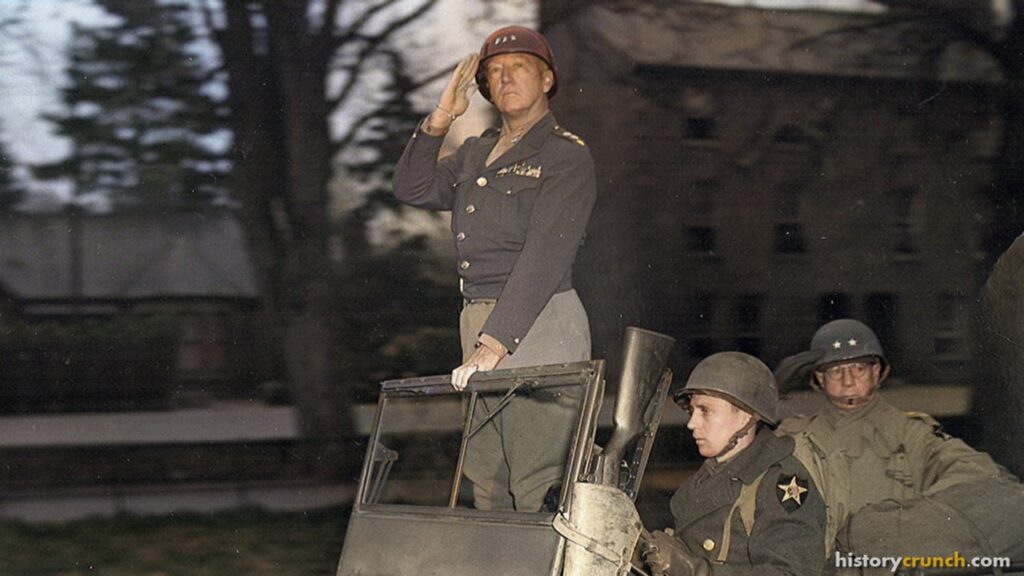
George S. Patton standing in an army jeep in April of 1944. (Colorized by historycrunch.com)
Source: National WWII Museum© factsthatcrunch.com
World War IICorkboard Timeline
Facts that CrunchFactsthatCrunch
Battle of the Bulge Day by Day
Final Push and Retreat, December 1944 to January 1945
1944
December 18th, 1944
German forces surrounded the town of Bastogne, Belgium, cutting off about 18,000 U.S. troops of the 101st Airborne Division and other units inside.
1944
December 22nd, 1944
German General Heinrich Luettwitz demanded the surrender of Bastogne; U.S. Brigadier General Anthony McAuliffe answered with a one-word reply: "NUTS!"
1944
December 23rd, 1944
Skies over Belgium cleared for the first time in days, allowing U.S. and Allied aircraft to drop supplies into Bastogne and attack German columns on the roads.
1944
December 26th, 1944
The 4th Armored Division of General George Patton's Third Army broke through German lines and reached Bastogne, ending the siege of the town.
1945
January 3rd, 1945
Allied forces launched a major counterattack from the north, with U.S. First Army pushing south to close the bulge from both sides.
1945
January 25th, 1945
German forces completed their withdrawal to their starting positions, ending the Battle of the Bulge after about six weeks of fighting.
A timeline pinned to the board.
Source: National WWII Museum© factsthatcrunch.comMore World War II Facts →
World War IIScale
Facts that CrunchFactsthatCrunch

How Were German Forces Split in the Battle of the Bulge? The 410,000-Troop Assault Force Was Divided Unequally Across Three Armies

6th SS Panzer Army (Dietrich)
~180,000 troops5th Panzer Army (von Manteuffel)
~150,000 troops7th Army (Brandenberger)
~80,000 troops

Germany's Army Group B under Field Marshal Walter Model launched the Battle of the Bulge on December 16th, 1944, with roughly 410,000 troops divided across three armies. Hitler gave the 6th SS Panzer Army the largest share and the best equipment, making it bigger than the other two armies combined. The 7th Army, the smallest force, had almost no tanks and relied on horses for supply, much as German forces had in 1914.
Source: UNESCO© factsthatcrunch.comMore World War II Facts →
Sherman vs. Tiger
crew needed to operate each tank
The American M4 Sherman required a crew of five men, while the German Tiger I also used five, but the Tiger weighed roughly 56 tons (51 metric tons) compared to the Sherman's 33 tons (30 metric tons), meaning the Allies could ship and produce far more Shermans for the same resources needed to field one Tiger.
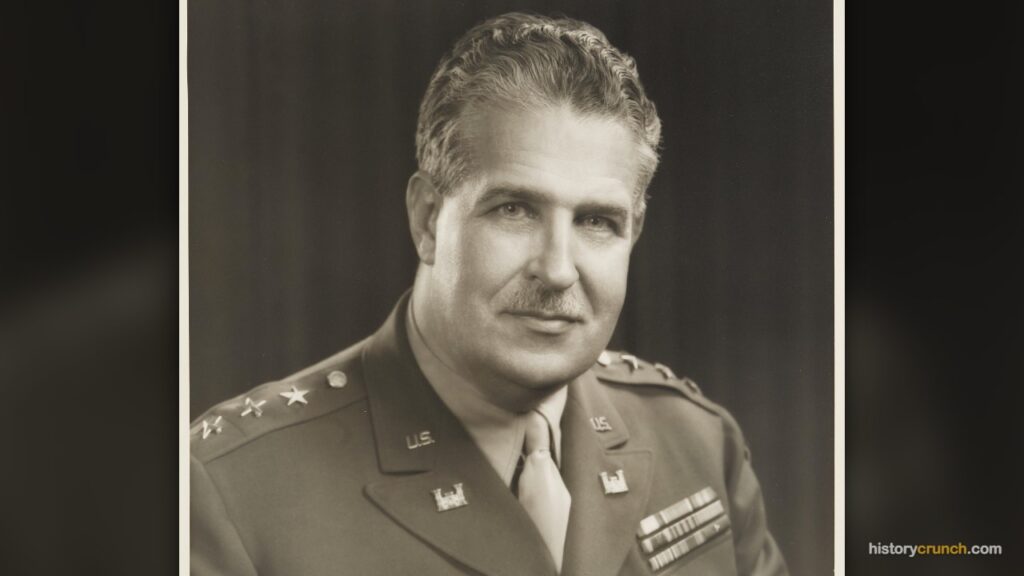
General Leslie Groves served as the military director of the Manhattan Project during World War II and is shown here in his U.S. Army major general's uniform.
Source: National WWII Museum© factsthatcrunch.comFacts that Crunch
World War IIImage ExplorerInteractive
Facts that CrunchFactsthatCrunch
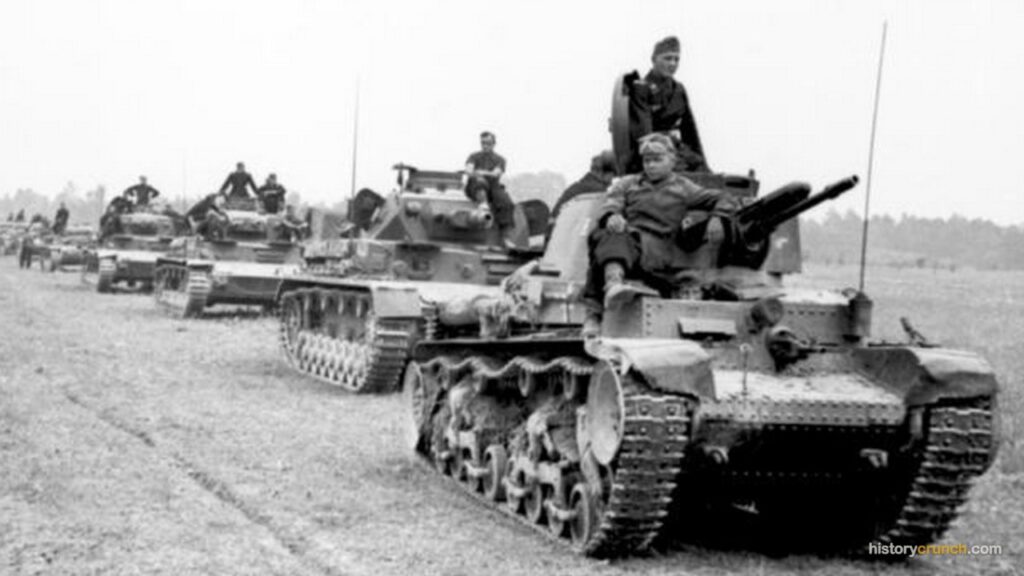
A column of German Panzer tanks advances along a dirt road during World War II, with crew members riding on top of the vehicles and infantry soldiers visible on the left side of the road.
Tank Column Formation Multiple tanks are lined up along a dirt road stretching into the distance. This column formation was central to German Blitzkrieg tactics, which used fast-moving armor to punch through enemy lines and advance quickly before defenders could respond.
Soldiers Riding on Top of Tanks Several soldiers are seated on the outside of the tanks rather than inside them. Crews often rode on the hull to conserve space, stay cooler, and keep watch, since visibility from inside an early World War II tank was very limited.
Short-Barreled Tank Gun The lead tank has a short, wide gun barrel mounted in its turret. Early German tanks like the Panzer 35(t) and Panzer 38(t) carried short-barreled guns designed mainly to support infantry rather than to defeat heavily armored enemy tanks, reflecting how tank warfare was understood in the early years of the war.
Open Flat Terrain The tanks are moving across wide, flat, open farmland with very little cover. Germany invaded Poland and later the Soviet Union across exactly this kind of terrain, which allowed armored columns to move at speed and made Blitzkrieg tactics highly effective in the early war years.
A column of German Panzer tanks advances along a dirt road during World War II, with crew members riding on top of the vehicles and infantry soldiers visible on the left side of the road.
Source: Library of Congress© factsthatcrunch.comMore World War II Facts →
World War IIRedacted FileInteractive
Facts that CrunchFactsthatCrunch
TOP SECRET / EYES ONLY
Fuhrer Directive: Authorization of Operation Watch on the Rhine, November 1944
On November 11th, 1944, Hitler signed a directive authorizing Operation Watch on the Rhine, the German counteroffensive planned for the Ardennes sector of the Western Front. The operation aimed to drive through Allied lines, cross the Meuse River, and capture the vital supply port of Antwerp, which Hitler believed would split the Allied armies and force a negotiated peace. Command of the offensive was given to Field Marshal Gerd von Rundstedt, though detailed planning was directed primarily by Hitler himself through OKW. The attack was to be launched in poor winter weather to neutralize Allied air superiority, with roughly 30 divisions committed to the initial thrust. Strict secrecy surrounded all preparations, and the directive was distributed only to the most senior commanders.
Tap the black bars to declassify.
Source: National Archives© factsthatcrunch.comMore World War II Facts →
Test Yourself

In the Battle of the Bulge in World War II, did each of these military units fight for the German side or the Allied side?

Read the item in the dashed box, then tap the column where it belongs.
SORT THIS ITEM1 / 10
1st SS Panzer Division
5th Panzer Army
Panzer Lehr Division
6th SS Panzer Army
7th Army (Wehrmacht)
U.S. 9th Army
U.S. 1st Army
U.S. 3rd Army
British 30th Corps
U.S. 101st Airborne Division
Sort all 10 to see your score
1st SS Panzer DivisionU.S. 9th Army5th Panzer ArmyPanzer Lehr DivisionU.S. 1st Army6th SS Panzer ArmyU.S. 3rd ArmyBritish 30th Corps7th Army (Wehrmacht)U.S. 101st Airborne Division
ExplanationGermany launched the Battle of the Bulge on December 16th, 1944, sending three armies, including the 6th SS Panzer Army under Sepp Dietrich, against Allied lines in the Ardennes; the U.S. 101st Airborne held Bastogne until Patton's 3rd Army broke through on December 26th, 1944.
Source: National WWII Museum© factsthatcrunch.comFacts that Crunch
World War II

The German offensive in the Ardennes in December 1944 aimed to capture the vital Allied supply port of Antwerp.

Tap an option.
ExplanationHitler's plan called for German forces to drive through the Ardennes, cross the Meuse River, and seize Antwerp, the main Allied supply port in Belgium. Cutting off that port was meant to split the Allied armies and force a negotiated peace on the Western Front.
Source: National WWII Museum© factsthatcrunch.comFacts that Crunch
Explore More Topics

Siege of Bastogne

Bastogne sat at the center of a road network that both sides needed to move troops and supplies through the Ardennes. German forces surrounded the town on December 20th, 1944, expecting the American defenders to give up quickly. The cards here explain what the surrounded garrison faced and how the situation at Bastogne affected the overall German timetable.

World War IIThen and Now
Facts that CrunchFactsthatCrunch
Then

When German forces surrounded Bastogne, Belgium, on December 20th, 1944, the town held a key road junction where seven major roads met, making it a critical supply and movement hub in the Ardennes. The U.S. 101st Airborne Division and attached units were cut off inside the town with limited ammunition, food, and medical supplies. Temperatures dropped well below freezing, and the defenders held a perimeter of roughly 16 miles (26 kilometers) around the town.

Now

Today Bastogne is a small Belgian city of about 16,000 people and serves as a major site of World War II remembrance in Europe. The Bastogne War Museum, opened in 2014, displays original vehicles, weapons, and personal accounts from the battle and draws visitors from across the world each year. A large star-shaped American memorial built in 1950 stands on the Mardasson Hill just outside town, honoring the roughly 76,000 American soldiers who fought in the Battle of the Bulge.

Bastogne went from a frozen, besieged crossroads town in December 1944 to one of the most visited World War II memorial sites in Western Europe.

Source: UNESCO© factsthatcrunch.comMore World War II Facts →
World War IIStat
Facts that CrunchFactsthatCrunch
soldiers killed, 101st Airborne Division

During the Siege of Bastogne, the 101st Airborne Division recorded 341 soldiers killed, 1,691 wounded, and 516 missing between December 19th, 1944 and January 6th, 1945.

The 101st Airborne held the Belgian crossroads town of Bastogne against repeated German attacks for about a week before relief arrived on December 26th, 1944. The 10th Armored Division's Combat Command B, which fought alongside the 101st, added roughly 500 more casualties to the total. The two units together held Bastogne at heavy cost and were each awarded the Presidential Unit Citation for their actions.
Source: Smithsonian Institution© factsthatcrunch.comMore World War II Facts →
Nuts!
Brigadier General Anthony McAuliffe
U.S. Army general leading the 101st Airborne Division at Bastogne, 1944
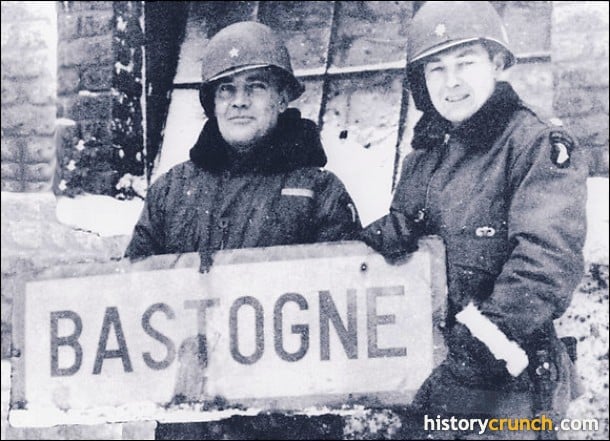
During the Battle of the Bulge, German forces surrounded the town of Bastogne in Belgium and demanded that the Americans surrender on December 22nd, 1944. McAuliffe sent back this one-word refusal, and his troops held the town until part of General Patton's Third Army broke through four days later.
Anthony C. McAuliffe, left, and then-Col. Harry W.O. Kinnard II at Bastogne · Wikimedia Commons / Unknown War photographer
Source: U.S. Army Center of Military History© factsthatcrunch.com
World War IIEyewitness
Facts that CrunchFactsthatCrunch
Eyewitness account

"When they got to the 400 yards, the lieutenant said, 'Now! Now!' and we opened up with everything we had. It was a slaughter."

VSVincent Speranza, Machine gunner, 501st Parachute Infantry Regiment, 101st Airborne Division
Context

Speranza recalled the German infantry attack near Bastogne at first light on December 19th, 1944, in a recorded 2021 interview.

Source: Vincent Speranza, American Veterans Center interview (2021)© factsthatcrunch.comMore World War II Facts →
World War IIQuote
Facts that CrunchFactsthatCrunch

Well, I don't know what to tell them. What you said initially would be hard to beat. Sir, you said nuts.

AM
Anthony McAuliffe and Harry KinnardActing commander of the 101st Airborne Division and his division operations officer, December 22nd, 1944, at Bastogne
Why it matters

Kinnard was in the room and later recalled how he reminded McAuliffe of his own first word, which then became the written reply.

Source: The Army Historical Foundation, account of Gen. Anthony C. McAuliffe© factsthatcrunch.comMore World War II Facts →
World War IINotebook Bio
Facts that CrunchFactsthatCrunch
Anthony C. McAuliffe, left, and then-Col. Harry W.O. Kinnard II at Bastogne · Wikimedia Commons / Unknown War photographer
Anthony McAuliffe
in World War II
U.S. Army General, Acting Commander of the 101st Airborne Division
Birth: Born July 2nd, 1898, in Washington, D.C.
Battle of the Bulge: Held Bastogne against German siege, December 1944
Famous reply: Answered German surrender demand with one word: "Nuts!"
Source: National WWII Museum© factsthatcrunch.comMore World War II Facts →
World War IIQ&A
Facts that CrunchFactsthatCrunch
Q

Why Did the 101st Airborne Division Hold Bastogne During the Battle of the Bulge?

A

The 101st Airborne Division held Bastogne because the town sat at the center of seven major roads, making it the key supply and movement hub in the Ardennes region of Belgium. German forces surrounded the town on December 20th, 1944, but American troops refused to retreat, knowing that losing Bastogne would allow Germany to push much deeper into Allied lines. General Anthony McAuliffe, commanding the defense, famously replied 'Nuts!' to a German surrender demand on December 22nd, 1944, and the garrison held out until General George Patton's Third Army broke through the encirclement on December 26th, 1944.

Source: UNESCO© factsthatcrunch.comMore World War II Facts →
World War IIFlip NotebookInteractive
Facts that CrunchFactsthatCrunch

What happened each day during the Siege of Bastogne, December 20th to December 27th, 1944?

Source: Library of Congress© factsthatcrunch.comMore World War II Facts →
Test Yourself
World War IIDecision PointInteractive
Facts that CrunchFactsthatCrunch
DECISION POINT

It is late December 1944, and you are Brigadier General Anthony McAuliffe, acting commander of the 101st Airborne Division during the Battle of the Bulge in World War II. German forces have surrounded your division at Bastogne, Belgium, cutting off supplies of food, ammunition, and medicine. If Bastogne falls, Germany controls a key road junction and its counteroffensive gains real momentum.

History turned on this choice. What would you have done?
What do you order the 101st Airborne to do at Bastogne?
Choose a path. Each choice opens a different future.
Your move
Pick option A, B, or C to walk down that path.
If you choose A
Your troops dig in and refuse to surrender. Casualties mount and supplies run dangerously low, but you pin down German forces and keep the road junction out of their hands. Relief has to come before your men run out of ammunition.
If you choose B
You risk your entire division in open country against a larger surrounding force. If the breakout fails, you lose Bastogne and much of the division. Even a successful breakout hands Germany the road junction it needs.
If you choose C
You end the fighting at Bastogne, freeing German forces to push deeper into Allied lines. Germany secures the junction and gains time and road access for its offensive in the Ardennes.
What really happened
McAuliffe chose to hold, famously replying 'Nuts!' to a German surrender demand delivered on December 22nd, 1944. The 101st held out until the 3rd Army's 4th Armored Division broke through on December 27th, 1944, ending the siege. Holding Bastogne denied Germany the road network it needed, helping to blunt and eventually stop the Ardennes offensive.
Source: National WWII Museum© factsthatcrunch.comMore World War II Facts →
World War II

During the Siege of Bastogne, the 101st Airborne Division was completely surrounded and cut off for nearly two weeks before any relief force reached them.

Myth or fact? Tap your call.
The truthGerman forces encircled Bastogne on December 19th, 1944, and the 101st Airborne held the town without a ground supply line until the 4th Armored Division broke through on December 26th, 1944, a stretch of about seven days, not two weeks, though resupply by air drop was limited and unreliable throughout.
Source: National WWII Museum© factsthatcrunch.comFacts that Crunch
World War IIImage QuestionInteractive
Facts that CrunchFactsthatCrunch
Americans of the 101st Engineers during the Battle of the Bulge. (Colorized by historycrunch.com)

In this colorized photograph of American soldiers from the 101st Engineers during the Battle of the Bulge, what does the mix of gear visible on the soldiers most strongly suggest about U.S. supply conditions at this stage of the battle?

Tap an option.
ExplanationThe soldiers wear a mix of overcoats, field jackets, and mismatched cold-weather clothing rather than uniform winter gear. German forces encircled Bastogne in December 1944, cutting off supply routes. American units inside the perimeter, including engineer troops repurposed for combat, had to make do with whatever clothing and weapons were on hand. The visible patchwork of gear matches the documented shortages of winter clothing and ammunition that units at Bastogne endured until the relief by Patton's Third Army opened a corridor on December 26th, 1944.
Source: UNESCO© factsthatcrunch.comMore World War II Facts →

Sources

Explore More Topics

American Counterattack

Once the Allied command understood the full scale of the German push, General Dwight Eisenhower reorganized the response and ordered General George Patton's Third Army to turn north and relieve Bastogne. Moving an entire army in winter conditions within days was a major feat of military planning. The cards in this section trace how Allied forces shifted from absorbing the attack to pushing the Germans back toward their starting lines.

World War IIBulletin Board BioInteractive
Facts that CrunchFactsthatCrunch
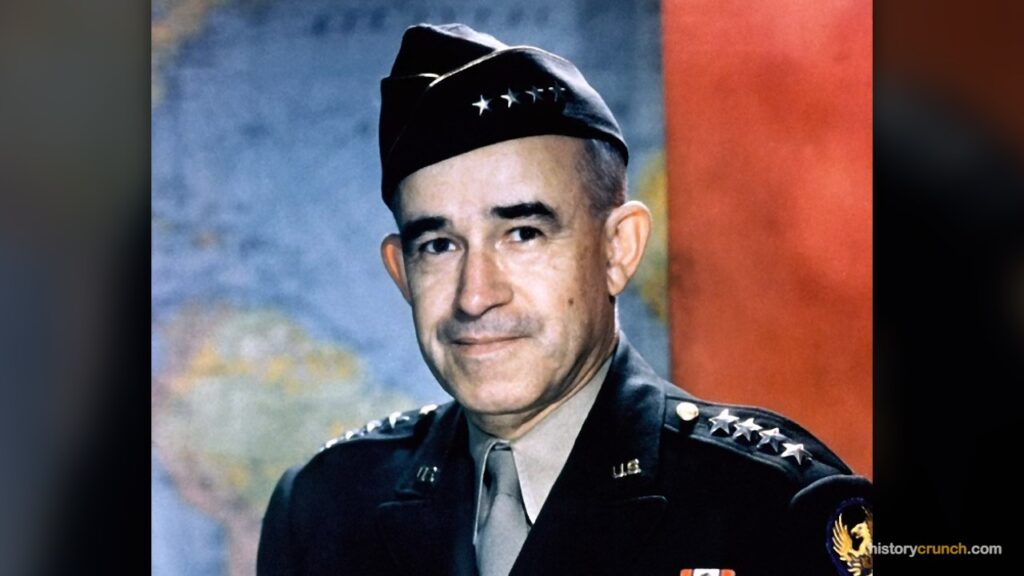
Omar Bradley, a four-star general in the U.S. Army, served as a senior American commander during World War II.
Omar Bradley
At a Glance
BornFebruary 12th, 1893, in Clark, Missouri
DiedApril 8th, 1981, in New York City, New York
RoleGeneral of the Army, U.S. Army; Commander of U.S. 12th Army Group in Europe
Tap a heading to open the note.
West Point Graduate
Bradley graduated from the United States Military Academy at West Point in 1915, the same class that later produced Dwight D. Eisenhower.
Command in North Africa
Bradley took command of II Corps in Tunisia in April 1943 and led it through the final Allied push that ended Axis resistance in North Africa on May 13th, 1943.
Largest American Field Army
As commander of the 12th Army Group from August 1944, Bradley oversaw more than 1.3 million American soldiers, the largest force ever commanded by a U.S. general in the field.
Breakthrough at Saint-Lo
Bradley planned Operation Cobra, the attack launched on July 25th, 1944, near Saint-Lo, France, which broke through German lines and opened the way for Allied forces to sweep across France.
Five-Star General
Congress created the rank of General of the Army in December 1944, and Bradley received his fifth star on September 22nd, 1950, after the war ended.
Veterans Administrator
From 1945 to 1947, Bradley served as head of the Veterans Administration, working to expand medical care and benefits for millions of returning American servicemembers.
Source: National Archives© factsthatcrunch.comMore World War II Facts →
World War IIBiography
Facts that CrunchFactsthatCrunch
George S. Patton
U.S. Army General, World War II
Born: November 11th, 1885, San Gabriel, California
Commanded: Seventh Army in Sicily, 1943
Commanded: Third Army across France, 1944 to 1945
Died: December 21st, 1945, Heidelberg, Germany

Patton led the U.S. Third Army in a rapid advance across France and into Germany after the breakout at Normandy in the summer of 1944, covering more ground in less time than almost any other Allied force in the war. He is remembered as one of the most aggressive and effective American field commanders of World War II, known for pushing his troops and armor fast to keep the enemy off balance.

U.S. Third ArmyNorth Africa and SicilyBattle of the Bulge reliefArmored warfare
George S. Patton standing in an army jeep in April of 1944. (Colorized by historycrunch.com)
Source: Smithsonian Institution© factsthatcrunch.comMore World War II Facts →
World War IIChain of Events
Facts that CrunchFactsthatCrunch
How the German Breakthrough at Bastogne Triggered Patton's Pivot
1
On December 16th, 1944, German forces launched a massive surprise attack through the Ardennes forest in Belgium and Luxembourg, splitting Allied lines.
2
By December 18th, German armored columns had encircled Bastogne, a critical road junction in Belgium held by the 101st Airborne Division and attached units.
3
General Dwight D. Eisenhower met with senior commanders at Verdun, France, on December 19th and asked General George S. Patton how quickly he could attack northward to relieve Bastogne. Patton said he could move within 48 hours.
4
Patton had quietly ordered his staff to begin drawing up three separate attack plans even before the Verdun meeting, so the Third Army could pivot north on short notice.
5
On December 22nd, Patton's III Corps, led by General John Millikin, began driving north from the Arlon area in Belgium toward the surrounded town.

The German attack through the Ardennes in December 1944 trapped American troops at Bastogne and threatened to break the Allied front. Patton's advance planning at the Verdun conference allowed the Third Army to begin its relief drive faster than most commanders thought possible.

Source: UNESCO© factsthatcrunch.comMore World War II Facts →
World War IITwo ViewsInteractive
Facts that CrunchFactsthatCrunch

How did Eisenhower's broad-front strategy look to Supreme Allied Command compared to General Patton's push for a rapid armored thrust?

A steady advance along the entire Allied line was the only safe way to keep supply lines secure and prevent Germany from hitting an exposed flank. Advancing on a broad front meant all Allied armies moved together, reducing the risk that one overextended force would be cut off and destroyed. Eisenhower believed speed without supplies was a formula for disaster, as Market Garden had already shown in September 1944.
Patton argued that a fast, concentrated armored drive into Germany could end the war months sooner by shocking the Wehrmacht before it could regroup. He believed the Third Army's rapid crossing of the Moselle River in September 1944 proved that aggressive momentum, not caution, was the key to victory. In his view, Eisenhower's insistence on an even advance wasted the best chance to reach Berlin before winter.
Source: Smithsonian Institution© factsthatcrunch.comMore World War II Facts →
Test Yourself
World War II

What did General Dwight D. Eisenhower decide at the Verdun conference on December 19th, 1944, during the Allied counterattack at the Battle of the Bulge?

Tap an option.
ExplanationAt the Verdun conference on December 19th, 1944, Eisenhower made the key command decision to place General Bernard Montgomery in charge of all Allied forces on the northern shoulder of the Bulge, while General Omar Bradley kept command in the south. This split allowed coordinated counterattacks from both sides of the German salient.
Source: National World War II Museum© factsthatcrunch.comFacts that Crunch
World War II

How many tons of supplies did Allied aircraft deliver to the surrounded defenders of Bastogne during the Siege of Bastogne in December 1944?

Take your best guess. Tap a range.
The real numberabout 1,100 tonsAllied aircraft dropped roughly 1,020 tons by parachute and delivered about 92 more tons by glider, totaling about 1,100 tons of ammunition, food, fuel, and medical supplies. Without that airlift, the 101st Airborne would have run out of artillery shells and rations before Patton's 3rd Army broke through on December 26th, 1944.
Source: United States Army (army.mil)© factsthatcrunch.comFacts that Crunch
Explore More Topics

Casualties

The Ardennes offensive produced some of the heaviest American losses of the entire European war in a single battle period. German losses were also severe, and replacements for experienced soldiers and destroyed equipment were nearly impossible to find at that stage of the war. The cards here place the human and material costs in the context of what each side could and could not afford to lose by early 1945.

World War IIStat
Facts that CrunchFactsthatCrunch
American soldiers killed

During the Battle of the Bulge from December 16th, 1944 to January 25th, 1945, roughly 19,000 American soldiers were killed in action, making it the deadliest single battle for the U.S. Army in World War II.

According to the U.S. Army Center of Military History, total American casualties reached about 89,500, including roughly 47,500 wounded and more than 23,000 missing or captured. Germany lost an estimated 100,000 soldiers killed, wounded, or captured, losses the German military could not replace.
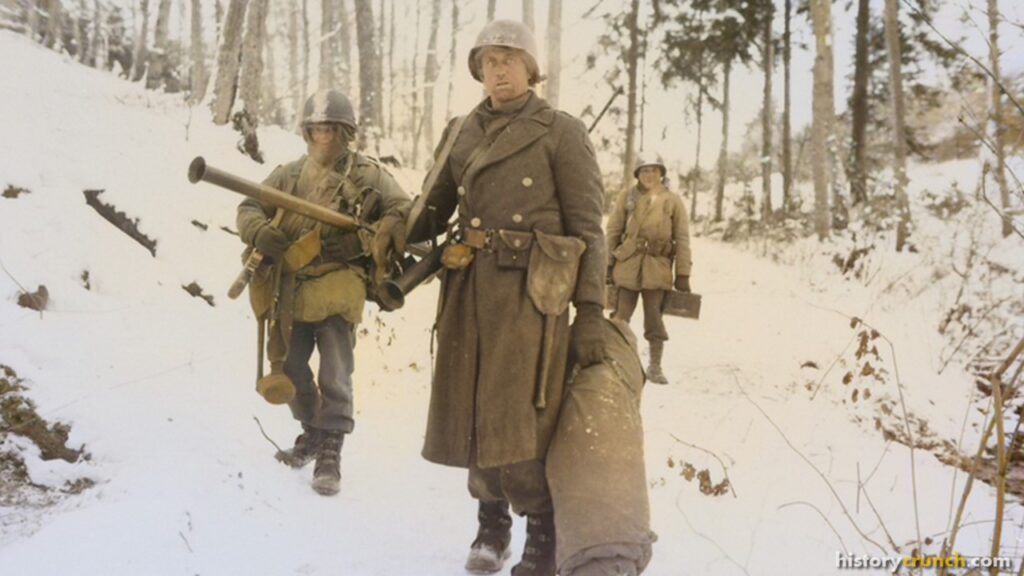
Americans of the 101st Engineers during the Battle of the Bulge. (Colorized by historycrunch.com)
Source: Library of Congress© factsthatcrunch.comMore World War II Facts →
World War IIRipple Effect
Facts that CrunchFactsthatCrunch
The Event

Hitler ordered the Ardennes Offensive in December 1944, committing Germany's last large reserve of armor, infantry, and fuel to a single all-or-nothing attack in the west.

Germany lost roughly 67,000 to 100,000 soldiers killed, wounded, or captured during the six-week battle, and those losses could not be replaced because German manpower reserves were nearly exhausted by late 1944.
Germany also expended most of its remaining tank strength and jet and prop aircraft in the offensive, leaving the Western Front with almost no armored reserve to slow the Allied drive into Germany that began in February 1945.
Allied forces, after absorbing the initial shock, transferred additional divisions from quieter sectors to the Ardennes, and those reinforcements arrived faster than German planners had expected, partly because Allied logistics and road networks had recovered more quickly from earlier fighting than German intelligence estimated.
The failure of the offensive persuaded several senior German generals that the war was lost, weakening internal confidence in Hitler's strategic judgment at the command level and making coordinated German resistance harder to sustain through the spring of 1945.
With German forces in the west critically weakened, the Allied Rhine crossings in March 1945 met far less resistance than they would have faced if the Ardennes reserve had been held back, shortening the final campaign in western Germany by weeks.
Source: Smithsonian Institution© factsthatcrunch.comMore World War II Facts →
World War IIRedacted FileInteractive
Facts that CrunchFactsthatCrunch
TOP SECRET
Bastogne Relief Assessment: Third Army Breakthrough, December 1944
By December 18th, 1944, German forces had encircled the town of Bastogne in Belgium, cutting off the 101st Airborne Division and elements of two armored divisions. The German commander sent a formal written demand for surrender, which the American commander, Brigadier General Anthony McAuliffe, rejected with a one-word reply: 'Nuts.' Supply drops by C-47 aircraft on December 23rd partially relieved the defenders, but ground relief remained critical. General George Patton redirected his Third Army northward from the Saar region and broke through the German encirclement from the south on December 26th, 1944. The siege lasted approximately eight days and cost the defenders significant casualties before the corridor was secured.
Tap the black bars to declassify.
Source: National Archives© factsthatcrunch.comMore World War II Facts →
Test Yourself
World War II

Can you put these key events of the Battle of the Bulge in the correct order, from the start of the German attack to the final Allied casualty count?

Use the arrows to put these in the right order, then tap Check order.
123456
Allied forces hold Bastogne against German assault
German forces surround Bastogne, Belgium
Germany launches surprise attack through the Ardennes
Germany's westward advance stopped at Dinant
Allied forces reach final casualty figures near 75,000
Patton's Third Army breaks through to Bastogne
Source: National WWII Museum© factsthatcrunch.comFacts that Crunch
World War II

How many total casualties across all sides did the Battle of the Bulge produce?

Take your best guess. Tap a range.
The real numberabout 186,000American forces alone suffered over 80,000 casualties, and Germany lost at least 100,000 killed, wounded, or missing, making the Battle of the Bulge the costliest battle ever fought by the U.S. Army. Those losses drained Germany's last strategic reserves in the west and sped up its final defeat.
Source: National WWII Museum, New Orleans© factsthatcrunch.comFacts that Crunch
Explore More Topics

Why Was the Battle of the Bulge Important?

The failure of the Ardennes offensive left Germany without the reserves it needed to mount another large-scale defense in the west. Allied forces crossed the Rhine River into Germany within weeks, and the war in Europe ended less than five months after the battle closed. The cards in this section connect the outcome of the battle to the final collapse of German military resistance in the spring of 1945.

World War IIFast Facts
Facts that CrunchFactsthatCrunch
Battle of the Bulge start dateDecember 16th, 1944
Battle of the Bulge end dateJanuary 25th, 1945
German troops committed to the offensiveAbout 410,000 soldiers
U.S. troops at the Battle of the BulgeAbout 610,000, the largest single U.S. engagement of World War II
U.S. casualties (killed, wounded, captured, or missing)About 75,000
German casualties (killed, wounded, or captured)About 60,000 to 100,000
Width of the German advance into Allied linesAbout 50 miles (80 kilometers) at its deepest point

Key takeaways

The Battle of the Bulge was Germany's last major offensive on the Western Front, and its failure left German forces too weakened to stop the Allied advance into Germany.

The United States suffered more casualties in this battle than in any other single engagement it fought in World War II.

After the German push was stopped by late January 1945, Allied forces crossed the Rhine River and pushed deep into Germany within weeks.

Source: Smithsonian Institution© factsthatcrunch.comMore World War II Facts →
World War IIConnections
Facts that CrunchFactsthatCrunch
Battle of the Bulge ends (January 1945)
Germany surrenders (May 1945)
The connection

When Germany's last major western offensive collapsed in January 1945, the Wehrmacht had spent its remaining armored reserves and could no longer mount a coordinated defense. That exhaustion of German armor and fuel supplies left the Rhine crossings and the road to Berlin open to Allied forces within months.

By the time the Bulge ended, Germany had lost roughly 1,000 tanks and assault guns it could not replace, and Allied forces crossed the Rhine at Remagen on March 7th, 1945, just weeks later.

Source: US National Archives© factsthatcrunch.comMore World War II Facts →
World War IISignificance
Facts that CrunchFactsthatCrunch
Why It Mattered

Germany's failed offensive in the Ardennes in late 1944 and early 1945 used up the last reserves of men and equipment that Germany needed to defend its western border.

By the time the battle ended on January 25th, 1945, Germany had lost roughly 600 tanks and assault guns it could not replace, leaving the Western Front nearly undefended against the Allied armies waiting to cross the Rhine.

The offensive delayed Allied operations by about six weeks, but it pulled German armor and fuel away from the Eastern Front at the same moment Soviet forces were preparing a massive winter push, helping the Red Army advance rapidly into Germany in January 1945.

Allied commanders, especially General Dwight D. Eisenhower, used the crisis to consolidate command and improve coordination between American and British forces, fixing communication problems that had slowed earlier campaigns.

Because Germany committed its last strategic reserve to the Ardennes and failed, Allied planners could move forward with operations like the Rhine crossings in March 1945 facing far weaker resistance than they would have met otherwise, shortening the overall campaign in Western Europe.

Source: Library of Congress© factsthatcrunch.comMore World War II Facts →
World War IITurning Point
Facts that CrunchFactsthatCrunch
Battle of the Bulge: Germany's Last Western Offensive
What Happened

On January 8th, 1945, German forces began a full withdrawal from the Ardennes salient after American troops held the key road junction at Bastogne and Allied armies closed in from the north and south, ending Germany's last major offensive in the West.

Before

Germany still held the initiative in parts of the Western Front and had punched a dangerous gap into Allied lines

After

Germany had no reserves left to mount another major attack, and Allied forces pushed steadily toward the Rhine

Source: UNESCO© factsthatcrunch.comMore World War II Facts →
World War IIImpactsInteractive
Facts that CrunchFactsthatCrunch
The eventSiege of Bastogne, December 1944: American forces held the Belgian town of Bastogne against a German encirclement during the Battle of the Bulge.

Tap each impact to read what it led to.

Allied Supply Lines Stayed OpenBastogne sat at a crossroads of seven roads. Holding the town kept German forces from controlling those routes, which protected the overall Allied supply network in Belgium and Luxembourg.
German Timetable CollapsedGerman planners needed Bastogne quickly to keep their offensive on schedule. The delay caused by American resistance gave Allied commanders time to organize a larger counterattack and stopped the German advance from reaching the Meuse River.
Airborne Troops Gained New RecognitionThe 101st Airborne Division held Bastogne with limited supplies and no immediate ground support. Their stand showed military leaders that airborne units could hold key positions independently, influencing how commanders used such forces later in the European campaign.
Luftwaffe Lost the Weather AdvantageCloudy skies had grounded Allied aircraft for most of the siege. When the weather cleared on December 24th, 1944, Allied planes flew supply missions into Bastogne and struck German columns, reducing the Luftwaffe's ability to support ground operations in the region.
German Reserve Strength Was ExposedThe Battle of the Bulge was Germany's last major offensive reserve on the Western Front. Failing to take Bastogne used up armored and infantry units that Germany could not replace, accelerating the collapse of German defenses in early 1945.
Step 1 of 5
Source: Library of Congress© factsthatcrunch.comMore World War II Facts →
Test Yourself
World War IIWho Am I?Interactive
Facts that CrunchFactsthatCrunch

Can you name this mystery person before the photo develops? Click through the hints and lock in your guess.
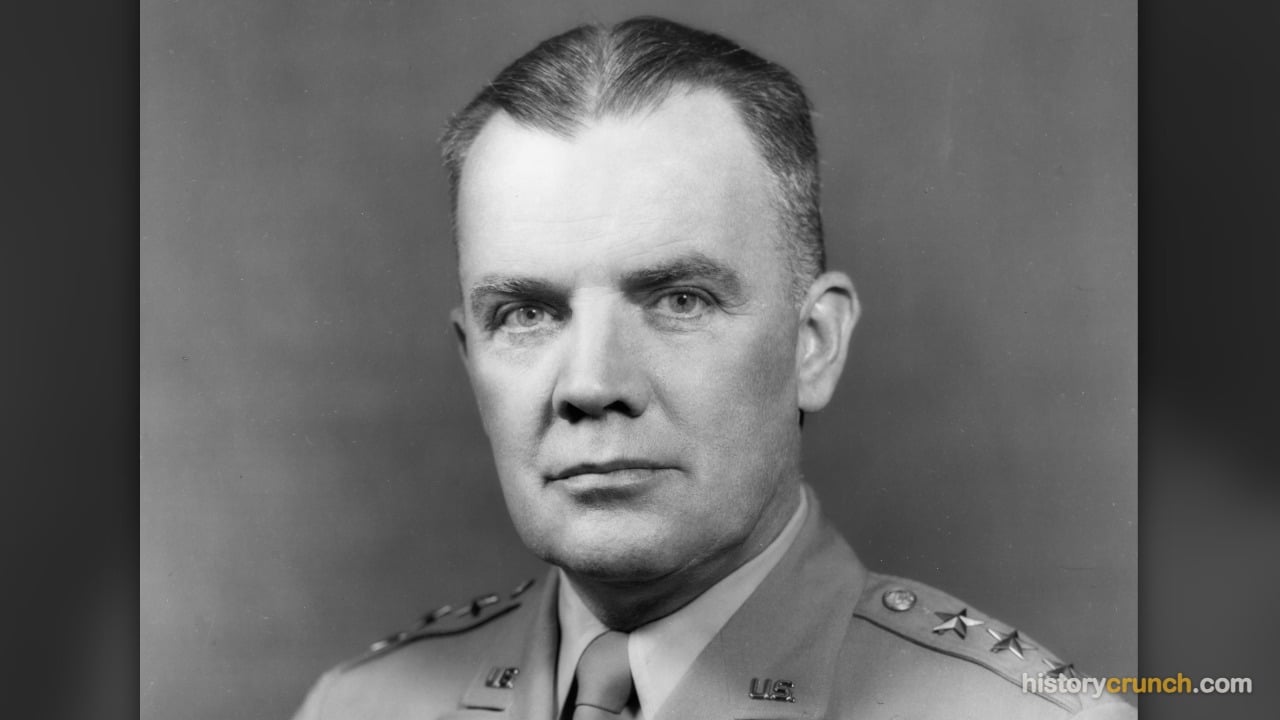
Anthony McAuliffe served as a U.S. Army general during World War II and is known for his role in the defense of Bastogne during the Battle of the Bulge.
Unknown subjectAnthony McAuliffe
Evidence
a Belgian crossroads town
a single word answer
Hint 1 of 4
1I was a temporary commander who had never expected to hold the job when the crisis hit.
2I led the defense of a Belgian crossroads town that German forces surrounded on all sides in December 1944.
3When the German commander sent a written demand that I surrender, I replied with a single word answer.
4My one-word reply to the Germans became famous, and that word was "Nuts!"
Identified
Anthony McAuliffe
American general at Bastogne
Case closed
Why it mattersHis refusal to surrender at Bastogne helped hold a vital crossroads, keeping Allied supply lines open and slowing the German advance during the Battle of the Bulge.
Source: United States Army Center of Military History© factsthatcrunch.comMore World War II Facts →

Sources

Explore More Topics
Explore More Topics