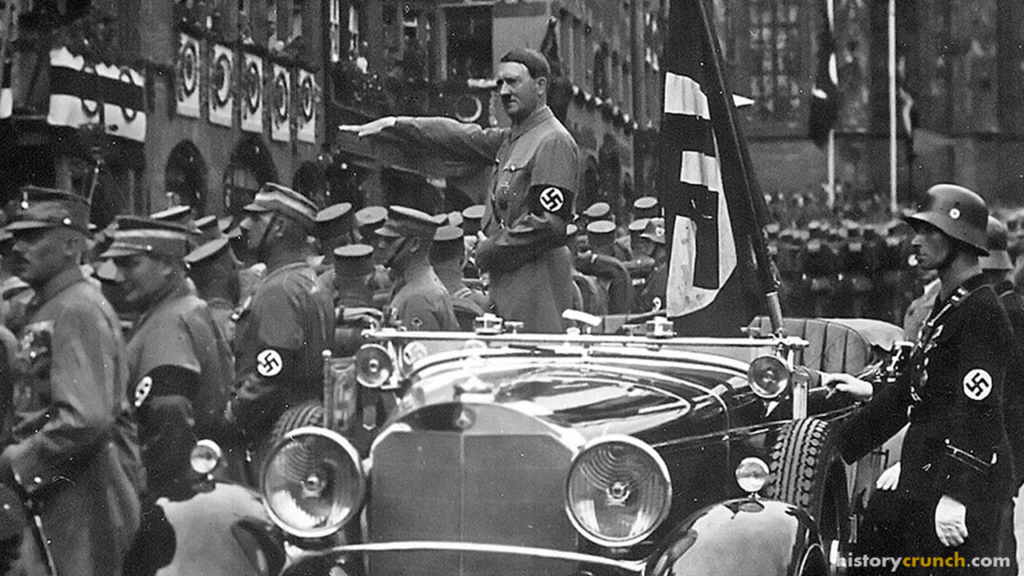
The European Theater of World War II shaped the political and physical map of Europe more than any other conflict in the 20th century. The fights covered here, from Germany's invasion of Poland in 1939 to the last major German offensive in the winter of 1944 to 1945, show how the war shifted in scale and momentum over six years. These cards give the key facts on each major event so students can study or review quickly without sorting through a long article. Related: Causes of World War II and Battle of the Bulge.
Invasion of Poland
Germany's attack on Poland on September 1st, 1939 brought Britain and France into the war and set the military and political terms that shaped the entire European conflict. Poland was divided between Germany and the Soviet Union within weeks, establishing the pattern of rapid territorial conquest that would define the war's early years. The speed and coordination of the German assault also showed the rest of Europe what modern mechanized warfare could do.
FactsthatCrunchYou can imagine what a bitter blow it is to me that all my long struggle to win peace has failed. Yet I cannot believe that there is anything more or anything different that I could have done and that would have been more successful.
Neville Chamberlain · Cabinet Room, 10 Downing Street, London · September 3rd, 1939
British Prime Minister Neville Chamberlain spoke these words in a radio broadcast at 11:15 a.m. on the 3rd of September, 1939, two days after Germany invaded Poland. Earlier that morning, Britain had demanded that Germany pull its troops out of Poland, and Germany gave no answer, so Britain was now at war. In this passage Chamberlain admits that his years of work to keep the peace, including his policy of appeasement, had failed.
FactsthatCrunchWhat Share of Its Population Did Poland Lose in World War II? About 1 in 6 Polish Citizens Died, the Highest Rate in Europe
Scholars estimate that between 5.5 and 6 million Polish citizens died during World War II, out of a prewar population of about 35.1 million. More than 90 percent of those deaths were civilian, not military. Poland's losses as a share of its total population were higher than those of any other European country.
FactsthatCrunchGermany Sends 60 Divisions Into Poland, Opening World War II in Europe
Germany launched its invasion of Poland before dawn on September 1st, 1939, deploying 60 divisions and close to 1.5 million soldiers along the border. The attacking force included more than 2,000 tanks and nearly 900 bombers, which struck Polish airfields and cities from the first hours of the assault. Poland's army was not fully mobilized and was heavily outnumbered, and its air force of roughly 300 planes was largely destroyed within the first few days of fighting.

FactsthatCrunch
FactsthatCrunch
FactsthatCrunch
FactsthatCrunchTrench warfare locked World War I into a nearly static stalemate where territory was measured in yards. Blitzkrieg was developed partly in response to that experience, using speed and coordination to prevent a static front from forming at all.
FactsthatCrunchBlitzkrieg was a military method used by Germany in World War II that combined fast-moving tanks, motorized infantry, and close air support to break through enemy lines quickly. The goal was to move so fast that the enemy could not organize a defense or move troops in time. Germany used this method to defeat Poland in about five weeks in 1939 and France in about six weeks in 1940.
"When German forces swept into France in May 1940, the speed and coordination of Blitzkrieg left Allied commanders unable to respond before large parts of the French army were cut off."

FactsthatCrunchAt 4:45 a.m. on September 1st, 1939, German forces crossed the Polish border along multiple fronts, and two days later Britain and France declared war on Germany, turning a regional attack into a full European war.
Germany had seized territory through threats and diplomacy; no European power had yet declared war on it
A state of war existed between Germany and the major Western European powers, making large-scale armed conflict unavoidable

FactsthatCrunchWhich definition fits each Battle of the Bulge term?
FactsthatCrunchIn the European Theater of World War II, German forces surrounded the city of Leningrad in September 1941 and began a siege that had ground on for nearly 900 days. By early January 1944, Soviet forces under General Kirill Meretskov had massed armies along the southern shore of Lake Ladoga and were preparing a massive offensive to push the Germans back from the city. The Soviet troops were in position, the attack orders had been issued, and the fate of Leningrad's starving population hung on what happened in the next few days.
Sources
- BBC radio broadcast, September 3rd, 1939
- Library of Congress
- National Archives
- National WWII Museum
- Saint Petersburg State Museum of the History of Saint Petersburg
- Smithsonian Institution
- UNESCO
- US National Archives
Phoney War
After Britain and France declared war on Germany in September of 1939, almost no large-scale fighting took place on the Western Front for about eight months. Both sides positioned forces and prepared, but neither launched a major ground offensive. That period of waiting shaped how Allied commanders thought about the war, and its abrupt end in May of 1940 caught them badly off guard.
FactsthatCrunchWhat Was the Phoney War in World War II?
The Phoney War was a period of about eight months, from September 1939 to May 1940, when Britain and France were officially at war with Germany but almost no major fighting happened on the Western Front. After Germany invaded Poland, the Western Allies declared war but held back from launching large attacks, and Germany focused on securing Poland rather than pushing west. The quiet period ended in April and May 1940 when Germany invaded Denmark, Norway, the Netherlands, Belgium, and France in quick succession.

FactsthatCrunch
FactsthatCrunchIn what order did these key events of the Phoney War unfold?
During the Phoney War, Britain and France did nothing to prepare for combat while Germany focused entirely on Poland.
Sources
- Imperial War Museums
- Smithsonian Institution
- UNESCO
Battle of France
Germany's campaign against France, Belgium, and the Netherlands in the spring of 1940 overturned assumptions that France's military and fortified borders could hold back a German advance. The fall of France in June of 1940 left Britain as the only major Allied power still fighting in Western Europe. That shift placed enormous strain on British resources and forced a complete rethinking of Allied strategy.

FactsthatCrunchPanzer is a German term used in World War II to describe armored fighting vehicles, especially tanks, and the military units built around them. Germany organized its tanks into panzer divisions, which combined tanks, motorized infantry, artillery, and support troops into fast-moving strike forces. These divisions were designed to break through enemy lines quickly and keep moving before defenders could regroup.
"During the invasion of France in May 1940, German panzer divisions crossed the Ardennes region and reached the English Channel in less than two weeks, cutting off Allied forces in the north."


FactsthatCrunch

FactsthatCrunchOn this tenth day of June, 1940, the hand that held the dagger has struck it into the back of its neighbor. On this tenth day of June, 1940, in this University founded by the first great American teacher of democracy, we send forth our prayers and our hopes to those beyond the seas who are maintaining with magnificent valor their battle for freedom.
Speaking live on national radio, Roosevelt condemned Mussolini's attack on a collapsing France and rallied Americans behind a new policy of sending material aid to the nations fighting the Axis, a clear step away from strict neutrality.

FactsthatCrunchWhy Did France Fall So Quickly in 1940?
France fell in roughly six weeks because Germany bypassed the heavily defended Maginot Line by sending armored divisions through the Ardennes forest, a route French commanders had considered nearly impassable. This attack, launched on May 10th, 1940, cut off Allied forces in Belgium and trapped them near the English Channel. French military planning relied on a slow, defensive style of war from World War I, so commanders could not respond fast enough to Germany's rapid armored advance.
FactsthatCrunch
FactsthatCrunch
FactsthatCrunchGerman and Allied forces entered the Battle of France in May 1940 with different strengths in command approach, armor use, air support, and troop numbers.
| Germany | Allied Forces (France, Britain, Belgium) | |
|---|---|---|
| Tanks available | about 2,439 | about 3,384 |
| Armor strategy | concentrated in fast-moving groups (Panzer divisions) | spread across infantry units |
| Air support | Luftwaffe closely coordinated with ground troops | limited coordination between air and ground |
| Command structure | unified under OKW, fast decisions | split among French, British, and Belgian commands |
| Troops committed | about 3 million | about 3.3 million |
| Campaign length | 46 days (May 10th to June 25th, 1940) | 46 days before armistice |
FactsthatCrunchThe Battle of France lasted only 46 days, yet it ended with France defeated, Paris occupied, and the entire Allied position in Western Europe collapsed.
FactsthatCrunchFrance signed an armistice with Germany on June 22nd, 1940, ending French resistance and leaving Germany in control of most of the country.
FactsthatCrunch
In this colorized photograph, German troops march in tight, uniform columns down a wide Parisian boulevard toward the Arc de Triomphe, while a mounted officer on horseback watches from the side. What does the choice of this specific route reveal about the purpose of the march?
The French government signed the armistice ending the Battle of France on June 22nd, 1940, in the same railway car where Germany had surrendered in 1918.
How many tons of bombs did Allied air forces drop during the strategic bombing campaign in the European Theater of World War II?
Sources
- Address at the University of Virginia, 1940, FDR Presidential Library
- Library of Congress
- National Archives and Records Administration
- National Army Museum, London
- National WWII Museum
- Smithsonian Institution
- UNESCO
- US National Archives
Dunkirk Evacuation
When German forces cut off Allied troops at the French coast in late May of 1940, a large-scale naval and civilian rescue operation became necessary to preserve what remained of the British Expeditionary Force. The operation removed hundreds of thousands of soldiers from a situation that had seemed likely to end in total capture. Those troops formed the core of the army Britain would need for later campaigns.

FactsthatCrunchOperation Dynamo was planned to save far fewer men than it actually did, and the precise breakdown by nationality, rescue point, and loss tells a fuller story.

FactsthatCrunchThe beach was one vast sea of bodies. I had never seen so much dejection.
Palmer described the crowded Dunkirk beaches, where he waited for rescue during the evacuation in late May 1940, in an oral history interview recorded after the war.
FactsthatCrunchEven repeated by the announcer, it sent shivers (not of fear) down my spine.
Churchill did not repeat the speech on live radio that evening, so a BBC newsreader read extracts on the news broadcast, and this reaction in a letter to her husband shows how the words reached listeners at home.
FactsthatCrunchOperation Dynamo, run from May 26th to June 4th, 1940, rescued 338,226 Allied troops from the beaches and harbor of Dunkirk, France, making it the largest military evacuation ever carried out.
British and Allied planners had expected to save no more than 20,000 to 30,000 men before German forces closed in. The final total included roughly 198,000 British soldiers and about 140,000 French and Belgian troops. Because most trained Allied soldiers were brought home safely, Britain was able to keep fighting and rebuild its army for the rest of the war.
FactsthatCrunchOperation Dynamo at Dunkirk ran for nine days and left behind precise, striking numbers that show how close the rescue came to failing completely.

FactsthatCrunchChurchill led Britain through its most difficult years of World War II, refusing to negotiate with Nazi Germany after France fell in June 1940. His speeches and decisions helped hold the Allied coalition together until victory in Europe was secured in May 1945.

FactsthatCrunchGermany's rapid armored advance through the Ardennes in May 1940 split Allied forces in two, trapping the British Expeditionary Force and large French and Belgian units against the English Channel coast near Dunkirk.
The Dunkirk evacuation ran from May 26th to June 4th, 1940, after German forces outflanked the Allies and cut off their retreat by land. The rescue kept Britain in the war at a moment when a total military collapse on the Western Front seemed possible.
FactsthatCrunch
Evidence Photo
FactsthatCrunchIt is late May 1940, and you are Winston Churchill, the new Prime Minister of Britain during World War II. The German army has trapped over 300,000 Allied troops on the beaches of Dunkirk, France, and Britain has no major ally ready to help. Your War Cabinet is divided: Foreign Secretary Lord Halifax believes Britain should ask Mussolini to broker peace talks with Hitler, while others want to fight on. The choice you make in the next few days will decide whether Britain stays in the war or accepts terms that Hitler will control.
What did the Dunkirk evacuation reveal about Allied strategy in 1940?
Sources
- Imperial War Museums
- Letter to Harold Nicolson, June 4th, 1940
- Library of Congress
- Max Arthur, Forgotten Voices of the Second World War (2004)
- National Archives
- National Army Museum, London
- Smithsonian Institution
Battle of Britain
After France fell, Germany needed air superiority over Britain before any invasion could be attempted. The air campaign that followed in the summer and autumn of 1940 was the first major military test fought entirely in the air, and its outcome determined whether Germany could press its advantage westward. Britain's ability to sustain its air defenses over several months altered the overall direction of German planning.

FactsthatCrunchWhy Did Britain Win the Battle of Britain?
Britain won the Battle of Britain in 1940 mainly because the Royal Air Force successfully defended British skies against the German Luftwaffe by using a coordinated radar warning system called Chain Home, which gave British pilots advance notice of incoming German aircraft. Germany also made a key mistake in early September 1940 when it shifted its bombing targets from RAF airfields to British cities, giving the RAF time to recover its strength. Britain's aircraft factories kept producing new planes faster than Germany had expected, and the English Channel made a German ground invasion impossible without air superiority.

FactsthatCrunchI felt a terrific explosion which knocked the control stick from my hand, and the whole machine quivered like a stricken animal. In a second, the cockpit was a mass of flames: instinctively, I reached up to open the hood. It would not move. I tore off my straps and managed to force it back; but this took time, and when I dropped back into the seat and reached for the stick in an effort to turn the plane on its back, the heat was so intense that I could feel myself going.
Hillary described the moment a Messerschmitt Bf 109 shot down his Spitfire over the Kent coast on September 3rd, 1940, leaving him badly burned before he escaped by parachute into the North Sea.
FactsthatCrunchHow did the Battle of Britain unfold week by week during the summer and fall of 1940?
Tap a point to read its detail.

FactsthatCrunch
FactsthatCrunchDuring the Battle of Britain from July 10th to October 31st, 1940, 422 Royal Air Force Fighter Command aircrew were wounded in addition to the 544 who were killed.
Fighter Command flew day after day against a Luftwaffe force that outnumbered it in both aircraft and pilots. Wounded pilots often returned to flying duties within days because replacements were so short. By mid-August 1940, new pilot losses were coming in faster than training schools could produce replacements.
FactsthatCrunch
FactsthatCrunchThe gratitude of every home in our Island, in our Empire, and indeed throughout the world, except in the abodes of the guilty, goes out to the British airmen who, undaunted by odds, unwearied in their constant challenge and mortal danger, are turning the tide of the World War by their prowess and by their devotion. Never in the field of human conflict was so much owed by so many to so few.
What does Churchill's claim that the pilots were 'turning the tide of the World War' reveal about the wider importance of the Battle of Britain in 1940?
Can you put these key turning points in the Battle of Britain in the correct order, from earliest to latest?
Sources
- Churchill, "The Few," House of Commons, August 20th, 1940 (Hansard)
- Imperial War Museums
- Library of Congress
- Richard Hillary, The Last Enemy (1942)
- Smithsonian Institution
- UNESCO
The Blitz
Germany's sustained bombing campaign against British cities, which ran from September of 1940 into May of 1941, was aimed at breaking civilian support for the war and disrupting industrial production. The campaign caused serious destruction across London and other cities, yet British war production continued and the government remained stable. The results shaped how military planners on both sides evaluated strategic bombing for the rest of the war.

FactsthatCrunch
FactsthatCrunchWhat Was the Blitz in World War II?
The Blitz was a sustained German bombing campaign against British cities that lasted from September 7th, 1940, to May 11th, 1941. Germany targeted London and other cities such as Coventry, Birmingham, and Liverpool, aiming to break British morale and damage its ability to produce war supplies. The bombing killed about 43,000 civilians and left more than a million people in London without homes.
FactsthatCrunchThe greatest of all the fires was directly in front of us. Flames seemed to whip hundreds of feet into the air. ... St. Paul's was surrounded by fire, but it came through. It was like a picture of some miraculous figure that appears before peace-hungry soldiers on a battlefield.
Pyle wrote this dispatch on December 30th, 1940, after watching the great German fire raid on London from a balcony the night before, when about 1,500 fires burned in the city and St. Paul's Cathedral survived 28 incendiary bombs.
FactsthatCrunchDuring the Blitz, German aircraft bombed London on 57 consecutive nights beginning on September 7th, 1940. The raids destroyed or damaged more than one million homes across Greater London, killed about 30,000 Londoners, and left whole neighborhoods in rubble. Areas such as the East End and the docklands around Stepney and Bermondsey suffered some of the heaviest damage.
Today, many of the streets and buildings that survived the Blitz still stand alongside modern structures built on cleared bomb sites. The Museum of London documents the bombing campaign through photographs, personal accounts, and recovered objects. Dozens of city parks and open spaces that Londoners recognize today were formerly bomb sites left empty after the war and later converted for public use.
The visible mix of Victorian, postwar, and modern architecture across London is a direct result of which buildings the Blitz destroyed and which it left standing.

FactsthatCrunchThe Battle of Britain was an air fight between the Luftwaffe and the RAF, where both sides sent military aircraft against each other. The Blitz was a bombing campaign in which Germany targeted British cities while Britain defended its civilian population rather than engaging in large air-to-air battles.
FactsthatCrunchDuring the Blitz in World War II, was each of these a cause of the bombing campaign or an effect it produced?
Sources
- Ernie Pyle, Ernie Pyle in England (1941)
- Imperial War Museums
- Library of Congress
- US National Archives
Normandy Invasion (D-Day)
On June 6th, 1944, Allied forces launched a massive amphibious assault on the beaches of Normandy in northern France. The operation involved American, British, Canadian, and other Allied troops crossing the English Channel to push German forces out of Western Europe. It was the largest seaborne invasion in history and marked a turning point in the European Theater.

FactsthatCrunch
FactsthatCrunch"As our boat touched sand and the ramp went down, I became a visitor to hell. I shut everything out and concentrated on following the men in front of me down the ramp and into the water."
Parley described the moment his landing craft reached Omaha Beach on the morning of June 6th, 1944, in an account he gave to historian Stephen Ambrose.

FactsthatCrunch
FactsthatCrunch
FactsthatCrunchWhen Was D-Day? Allied Airborne Troops Begin the Normandy Invasion Just After Midnight
D-Day was first set for June 5th, 1944, but RAF Group Captain James Martin Stagg warned General Dwight D. Eisenhower that a storm was moving in over the English Channel, and Eisenhower postponed the invasion by 24 hours. Just after midnight on June 6th, 1944, thousands of American, British, and Canadian airborne troops dropped behind German lines in Normandy to secure roads and bridges ahead of the beach landings. The amphibious assault on five beaches, Utah, Omaha, Gold, Juno, and Sword, followed at 6:30 in the morning, with Allied forces suffering around 10,300 total casualties that day.

FactsthatCrunchOn the night of June 5th to 6th, 1944, Allied airborne forces dropped behind German lines with precise, striking numbers that set the stage for the D-Day beach landings.
FactsthatCrunch
FactsthatCrunchD-Day was the pivot point of the 20th century. Everything that went before it can be said to have led up to it; all that followed came about because of what happened that day.
Ambrose's verdict echoed the warning Field Marshal Erwin Rommel gave his aide Helmuth Lang on April 22nd, 1944, that the invasion would be decided in its opening day, the remark that gave Cornelius Ryan's 1959 book The Longest Day its title.
FactsthatCrunch"The bullets tore holes in the water around me, and I made for the nearest steel obstacle."
Capa wrote these words in his 1947 memoir, recalling how he waded ashore under German fire with the first wave of American troops on the Easy Red sector of Omaha Beach during the D-Day landing in Normandy.
FactsthatCrunch
FactsthatCrunchYou are about to embark upon the Great Crusade, toward which we have striven these many months. The eyes of the world are upon you.
General Dwight D. Eisenhower · Order of the Day, Supreme Headquarters Allied Expeditionary Force · June 6th, 1944
Eisenhower was the Supreme Commander of the Allied Expeditionary Force, and he began drafting this printed Order of the Day in February 1944. The order was distributed to the 175,000-member expeditionary force on the eve of the invasion of Normandy. A pre-recorded voice version of the message was also broadcast to audiences in both England and the United States on the day of the landings.

FactsthatCrunchWhat Does the D in D-Day Stand for?
The D in D-Day simply stands for 'Day.' The term was standard U.S. military shorthand used to mark the date an operation was set to begin, without naming the actual calendar date in orders or communications. The Normandy invasion on June 6th, 1944, became so famous that 'D-Day' is now linked almost entirely to that landing, but American forces used the same term for other operations throughout the war.
FactsthatCrunchEisenhower commanded Allied forces in North Africa and Europe, coordinating armies from multiple nations to defeat Nazi Germany. His leadership of Operation Overlord, the large-scale Allied invasion of Western Europe, proved central to ending the war on the European front.

FactsthatCrunchWhat Share of the D-Day Ground Troops Came from Each Allied Nation? Americans Made Up Nearly Half of the Force That Landed in Normandy on June 6th, 1944.
About 160,000 Allied troops landed in Normandy on June 6th, 1944, coming from the United States, Britain, Canada, and several other Allied nations including Norway, Poland, and Free France. Americans supplied the largest share, landing on two beaches and dropping two airborne divisions, yet the British contribution was close behind, covering two beaches plus their own airborne forces. Canada, though the smallest of the three main ground forces, took on one full beach at Juno entirely on its own.
FactsthatCrunchD-Day is a military code term for the first day of a planned attack or operation. Commanders used it so that orders could be written before a final date was chosen, since the calendar date was kept secret until close to the launch. The most famous D-Day in history was June 6th, 1944, when Allied forces landed on the beaches of Normandy, France, to begin the liberation of Western Europe from German control.
"Because planners used the term D-Day in their orders for the Normandy invasion, soldiers knew exactly when to move without the date being spelled out in documents that might fall into enemy hands."

FactsthatCrunch
FactsthatCrunch
In this photograph of the Normandy American Cemetery, both American and French flags stand beside the white marble crosses marking U.S. soldiers' graves. What does the placement of French flags at a U.S. military cemetery most directly reveal about the D-Day landings and their aftermath?
FactsthatCrunchWhich definition fits each D-Day term?
We shall never surrender.
Sources
- American Battle Monuments Commission
- Library of Congress
- National Archives
- National WWII Museum
- Order of the Day, 1944, Eisenhower Presidential Library
- Robert Capa, Slightly Out of Focus (1947)
- Smithsonian Institution
- Stephen Ambrose, D-Day June 6, 1944 (1994)
- To America: Personal Reflections of an Historian, 2002
- UNESCO
- US National Archives
Battle of the Bulge
Germany's offensive through the Ardennes forest in December of 1944 was its last major attempt to reverse the Allied advance in the west. The attack pushed Allied lines back significantly before being contained, and the fighting stretched into January of 1945. The failure of the offensive left Germany without the reserves needed to mount another large-scale defense on the Western Front.
FactsthatCrunchThe German High Command's own official figure listed 84,834 German soldiers killed, wounded, or captured during the Battle of the Bulge from December 16th, 1944 to January 25th, 1945.
Other estimates put German losses between 60,000 and 100,000. Germany committed over 410,000 men to the attack, so the casualties represented a major share of its remaining fighting strength in the West. Unlike the Allies, Germany could not replace these losses, and most surviving units retreated to the Siegfried Line in a badly weakened state.
FactsthatCrunch
FactsthatCrunchDuring the Battle of the Bulge from December 16th, 1944 to January 25th, 1945, roughly 19,000 American soldiers were killed in action, making it the deadliest single battle for the U.S. Army in World War II.
According to the U.S. Army Center of Military History, total American casualties reached about 89,500, including roughly 47,500 wounded and more than 23,000 missing or captured. Germany lost an estimated 100,000 soldiers killed, wounded, or captured, losses the German military could not replace.

FactsthatCrunchKey takeaways
The Battle of the Bulge was Germany's last major offensive on the Western Front, and its failure left German forces too weakened to stop the Allied advance into Germany.
The United States suffered more casualties in this battle than in any other single engagement it fought in World War II.
After the German push was stopped by late January 1945, Allied forces crossed the Rhine River and pushed deep into Germany within weeks.
FactsthatCrunchThe term 'Battle of the Bulge' was coined not by generals or official military reports but by American war correspondent maps that showed a bulging westward dent in the Allied front line, and the U.S. Army never adopted it as a formal name.
When German forces launched their Ardennes offensive on December 16th, 1944, they pushed Allied lines outward in a shape that looked like a bulge on news maps printed back home. Reporters began using the phrase to describe that visual shape, and readers recognized it immediately. The official U.S. Army name for the campaign was the Ardennes-Alsace Campaign, a title almost no one uses today.

FactsthatCrunch
FactsthatCrunchHow Were German Forces Split in the Battle of the Bulge? The 410,000-Troop Assault Force Was Divided Unequally Across Three Armies
Germany's Army Group B under Field Marshal Walter Model launched the Battle of the Bulge on December 16th, 1944, with roughly 410,000 troops divided across three armies. Hitler gave the 6th SS Panzer Army the largest share and the best equipment, making it bigger than the other two armies combined. The 7th Army, the smallest force, had almost no tanks and relied on horses for supply, much as German forces had in 1914.
FactsthatCrunchPatton led the U.S. Third Army in a rapid advance across France and into Germany after the breakout at Normandy in the summer of 1944, covering more ground in less time than almost any other Allied force in the war. He is remembered as one of the most aggressive and effective American field commanders of World War II, known for pushing his troops and armor fast to keep the enemy off balance.

FactsthatCrunchBoth happened in 1944 and together marked the turning point of the war in Western Europe: the liberation of Paris in August 1944 showed the Allied advance was unstoppable, and the failed German counteroffensive at the Bulge in December 1944 confirmed Germany had no realistic path to reversing Allied gains in the west.
After German forces were pushed back from the Bulge by late January 1945, the Western Allies crossed into Germany itself within weeks, and the war in Europe ended on May 8th, 1945.
FactsthatCrunchHow did the Battle of the Bulge look to American soldiers holding the line versus German commanders planning the attack?
FactsthatCrunch
FactsthatCrunchWhat was the German code name for the offensive that launched the Battle of the Bulge in December 1944?
FactsthatCrunchAmerican forces at Bastogne held out against German encirclement during the Battle of the Bulge