Pacific Theater of World War II Facts

Quick facts on the Pacific Theater of World War II, covering Pearl Harbor, Midway, island-hopping, Iwo Jima, and more for students and teachers.

The Pacific Theater shaped the final years of World War II and drew the United States into a conflict that stretched across millions of square miles of ocean and island chains. Decisions made in the Pacific, from naval strategy to the use of atomic weapons, changed how countries thought about modern war and international power. This page collects the key facts on the major battles, campaigns, and turning points so students can review the topic quickly and accurately. Related: Causes of World War II and European Theater of World War II.

Attack on Pearl Harbor

The Pacific war began for the United States not with a declaration but with a surprise strike. Japan's decision to attack the American naval base at Pearl Harbor on December 7th, 1941 brought the United States directly into World War II and reshaped the overall direction of the conflict across both the Pacific and Atlantic theaters.

World War IIStat
Facts that CrunchFactsthatCrunch
Marines killed at Pearl Harbor

On December 7th, 1941, 109 U.S. Marines were killed during the Japanese attack on Pearl Harbor, and another 69 were wounded.

The Marines at Pearl Harbor were stationed across several sites on Oahu, including the Naval Air Station at Ewa, where Japanese planes destroyed aircraft on the ground and hit personnel. The U.S. Navy suffered the largest share of deaths that morning, with 2,008 sailors killed, but every branch of service on the island lost men. In all, 2,403 Americans died and 1,178 were wounded in fewer than two hours.
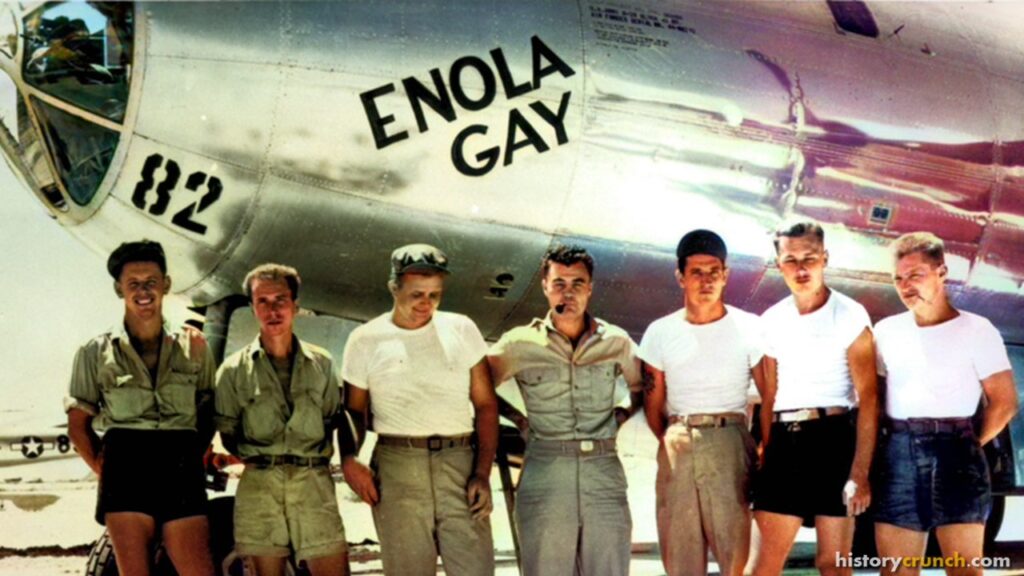
The Enola Gay dropped the 'Little Boy' atomic bomb on Hiroshima in 1945. Pilot, Paul Tibbets, can be seen in the center. (Colorized by historycrunch.com)
Source: Smithsonian Institution© factsthatcrunch.comMore World War II Facts →
Tora! Tora! Tora!
Mitsuo Fuchida
Lead pilot of the first attack wave at Pearl Harbor, December 7th, 1941
Fuchida radioed this code word back to the Japanese carrier Akagi at about 7:53 a.m. Hawaii time. Tora means tiger in Japanese, and the signal told the fleet that the attack had caught the American base by complete surprise.
NDL10272556 Court Exh. No. 3008- Affidavit of MITSUO, Fuchida, dated 25 June 1947.pdf · Wikimedia Commons
Source: Naval History and Heritage Command© factsthatcrunch.com
World War IIStat
Facts that CrunchFactsthatCrunch
Americans wounded at Pearl Harbor

The Japanese attack on Pearl Harbor on December 7th, 1941, wounded 1,178 Americans in addition to killing 2,403.

The U.S. Navy suffered the largest share of the wounded, along with Army, Marine Corps, and civilian casualties. The attack lasted roughly two hours and struck airfields, battleships, and support facilities across the base. Many of the wounded required long-term care and carried lasting injuries from burns, shrapnel, and the sinking of ships.

Source: Library of Congress© factsthatcrunch.comMore World War II Facts →
World War IINotebook Bio
Facts that CrunchFactsthatCrunch
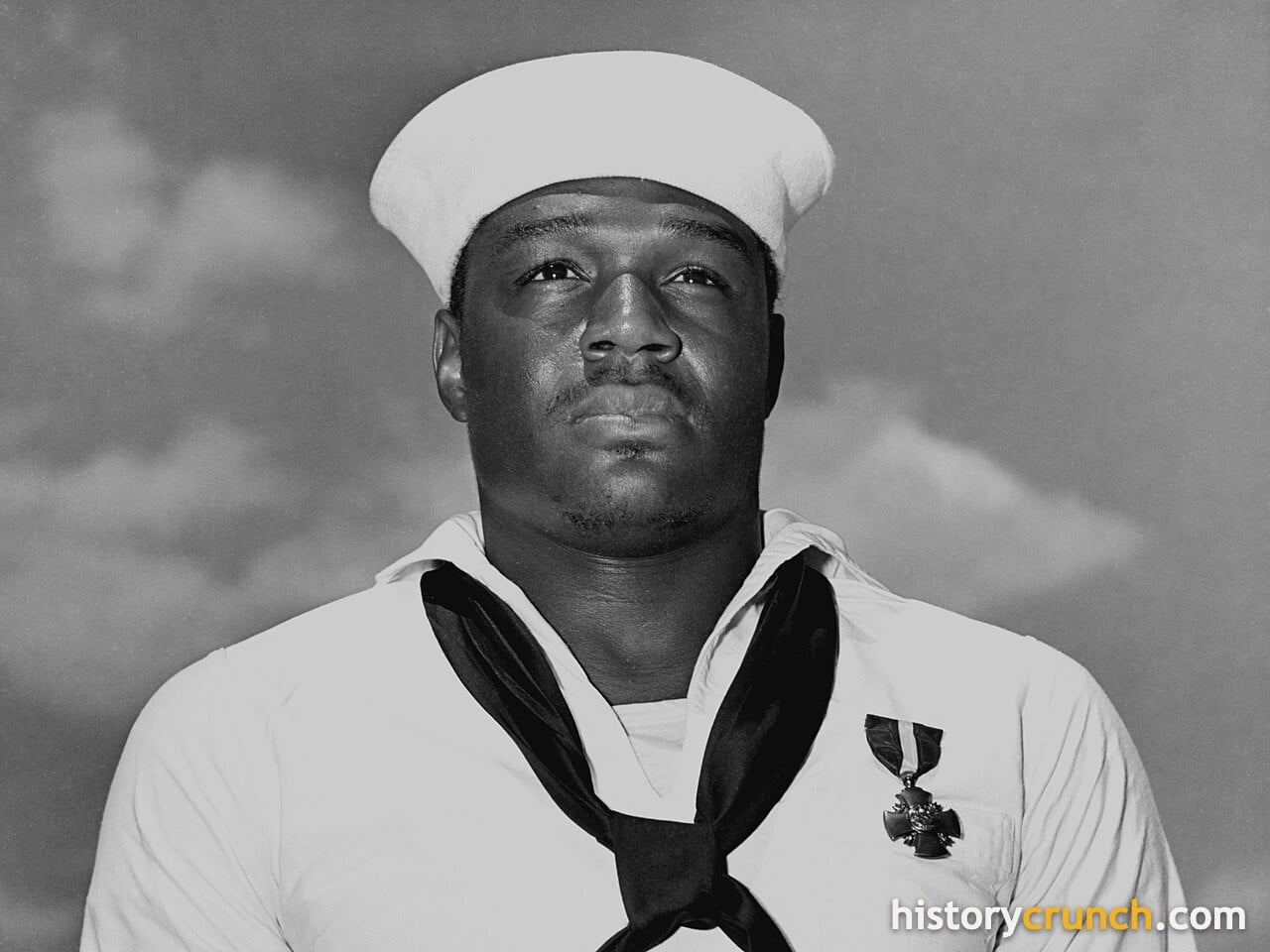
Dorie Miller · Wikimedia Commons
Dorie Miller
in World War II
U.S. Navy Messman, Pearl Harbor hero
Born: October 12th, 1919, Waco, Texas
Action: manned anti-aircraft gun during Pearl Harbor attack, December 7th, 1941
Honor: first Black American awarded the Navy Cross, May 27th, 1942
Source: National Museum of African American History and Culture© factsthatcrunch.comMore World War II Facts →
World War IIStat
Facts that CrunchFactsthatCrunch
civilians killed at Pearl Harbor

Of the 2,403 Americans killed at Pearl Harbor, 68 were civilians, most of them struck by improperly fused U.S. Navy anti-aircraft shells that fell on Honolulu.

Japanese aircraft targeted warships and airfields, not residential areas. Navy gunners fired back quickly, but some shells were not properly fused to detonate at altitude and came down on the city instead. The 68 civilian deaths were a small share of the total toll, yet they show that the attack's damage reached well beyond the harbor's military targets.

Source: Smithsonian Institution© factsthatcrunch.comMore World War II Facts →
World War IIQuote
Facts that CrunchFactsthatCrunch

Before we're through with 'em, the Japanese language will be spoken only in hell!

WF
William F. HalseyU.S. Navy vice admiral commanding the USS Enterprise task force, December 1941, entering Pearl Harbor the night after the attack
Why it matters

Halsey spoke this vow as a firsthand witness, looking out from the bridge of the carrier Enterprise as it sailed past the burning, oil-covered wreckage of the Pacific Fleet, and his crew heard in it a promise that the United States would fight back.

Source: Admiral Halsey's Story, 1947; Naval History and Heritage Command© factsthatcrunch.comMore World War II Facts →
World War IIStat
Facts that CrunchFactsthatCrunch
U.S. Navy sailors killed

Of the 2,403 Americans killed at Pearl Harbor on December 7th, 1941, 2,008 were U.S. Navy sailors, making the Navy by far the hardest-hit branch.

The U.S. Army lost 218 soldiers and the Marine Corps lost 109 men in the same attack. Another 68 civilians were also killed, many from bomb and gunfire damage near the harbor and its airfields. In all, 1,178 more Americans were wounded during the roughly two-hour assault.
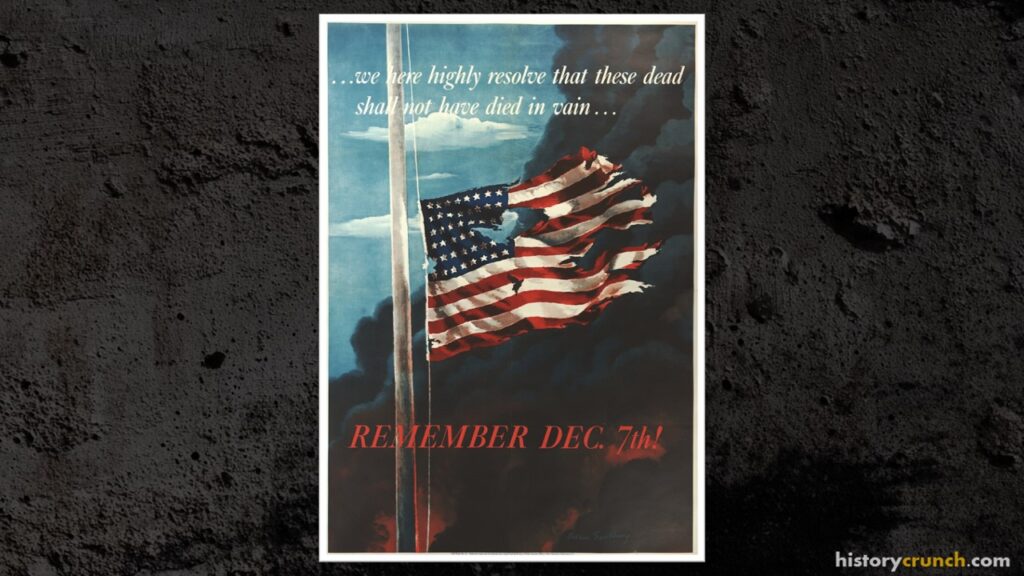
Propaganda in World War II took many forms during World War II, including: posters, radio broadcasts, films, newspapers, and pamphlets. This poster from 1942 focuses on the events of the attack on Pearl Harbor.
Source: US National Archives© factsthatcrunch.comMore World War II Facts →
World War IIEyewitness
Facts that CrunchFactsthatCrunch
Eyewitness account

When the attack started on December 7, 1941, it was just before 0800 and I was on the forecastle of the USS Arizona. I saw torpedo planes, with the rising sun insignia under their wings, attacking ships ahead of us. General alarm was then sounded and we were all told to seek cover.

GHG. H. Lane, Radioman Third Class, US Navy, serving aboard the battleship USS Arizona
Context

Lane gave this statement in an official Navy survivor report filed after the Japanese attack on Pearl Harbor, Hawaii, where the USS Arizona exploded and sank with 1,177 of her crew.

Source: G. H. Lane survivor report (1941), Naval History and Heritage Command© factsthatcrunch.comMore World War II Facts →
World War IIMini Timeline
Facts that CrunchFactsthatCrunch
Japan's attack on Pearl Harbor on December 7th, 1941, began in the early morning hours with little warning to American forces on the island of Oahu, Hawaii. The first wave of Japanese aircraft struck before most sailors and soldiers were awake. These opening minutes set the course of the entire attack.
7:02 AM
Radar Picks Up AircraftTwo U.S. Army privates at Opana Point radar station detect a large group of aircraft approaching from the north but are told not to worry about it.
7:53 AM
First Wave ArrivesCommander Mitsuo Fuchida radios the signal 'Tora! Tora! Tora!' to confirm complete surprise as 183 Japanese aircraft begin striking the airfields and battleship row.
7:55 AM
Battleships HitBombs and torpedoes strike ships moored along Battleship Row, including the USS Arizona, USS Oklahoma, and USS West Virginia, within the first minutes of the attack.
8:10 AM
USS Arizona ExplodesA bomb pierces the Arizona's forward magazine, causing a massive explosion that kills 1,177 of her crew, the single largest loss of life in the attack.
8:54 AM
Second Wave BeginsA second wave of 167 Japanese aircraft arrives and continues strikes on airfields, harbor facilities, and ships already damaged in the first wave.
183
Aircraft in Japan's first attack wave
1,177
Sailors and Marines killed on the USS Arizona alone
7:53 AM
Time the first wave began its strike on Pearl Harbor
Source: US National Archives© factsthatcrunch.comMore World War II Facts →
World War IITimelineInteractive
Facts that CrunchFactsthatCrunch

How did the Pacific War unfold from the attack on Pearl Harbor to Japan's formal surrender?

December 7th, 1941December 8th, 1941December 10th, 1941December 23rd, 1941February 15th, 1942April 9th, 1942May 7th, 1942
December 7th, 1941 — Pearl Harbor Attacked Japan launched a surprise air attack on the U.S. naval base at Pearl Harbor, Hawaii, killing 2,403 Americans and wounding about 1,178 more.
December 8th, 1941 — U.S. Declares War on Japan Congress voted to declare war on Japan the day after the Pearl Harbor attack. Only one member of Congress, Representative Jeannette Rankin of Montana, voted against the declaration.
December 10th, 1941 — Guam Falls Japanese forces captured the U.S. territory of Guam just three days after Pearl Harbor. The island's small garrison of about 500 American troops could not hold against a force of roughly 5,900 Japanese soldiers.
December 23rd, 1941 — Wake Island Falls U.S. Marines and civilian contractors on Wake Island surrendered to Japanese forces after a 15-day defense. American forces had repelled one earlier Japanese landing attempt before being overwhelmed.
February 15th, 1942 — Singapore Surrenders British forces surrendered Singapore to Japan, and about 85,000 Allied troops became prisoners of war. It was one of the largest British military surrenders in history.
April 9th, 1942 — Bataan Death March About 75,000 Filipino and American prisoners were forced to march roughly 65 miles (105 km) under brutal conditions after the fall of Bataan in the Philippines. Thousands died from violence, disease, and exhaustion along the route.
May 7th, 1942 — Battle of the Coral Sea The U.S. and Japanese navies fought the first carrier-versus-carrier battle in history in the Coral Sea. Japan was turned back from an amphibious operation targeting Port Moresby, New Guinea.
December 7th, 1941 — Pearl Harbor AttackedJapan launched a surprise air attack on the U.S. naval base at Pearl Harbor, Hawaii, killing 2,403 Americans and wounding about 1,178 more.
December 8th, 1941 — U.S. Declares War on JapanCongress voted to declare war on Japan the day after the Pearl Harbor attack. Only one member of Congress, Representative Jeannette Rankin of Montana, voted against the declaration.
December 10th, 1941 — Guam FallsJapanese forces captured the U.S. territory of Guam just three days after Pearl Harbor. The island's small garrison of about 500 American troops could not hold against a force of roughly 5,900 Japanese soldiers.
December 23rd, 1941 — Wake Island FallsU.S. Marines and civilian contractors on Wake Island surrendered to Japanese forces after a 15-day defense. American forces had repelled one earlier Japanese landing attempt before being overwhelmed.
February 15th, 1942 — Singapore SurrendersBritish forces surrendered Singapore to Japan, and about 85,000 Allied troops became prisoners of war. It was one of the largest British military surrenders in history.
April 9th, 1942 — Bataan Death MarchAbout 75,000 Filipino and American prisoners were forced to march roughly 65 miles (105 km) under brutal conditions after the fall of Bataan in the Philippines. Thousands died from violence, disease, and exhaustion along the route.
May 7th, 1942 — Battle of the Coral SeaThe U.S. and Japanese navies fought the first carrier-versus-carrier battle in history in the Coral Sea. Japan was turned back from an amphibious operation targeting Port Moresby, New Guinea.

Tap a point to read its detail.

Source: Smithsonian Institution© factsthatcrunch.comMore World War II Facts →
World War IINotebook Timeline
Facts that CrunchFactsthatCrunch
World War II
Japanese Expansion Before Pearl Harbor
September 18th, 1931: Japan seized Manchuria from China and set up a puppet state called Manchukuo.
July 7th, 1937: Japan launched a full-scale invasion of China after a skirmish at the Marco Polo Bridge near Beijing.
December 13th, 1937: Japanese forces captured Nanjing and killed large numbers of Chinese civilians and soldiers.
September 27th, 1940: Japan signed the Tripartite Pact with Germany and Italy, formally joining the Axis.
July 26th, 1941: The United States froze Japanese assets and cut off oil exports to Japan after Japan occupied southern French Indochina.
December 7th, 1941: Japan attacked the U.S. naval base at Pearl Harbor, Hawaii, bringing the United States into World War II.
Source: National Archives© factsthatcrunch.comMore World War II Facts →
World War IITurning Point
Facts that CrunchFactsthatCrunch
Attack on Pearl Harbor, December 7th, 1941
What Happened

On December 7th, 1941, Japan launched a surprise air attack on the U.S. naval base at Pearl Harbor, Hawaii, killing 2,403 Americans, wounding about 1,178 more, and sinking or damaging 19 U.S. Navy ships, including 8 battleships. Congress declared war on Japan the following day, bringing the United States into World War II as a full combatant.

Before

U.S. supplied Allies but stayed out of direct fighting

After

U.S. entered the war, turning a European conflict into a truly global one

Source: UNESCO© factsthatcrunch.comMore World War II Facts →
Test Yourself
World War IIMultiple ChoiceInteractive
Facts that CrunchFactsthatCrunch

What strategic mistake did Japan make by not destroying Pearl Harbor's fuel tanks and repair yards during the attack?

Tap an option.
ExplanationJapanese aircraft focused on battleships and planes but left the fuel storage and repair facilities intact. This meant the Pacific Fleet could continue using Pearl Harbor as a fully working base, repair several damaged ships, and stage operations across the Pacific far sooner than if those facilities had been destroyed.
Source: Library of Congress© factsthatcrunch.comMore World War II Facts →
World War IIWhat Happened NextInteractive
Facts that CrunchFactsthatCrunch
What happened next?

On the morning of December 7th, 1941, Japanese aircraft finished their second wave of attacks on Pearl Harbor, Hawaii, leaving battleships burning and more than 2,400 Americans dead. President Franklin D. Roosevelt and his cabinet met in Washington to decide how the United States would respond to the attack. Roosevelt sat down to draft his address to Congress, knowing that what he said next would determine whether the country entered the war. No one in the room could be certain how Congress or the American public would react.

Three futures. One is real. Tap your call.
What actually happenedRoosevelt addressed Congress on December 8th, 1941, calling it a date which will live in infamy, and Congress declared war on Japan that same day with only one dissenting vote. Germany and Italy then declared war on the United States on December 11th, 1941, which brought the United States fully into the European war and turned the conflict into a truly global struggle.
Source: Franklin D. Roosevelt Presidential Library and Museum© factsthatcrunch.comMore World War II Facts →

Sources

Explore More Topics

Bataan Death March

Military defeat is one part of combat history; what happens to prisoners afterward is another. The forced march of American and Filipino prisoners of war in April of 1942 revealed how Japan's military treated captured soldiers, and it became a significant factor in how the United States and the Philippines understood the human costs of the Pacific war.

World War IIFast Facts
Facts that CrunchFactsthatCrunch
Prisoners captured on BataanAbout 76,000 Filipino and American troops surrendered on April 9th, 1942
American prisoners in the groupAbout 12,000 U.S. soldiers
Filipino prisoners in the groupAbout 64,000 Filipino soldiers
Length of the forced marchAbout 65 miles (105 kilometers), from Bataan to Camp O'Donnell
Days the march lastedRoughly 5 to 12 days depending on where each group started
Deaths during the marchEstimates range from 5,000 to 10,000 Filipino and American prisoners
Deaths at Camp O'Donnell after arrivalAn estimated 16,000 Filipino and 1,500 American prisoners died there in the months that followed

Key takeaways

The Bataan Death March took place in the Philippines in April 1942, after U.S. and Filipino forces surrendered to Japanese troops following months of fighting.

Prisoners were forced to walk in extreme heat with little food or water, and those who fell behind or collapsed were often beaten or killed by guards.

Japanese General Masaharu Homma was later tried for war crimes connected to the march and was executed on April 3rd, 1946.

Source: UNESCO© factsthatcrunch.comMore World War II Facts →
World War IIScale
Facts that CrunchFactsthatCrunch

How Long Was the Bataan Death March in World War II? Prisoners Walked About 65 Miles Across the Philippines

New York City to Philadelphia by road
95 miles (153 km)Bataan Death March, April 1942
65 miles (105 km)A standard marathon race
26.2 miles (42 km)Length of Manhattan island
13.4 miles (22 km)

Beginning on April 9th, 1942, Filipino and American prisoners of war were forced to walk from Mariveles, on the tip of the Bataan Peninsula, north to San Fernando, then on to Camp O'Donnell. That total distance of about 65 miles is roughly two and a half standard marathons walked back to back in tropical heat with little food or water. The march lasted five to ten days, depending on where a prisoner joined the column, and was later judged a war crime by an Allied military commission.

Source: Smithsonian Institution© factsthatcrunch.comMore World War II Facts →
World War IIEyewitness
Facts that CrunchFactsthatCrunch
Eyewitness account

If you stopped walking you died. If you had to defecate, you died. If you had a malaria attack, you died.

LTLester Tenney, US Army tank commander, 192nd Tank Battalion, prisoner of war
Context

Tenney, who survived the April 1942 march on the Bataan Peninsula in the Philippines, gave this account in an oral history interview recorded on December 3rd, 2013.

Source: Lester Tenney, Atomic Heritage Foundation oral history (2013)© factsthatcrunch.comMore World War II Facts →
World War IIQuote
Facts that CrunchFactsthatCrunch

You have taken me out of the jaws of death, and I won't forget it.

GD
General Douglas MacArthurU.S. Army general and commander of United States forces in the Far East, March 13th, 1942, on reaching Mindanao
Why it matters

MacArthur said this to Lieutenant John Bulkeley after Bulkeley's PT boats carried him about 560 miles (900 km) through Japanese-patrolled seas away from the fall of the Philippines.

Source: Naval History and Heritage Command, MacArthur departure record© factsthatcrunch.comMore World War II Facts →
World War IIBy the Numbers
Facts that CrunchFactsthatCrunch

The Bataan Death March in April 1942 left behind documented death figures that show how the killing continued long after the march itself ended.

500 to 650
American deaths during the march
5,000 to 18,000
Filipino deaths during the march
About 26,000
Prisoners who never reached Camp O'Donnell
Up to 20,000
Deaths at Camp O'Donnell after the march
5 to 10
Days the main march lasted
43
War crimes charges against Japanese commander General Homma
The U.S. Department of Veterans Affairs estimates 650 American and 16,500 Filipino soldiers were killed during and after the march. Filipino deaths are harder to pin down because some prisoners blended into the civilian population and escaped, making exact counts impossible.
Source: UNESCO© factsthatcrunch.comMore World War II Facts →
War Crimes
illegal acts done during war
War crimes are serious violations of the laws of war that are defined under international agreements such as the Geneva Conventions, which set rules protecting prisoners of war, wounded soldiers, and civilians. During World War II, the Nuremberg Trials, which opened in November 1945, prosecuted Nazi leaders for war crimes including the mistreatment of prisoners and the deliberate killing of civilians.
Source: National Archives© factsthatcrunch.comFacts that Crunch
World War IIStat
Facts that CrunchFactsthatCrunch
American prisoners died during the march itself

Roughly 500 American prisoners died during the Bataan Death March in April 1942, along with approximately 2,500 Filipino prisoners, before the survivors even reached Camp O'Donnell.

The march began on April 9th, 1942, after about 75,000 Filipino and American soldiers surrendered on the Bataan Peninsula in the Philippines. Japanese forces gave the prisoners almost no food or water during the roughly 65-mile (105 km) march in tropical heat, and guards beat or killed those who could not keep up. The deaths during the march itself do not count the thousands more who died from disease and abuse in the camps afterward.
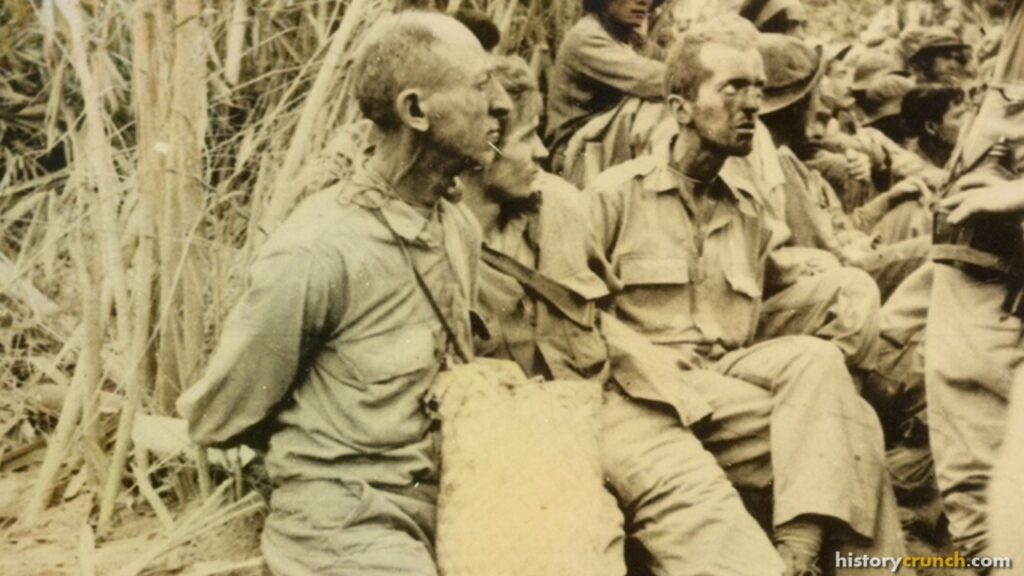
Prisoners of the Bataan Death March in 1942.
Source: UNESCO© factsthatcrunch.comMore World War II Facts →
World War IIBiography
Facts that CrunchFactsthatCrunch
Douglas MacArthur
General of the Army, Supreme Commander for the Allied Powers in the Pacific
Born: January 26th, 1880, Little Rock, Arkansas
Commissioned: 1903, U.S. Military Academy, West Point
Returned to Philippines: October 20th, 1944, Leyte
Accepted Japanese Surrender: September 2nd, 1945, Tokyo Bay
Relieved of Command: April 11th, 1951, by President Truman
Died: April 5th, 1964, Washington, D.C.

Douglas MacArthur commanded Allied forces across the Southwest Pacific during World War II, directing the island-hopping campaign that pushed Japanese forces back toward the home islands. He presided over the formal Japanese surrender ceremony aboard the USS Missouri in Tokyo Bay and then led the postwar occupation of Japan, overseeing major political and economic reforms in the country.
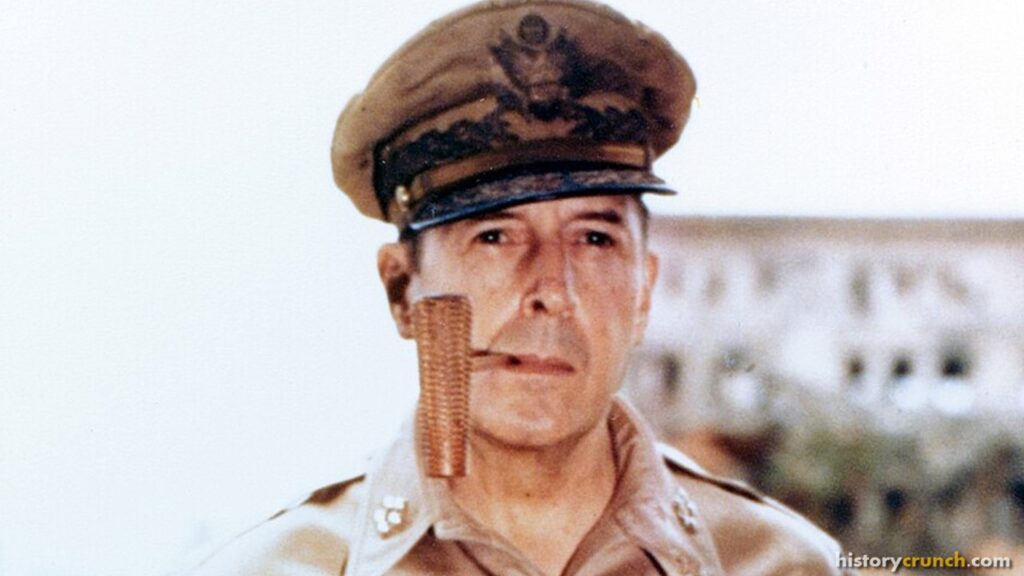
General of the ArmySouthwest Pacific CommanderPhilippines CampaignJapanese Occupation
Douglas MacArthur in the Philippines in August of 1945.
Source: Smithsonian Institution© factsthatcrunch.comMore World War II Facts →
World War IIImage ExplorerInteractive
Facts that CrunchFactsthatCrunch
Prisoners of the Bataan Death March in 1942.
Shaved heads Several men in the foreground have fully shaved heads, which was common among American and Filipino prisoners of war held by Japanese forces in the Pacific. Japanese captors sometimes shaved prisoners' heads as a control measure during captivity.
Worn and dirty uniforms The men wear light-colored military shirts that are visibly soiled and worn thin. This kind of deterioration in clothing reflects the extreme shortages of food, water, and supplies that prisoners experienced during events like the Bataan Death March in April 1942.
Dense jungle vegetation Bamboo stalks and thick brush fill the background. The Pacific theater fighting took place largely in tropical jungle terrain in the Philippines and across island chains, making supply and rescue of prisoners extremely difficult.
Large group seated on the ground A crowd of men stretches across the full width of the image, all seated and clustered together in an outdoor setting. Groups of prisoners this size were forced to march or wait in the open without shelter, contributing to the high death toll among Allied POWs in the Pacific.
Prisoners of the Bataan Death March in 1942.
Source: Library of Congress© factsthatcrunch.comMore World War II Facts →
Test Yourself
World War IITrue or FalseInteractive
Facts that CrunchFactsthatCrunch

American and Filipino forces on Bataan held out for roughly four months after Japan's initial invasion of Luzon before finally surrendering in April 1942.

ExplanationJapan invaded Luzon on December 22nd, 1941, and American and Filipino forces under General Douglas MacArthur withdrew to the Bataan Peninsula. They held out under severe shortages of food, medicine, and ammunition until General Edward King surrendered approximately 76,000 troops on April 9th, 1942, making it the largest surrender of American-led forces in U.S. history.
Source: UNESCO© factsthatcrunch.comMore World War II Facts →

During the Bataan Death March in World War II, was each of these a cause of the march or an effect it produced?

Read the item in the dashed box, then tap the column where it belongs.
SORT THIS ITEM1 / 10
Japan's failure to plan for 76,000 prisoners
Disease among troops before capture
Fall of Bataan, April 9th, 1942
Japan's rejection of surrender protections
Severe food shortages before surrender
Thousands of prisoners died on the route
International condemnation of Japan
Trial of General Homma Masaharu
Strengthened U.S. resolve in the Pacific
Survivors held in Camp O'Donnell
Sort all 10 to see your score
Japan's failure to plan for 76,000 prisonersThousands of prisoners died on the routeInternational condemnation of JapanDisease among troops before captureFall of Bataan, April 9th, 1942Japan's rejection of surrender protectionsTrial of General Homma MasaharuStrengthened U.S. resolve in the PacificSevere food shortages before surrenderSurvivors held in Camp O'Donnell
ExplanationThe march began after Filipino and American forces surrendered on April 9th, 1942, but Japanese commanders had not prepared to move 76,000 prisoners under brutal conditions, leading to deaths from execution, disease, and exhaustion along the roughly 65-mile (105-kilometer) route to Camp O'Donnell.
Source: National Archives© factsthatcrunch.comFacts that Crunch

Sources

Explore More Topics

Battle of Midway

Six months after Pearl Harbor, the balance of naval power in the Pacific shifted in a single engagement. The outcome at Midway in June of 1942 changed which side held the advantage at sea, and that shift shaped every major American military operation that followed in the region.

World War IIFast Facts
Facts that CrunchFactsthatCrunch
Raid dateApril 18th, 1942
B-25 Mitchell bombers launched16 aircraft
Aircrew who flew the mission80 men, all volunteers
Carrier that launched the planesUSS Hornet (CV-8)
Distance planes flew before launchAbout 650 miles (1,046 kilometers) from Japan, farther than planned
Bombers that reached China or Soviet territory15 crews made it to allied or neutral ground; 1 crew landed in the Soviet Union
Men captured by Japanese forces8 airmen captured; 3 were executed

Key takeaways

The 16 B-25 bombers were launched from a Navy carrier, which was unusual because the B-25 was an Army Air Forces plane not designed for carrier use. The raid caused little physical damage to Japan but showed that Tokyo could be reached by American air attack. Lieutenant Colonel James Doolittle led the mission and later received the Medal of Honor for his role.

Source: UNESCO© factsthatcrunch.comMore World War II Facts →
World War IIEyewitness
Facts that CrunchFactsthatCrunch
Eyewitness account

Well, Torpedo 8 had a difficult problem, we had old planes and we were new in the organization. We had a dual job of not only training a squadron of boot Ensigns, of which I was one of course, we also had to fight the war at the same time, and when we finally got up to the Battle of Midway it was the first time I had ever carried a torpedo on an aircraft and was the first time I had ever had taken a torpedo off of a ship, had never even seen it done. None of the other Ensigns in the squadron had either.

GHGeorge H. Gay Jr., US Navy torpedo bomber pilot, the only survivor of the 30 Torpedo Squadron 8 airmen who flew from USS Hornet on June 4th, 1942
Context

Gay gave this account in an official US Navy oral history interview recorded in Washington, D.C. on October 12th, 1943, describing his squadron's attack at the Battle of Midway.

Source: George Gay, US Navy oral history interview (1943)© factsthatcrunch.comMore World War II Facts →
World War IIFast Facts
Facts that CrunchFactsthatCrunch
Japanese aircraft launched in first strike108 planes sent against Midway Island on June 4th, 1942
U.S. aircraft carriers at Midway3 carriers: Enterprise, Hornet, and Yorktown
Yorktown's repair time before battleAbout 72 hours, repaired at Pearl Harbor after being badly damaged at Coral Sea
Japanese carriers in the Midway force4 fleet carriers: Akagi, Kaga, Soryu, and Hiryu
Japanese aircraft lost at MidwayAbout 248 planes lost in the battle
Experienced Japanese naval aviators killed at MidwayRoughly 110 veteran carrier pilots died, losses Japan could not replace
U.S. carriers lost at Midway1, the Yorktown, sunk on June 7th, 1942

Key takeaways

Japan lost all four of its attacking fleet carriers at Midway, while the United States lost one, shifting the balance of carrier power in the Pacific for the rest of the war.

The death of roughly 110 experienced Japanese naval aviators was a serious long-term loss, because Japan's pilot training program could not produce replacements fast enough to make up for them.

After Midway, Japan shifted from offensive operations to a defensive strategy, giving the United States and its allies the initiative in the Pacific.

Source: UNESCO© factsthatcrunch.comMore World War II Facts →
Battle of Coral Sea
May 4th–8th, 1942; U.S. lost the carrier Lexington and roughly 66 aircraft; Japan lost the light carrier Shoho and about 92 aircraft; tactically a draw
VS
Battle of Midway
June 4th–7th, 1942; U.S. lost the carrier Yorktown and about 150 aircraft; Japan lost four fleet carriers and about 248 aircraft
Coral Sea was the first carrier battle in history where ships never saw each other, settling nothing decisively. Midway destroyed Japan's four-carrier strike force and shifted naval power in the Pacific firmly to the United States.
Source: National WWII Museum© factsthatcrunch.comFacts that Crunch
World War IIMini Timeline
Facts that CrunchFactsthatCrunch
The Battle of Midway began on June 3rd, 1942, with American search planes spotting the Japanese fleet west of Midway Atoll.
The United States Navy had broken Japanese naval codes before the battle, giving American commanders advance knowledge of Japan's plan.
The opening phase unfolded over roughly 24 hours and set the conditions for the entire engagement.
June 3rd, 1942
First ContactA PBY Catalina patrol plane spotted the Japanese Occupation Force about 700 miles (1,125 km) west-southwest of Midway and radioed the position.
June 4th, 1942, early morning
Japanese Strike on MidwayJapan launched 108 aircraft from four carriers to attack Midway Atoll's airfields and installations before a planned landing.
June 4th, 1942, mid-morning
American Torpedo AttacksU.S. torpedo bomber squadrons, including Torpedo Squadron 8, attacked the Japanese carrier force and suffered severe losses without scoring hits.
June 4th, 1942, around 10:20 a.m.
Dive-Bomber AttackAmerican SBD Dauntless dive-bombers from USS Enterprise and USS Yorktown caught three Japanese carriers, Akagi, Kaga, and Soryu, with flight decks loaded with aircraft and fuel.
June 4th, 1942, afternoon
Fourth Carrier HitJapanese carrier Hiryu launched counterstrikes that damaged USS Yorktown; U.S. dive-bombers then found and fatally struck Hiryu later that afternoon.
4
Japanese Fleet Carriers Lost at Midway
307
Japanese Aircraft Lost During the Battle
3,057
Japanese Sailors and Airmen Killed in the Battle
Source: Library of Congress© factsthatcrunch.comMore World War II Facts →
Aircraft Carrier
noun
An aircraft carrier is a large warship with a flat deck that allows military planes to take off and land at sea. In World War II, carriers replaced battleships as the most important type of warship in naval combat, especially in the Pacific Ocean.
Source: National WWII Museum© factsthatcrunch.com
World War IIHead to Head
Facts that CrunchFactsthatCrunch
U.S. Pacific Fleet (Midway, June 1942)VSImperial Japanese Navy (Midway, June 1942)
1513
Destroyers present
816
Cruisers present
~50~200
Total ships in fleet
98248
Carrier aircraft lost
1915
Submarine escorts
Source: Naval History and Heritage Command© factsthatcrunch.comMore World War II Facts →
World War IIBulletin Board BioInteractive
Facts that CrunchFactsthatCrunch
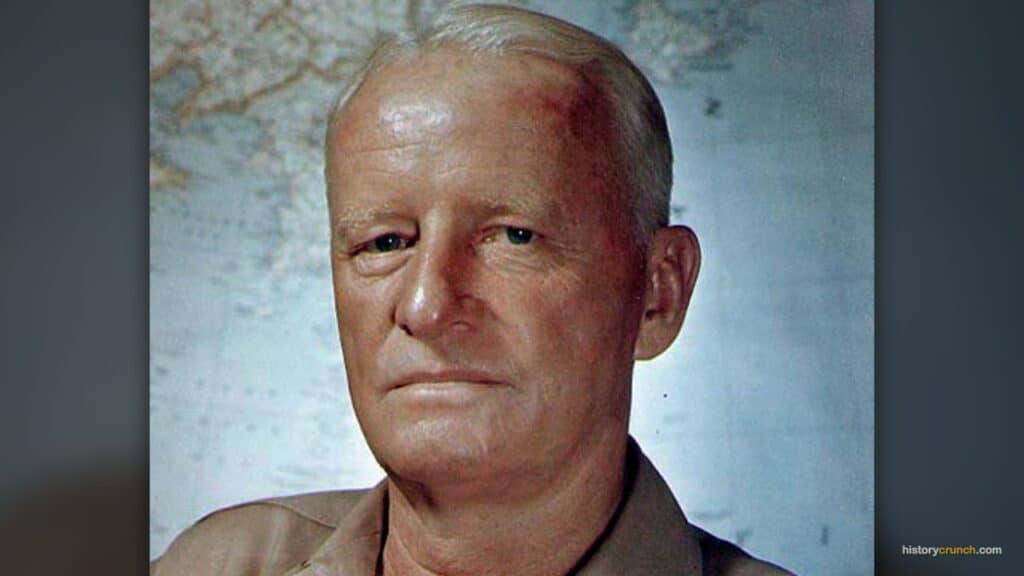
Admiral Chester Nimitz, commander of U.S. naval forces in the Pacific during World War II, is shown in a military portrait with a map visible in the background.
Chester Nimitz
At a Glance
BornFebruary 24th, 1885, in Fredericksburg, Texas
DiedFebruary 20th, 1966, in San Francisco, California
RoleFleet Admiral, U.S. Navy; Commander in Chief, Pacific Fleet (CINCPAC) during World War II
Tap a heading to open the note.
Early Navy Career
Nimitz graduated from the U.S. Naval Academy in Annapolis, Maryland, in 1905 and later became one of the Navy's leading experts on submarine operations.
Taking Command
President Franklin D. Roosevelt appointed Nimitz to lead the Pacific Fleet on December 31st, 1941, just weeks after the attack on Pearl Harbor.
Midway Victory
Nimitz directed the American victory at the Battle of Midway in June 1942, a turning point that stopped Japan's advance across the central Pacific.
Island Campaign
Nimitz oversaw the U.S. strategy of advancing across the Pacific by capturing key islands, including Guadalcanal, Iwo Jima, and Okinawa, to move closer to Japan.
Five-Star Rank
Congress created the rank of Fleet Admiral in December 1944, and Nimitz was promoted to that five-star rank on December 19th, 1944, one of only four men to hold it in the Navy.
Surrender Ceremony
Nimitz signed the Japanese surrender documents on behalf of the United States aboard the USS Missouri in Tokyo Bay on September 2nd, 1945.
Source: Naval History and Heritage Command© factsthatcrunch.comMore World War II Facts →
World War IIBy the Numbers
Facts that CrunchFactsthatCrunch

Japan lost four carriers at Midway in June 1942, and the crew losses across each ship tell a precise story of how hard the battle hit.

4
Carriers lost by Japan on June 4th, 1942
3,057
Japanese personnel killed across all four carriers
248
Japanese aircraft lost in the battle
711
Crew killed aboard Soryuu, the highest share of any carrier lost
811
Crew killed aboard Kaga
267
Crew killed aboard Akagi
All four carriers, the Akagi, Kaga, Soryuu, and Hiryuu, had taken part in the attack on Pearl Harbor only six months before. The loss of these ships and their trained crews ended Japan's ability to launch a major carrier offensive in the Pacific.
Source: UNESCO© factsthatcrunch.comMore World War II Facts →
World War IITurning Point
Facts that CrunchFactsthatCrunch
Battle of Midway: Japan Loses Its Carrier Strike Force
What Happened

On the morning of June 4th, 1942, American dive bombers attacked the Japanese fleet during a critical window when enemy decks were crowded with refueling aircraft, sinking three Japanese fleet carriers within six minutes and a fourth later that day.

Before

Japan held the initiative in the Pacific and could strike almost anywhere it chose

After

Japan never rebuilt its lost carrier force or trained enough experienced pilots to regain the offensive

Source: Smithsonian Institution© factsthatcrunch.comMore World War II Facts →
Test Yourself
World War IISequenceInteractive
Facts that CrunchFactsthatCrunch

In what order did these decisions and strikes lead to the sinking of all four Japanese carriers at the Battle of Midway?

Use the arrows to put these in the right order, then tap Check order.
123456
Japanese planes are rearmed with bombs for a second land attack
Hiryu launches counterstrikes before she too is found and fatally bombed
U.S. codebreakers confirm Japanese fleet's target and arrival date
Dive bombers from Enterprise and Yorktown strike three undefended carriers
Admiral Nagumo launches first airstrike wave against Midway Island
U.S. torpedo bombers attack and draw Japanese fighter cover down low
Source: UNESCO© factsthatcrunch.comMore World War II Facts →
World War II

At the Battle of Midway in June 1942, American forces sank four Japanese fleet carriers in a single engagement.

Tap an option.
ExplanationAmerican dive bombers sank all four Japanese fleet carriers that Japan had committed to the battle: Akagi, Kaga, Soryu, and Hiryu. Losing those four carriers in one battle ended Japan's ability to launch major offensive carrier operations in the Pacific.
Source: National World War II Museum© factsthatcrunch.comFacts that Crunch

Sources

Explore More Topics

Island-Hopping

The Pacific Ocean covers roughly 60 million square miles (155 million square kilometers), and the Allied strategy had to account for that scale. Rather than trying to capture every Japanese-held position, American commanders chose specific islands whose locations gave aircraft and ships the range needed to push closer to Japan, leaving other enemy positions cut off and unable to affect the fight.

Island-Hopping
skipping islands to reach Japan
Island-hopping was the Allied strategy in the Pacific War of capturing some Japanese-held islands while bypassing others, cutting off enemy troops and moving air bases closer to Japan. The U.S. military used this approach from 1943 onward, advancing through chains such as the Solomon Islands and the Marianas to bring American bombers within range of the Japanese home islands.
Source: National WWII Museum© factsthatcrunch.comFacts that Crunch
World War IIQuote
Facts that CrunchFactsthatCrunch

Rally to me. Let the indomitable spirit of Bataan and Corregidor lead on. As the lines of battle roll forward to bring you within the zone of operations, rise and strike. Strike at every favorable opportunity. For your homes and hearths, strike! For future generations of your sons and daughters, strike! In the name of your sacred dead, strike!

DM
Douglas MacArthurU.S. Army general and Allied commander in the Southwest Pacific, October 20th, 1944, radio address from the Leyte beachhead
Why it matters

MacArthur spoke these words by radio from a beach on Leyte on October 20th, 1944, and in the months after the landing many Filipinos fought as guerrillas behind Japanese lines while American forces pushed on through the islands.
Source: Radio address at Leyte, October 20th, 1944, MacArthur Memorial© factsthatcrunch.comMore World War II Facts →
Beachhead
noun
A beachhead is a section of enemy shoreline that attacking forces capture and hold so that more troops and supplies can come ashore safely. Allied forces established a beachhead on the beaches of Normandy, France, during the D-Day landings on June 6th, 1944, then pushed inland from that position.
Source: National WWII Museum© factsthatcrunch.com
Nimitz vs MacArthur
forces under command at the peak of the Pacific War
At the height of the Pacific War in 1944 and 1945, Admiral Chester Nimitz commanded roughly 1.3 million Navy and Marine personnel across the Central Pacific theater, while General Douglas MacArthur commanded approximately 750,000 Army and Allied ground troops in the Southwest Pacific theater. The two commands operated under separate chains of authority and often competed for ships, troops, and resources, a division that shaped which island campaigns were fought and in what order.
Source: National Archives© factsthatcrunch.comFacts that Crunch
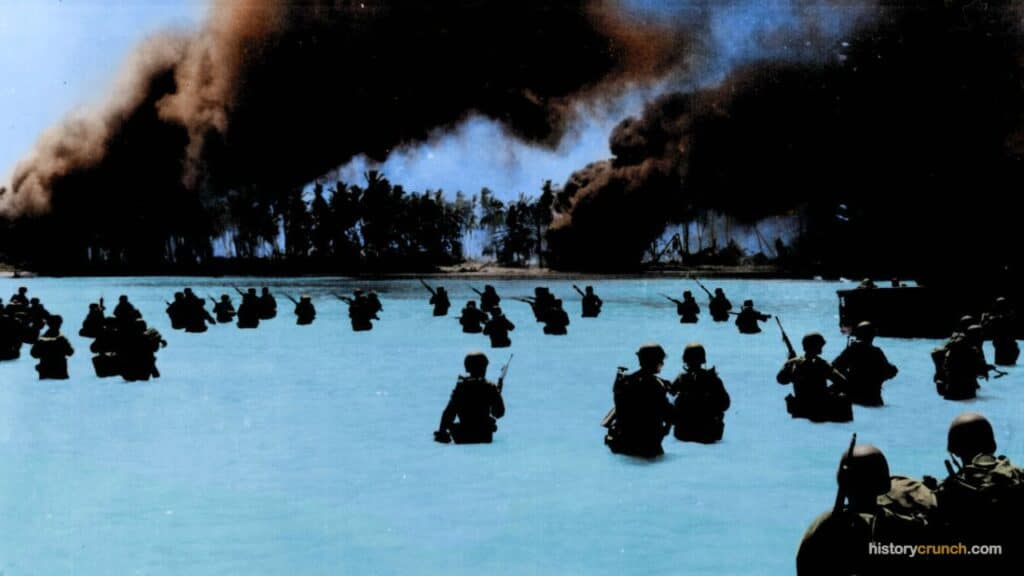
'US Army soldiers wave at Makin Atoll (35119484575)' by Cassowary Colorizations (2017). (Photo: Cassowary Colorizations, CC BY 2.0, via Wikimedia Commons)
US Army Soldiers Wading Ashore at Makin Atoll, World War II, November 1943
LOOK CLOSELY
Dozens of soldiers move through shallow, bright blue water toward a low, tree-lined shore. They carry rifles above their heads or at their chests to keep them dry. Dark smoke rises from fires burning on the island ahead of them.
THE CONTEXT
The photo was taken during Operation Galvanic, the American assault on Makin Atoll in the Gilbert Islands on November 20th, 1943. US Army soldiers of the 165th Infantry Regiment landed on Butaritari Island to take it from a Japanese garrison of roughly 300 combat troops. The battle ended on November 23rd, 1943, with the atoll secured by American forces.
THE DETAIL
A military vehicle, likely an amphibious craft, is visible at the far right edge of the frame, showing that the assault used both wading infantry and motorized support at the same time.
WHY IT MATTERS
This photo is one of the few colorized images showing Army infantry on foot during the Gilbert Islands campaign, making the scale and conditions of a Pacific island assault easy for students to see clearly.
1 / 4
Source: Naval History and Heritage Command© factsthatcrunch.com
World War IINotebook Timeline
Facts that CrunchFactsthatCrunch
World War II
Pacific Theater: Key Battles
August 7th, 1942: U.S. forces landed on Guadalcanal, beginning the first major Allied ground offensive in the Pacific.
November 20th, 1943: U.S. Marines attacked Tarawa Atoll in the Gilbert Islands, facing heavily fortified Japanese defenses.
June 19th, 1944: The Battle of the Philippine Sea saw Japan lose over 600 aircraft in a single day, crippling its carrier air power.
October 25th, 1944: Japan used organized kamikaze attacks for the first time during the Battle of Leyte Gulf.
February 19th, 1945: U.S. Marines landed on Iwo Jima and fought for 36 days before securing the island.
April 1st, 1945: U.S. forces landed on Okinawa in the largest amphibious assault of the Pacific war.
Source: National WWII Museum© factsthatcrunch.comMore World War II Facts →
Amphibious Assault
attack from sea onto land
An amphibious assault is a military operation in which naval ships carry troops and equipment from the sea and land them directly onto a defended shore. Allied forces used this method at Tarawa Atoll on November 20th, 1943, where U.S. Marines landed under heavy fire in one of the Pacific War's most costly shore attacks.
'US Army soldiers wave at Makin Atoll (35119484575)' by Cassowary Colorizations (2017). (Photo: Cassowary Colorizations, CC BY 2.0, via Wikimedia Commons)
Source: National WWII Museum© factsthatcrunch.comFacts that Crunch
World War IICause & Effect
Facts that CrunchFactsthatCrunch
Cause

In 1943, American military planners under Admiral Ernest King and General Douglas MacArthur agreed on a strategy of bypassing heavily defended Japanese island bases and capturing only those islands needed as stepping stones toward Japan.

Effects
American forces avoided costly assaults on fortified Japanese garrisons at places like Rabaul and Truk, keeping casualty numbers lower than a direct island-by-island advance would have produced.
Bypassed Japanese bases, including Rabaul with roughly 100,000 troops, were cut off from supply lines and left unable to affect the main advance.
The captured islands, such as Saipan and Tinian in mid-1944, gave American bombers bases within range of the Japanese home islands.
Japan was forced to spread its remaining naval and air forces across a wide area, making it harder to concentrate strength against any single American thrust.

Island-hopping, formally called leapfrogging, let American forces move across the Pacific faster and with fewer losses than fighting through every Japanese stronghold would have required. The strategy reflected a political and command-level decision to treat the Pacific as a problem of logistics and air power rather than pure ground combat.

Source: UNESCO© factsthatcrunch.comMore World War II Facts →
World War IIConnections
Facts that CrunchFactsthatCrunch
Battle of Tarawa (November 1943)
Battle of Kwajalein (February 1944)
The connection

Tarawa, seized in November 1943, gave U.S. planners hard lessons about amphibious assault tactics against fortified coral atolls, and those lessons were applied directly at Kwajalein three months later, making the February 1944 landing faster and less costly.

Kwajalein's capture also gave American forces an airfield within bomber range of the next ring of Japanese-held islands, advancing both the air coverage and the supply line that island-hopping depended on.

Source: Smithsonian Institution© factsthatcrunch.comMore World War II Facts →
Test Yourself
World War IIMultiple ChoiceInteractive
Facts that CrunchFactsthatCrunch

Which Pacific island was bypassed and left to wither by the Island-Hopping strategy rather than being directly attacked?

Tap an option.
ExplanationAmerican commanders chose to bypass Rabaul, the heavily fortified Japanese base in New Britain, rather than launch a costly direct assault. Allied forces cut off its supply lines and air support, leaving more than 100,000 Japanese troops there idle while the campaign moved on toward the Philippines and Japan.
Source: UNESCO© factsthatcrunch.comMore World War II Facts →

Sources

Explore More Topics

Battle of Guadalcanal

Guadalcanal was the first major land offensive the United States launched against Japan, and it ran from August of 1942 into February of 1943. The months of fighting on the island and in the surrounding waters showed how difficult sustained ground and naval combat in the Pacific would be, and it set the pattern for the island campaigns that followed.

World War IICorkboard Timeline
Facts that CrunchFactsthatCrunch
Battle of Guadalcanal
Key Dates, 1942 to 1943
1942
August 7th, 1942
U.S. Marines landed on Guadalcanal and nearby islands, marking the first major American offensive ground operation of World War II in the Pacific.
1942
August 9th, 1942
Japanese naval forces defeated the Allied fleet at the Battle of Savo Island, sinking four cruisers and forcing supply ships to withdraw, leaving Marines with limited supplies.
1942
October 26th, 1942
Japanese and U.S. carrier forces clashed at the Battle of Santa Cruz Islands, with the U.S. losing the carrier Hornet but holding the waters around Guadalcanal.
1942
November 13th, 1942
A major three-day naval battle near Guadalcanal began, costing both sides heavily but ending with U.S. forces blocking a large Japanese troop convoy.
1942
December 9th, 1942
Army General Alexander Patch took command of ground forces on Guadalcanal, replacing the exhausted Marine units who had held the island since August.
1943
February 9th, 1943
General Patch declared Guadalcanal secure after Japanese forces completed a secret nighttime evacuation, ending six months of fighting on the island.
A timeline pinned to the board.
Source: National WWII Museum© factsthatcrunch.comMore World War II Facts →
World War IIStat
Facts that CrunchFactsthatCrunch
warships lost by each side

During the Battle of Guadalcanal from August 7th, 1942 to February 9th, 1943, the naval battles cost the United States and Japan exactly 24 warships each.

Japan lost 2 battleships, 4 cruisers, 1 light carrier, 11 destroyers, and 6 submarines. The United States lost 8 cruisers, 2 heavy carriers, and 14 destroyers. The equal ship count masked very different consequences, as Japan could not replace its losses fast enough to hold the island, and withdrew its remaining troops in early February 1943.

Source: UNESCO© factsthatcrunch.comMore World War II Facts →
World War IIPhoto Analysis
Facts that CrunchFactsthatCrunch
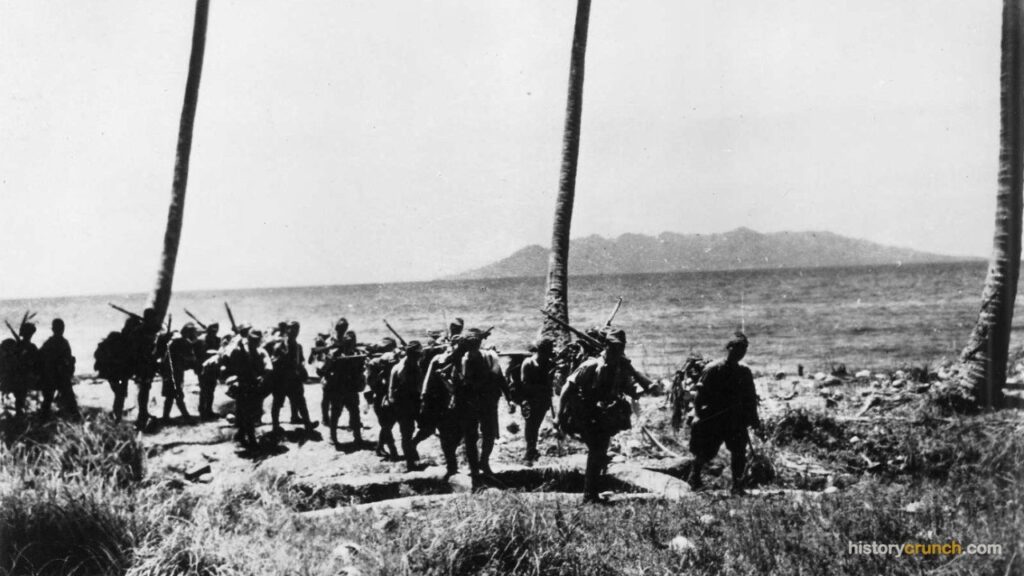
Japanese troops arriving on Guadalcanal.
Japanese Troops Arriving on Guadalcanal, World War II, 1942
Look closely
A large group of soldiers moves along a narrow coastal strip, carrying rifles and heavy packs.
Tall palm trees frame the scene, and a hilly island is visible across the water in the background.
The soldiers are shown in silhouette, moving in a loose column away from the shoreline.
The context
Japan landed troops on Guadalcanal in the Solomon Islands in mid-1942 and began building an airstrip there.
American forces landed on August 7th, 1942, to stop that effort, starting a campaign that lasted roughly six months.
Both sides poured reinforcements onto the island and into the surrounding waters throughout the rest of 1942.
What it tells us
The photo shows that Japanese forces moved across Guadalcanal on foot through difficult coastal terrain, which helps explain why supply and movement were major problems for both sides during the campaign.
Images like this were used after the war to document Japanese military operations in the Pacific.
The tropical setting visible in the photo, with dense vegetation and a coastline, helps students understand the physical environment soldiers on both sides had to work in.
Source: National Archives and Records Administration© factsthatcrunch.comMore World War II Facts →
World War IITurning Point
Facts that CrunchFactsthatCrunch
Battle of Guadalcanal: First Major Allied Offensive Victory in the Pacific
What Happened

On the night of November 14th and 15th, 1942, American naval and air forces turned back a Japanese convoy carrying reinforcements to Guadalcanal, sinking most of the troop transports and ending Japan's last serious attempt to retake Henderson Field by force.

Before

Japan held the initiative in the Pacific and had been pushing Allied forces back since late 1941

After

Allied forces moved from defense to offense, and Japan shifted permanently to a defensive posture in the South Pacific

Source: US National Archives© factsthatcrunch.comMore World War II Facts →
World War IIImage ExplorerInteractive
Facts that CrunchFactsthatCrunch
Japanese troops arriving on Guadalcanal.
Rifles carried on shoulders The soldiers carry their rifles angled upward and slung across their backs or shoulders, showing they are on the move rather than in immediate combat. This was a common carry position during the Pacific island campaigns when troops advanced inland after landing.
Heavy full packs Each soldier carries a large pack loaded with gear. In the Pacific Theater, troops had to carry all their food, ammunition, and equipment with them because supply lines across ocean distances were slow and difficult to maintain.
Palm trees along the shoreline The tall, thin palm trees visible throughout the image identify this as a tropical Pacific island setting. The United States and Japan fought a long series of island battles across the Pacific from 1942 to 1945, and this kind of coastline was the entry point for nearly every Allied amphibious landing.
Island visible across the water A second landmass is clearly visible on the horizon across the water. In the Pacific island-hopping campaign, Allied forces frequently operated within sight of multiple islands at once, and controlling the waters and islands nearby was central to cutting off Japanese supply and reinforcement routes.
Japanese troops arriving on Guadalcanal.
Source: US National Archives© factsthatcrunch.comMore World War II Facts →
Test Yourself
World War IISource QuestionInteractive
Facts that CrunchFactsthatCrunch
By mid-August 1942, U.S. Marines had seized a partly finished Japanese airstrip on Guadalcanal and renamed it Henderson Field. Japan immediately set out to retake it, sending ground troops, warships, and aircraft in repeated attacks, because losing the airfield meant losing the ability to contest Allied control of the surrounding sea and air.

The airfield on Guadalcanal was the key to the campaign. Whoever held the airfield controlled the air over the southern Solomons, and whoever controlled the air controlled the sea lanes over which both sides had to move their supplies and reinforcements.

Major John L. Zimmerman, USMC · The Guadalcanal Campaign · 1949

Based on the passage and the context, why did control of Henderson Field determine which side could sustain its forces on Guadalcanal?

Tap an option.
ExplanationThe passage states directly that whoever held the airfield controlled the air, and whoever controlled the air controlled the sea lanes used for supply and reinforcement. Without air cover, neither side could safely move ships to the island, so the airfield decided the outcome of the whole campaign.
Source: Zimmerman, The Guadalcanal Campaign, USMC Historical Branch, 1949© factsthatcrunch.comMore World War II Facts →

Sources

Explore More Topics

Battle of Iwo Jima

Iwo Jima's value was almost entirely geographic. The island sat within range of the Japanese home islands, and control of its airstrips meant American bombers had a place to land in emergencies and fighter planes had a base from which to escort those bombers, making the high cost of capturing it a direct part of the air campaign against Japan.

World War IIQuote
Facts that CrunchFactsthatCrunch

Holland, the raising of that flag on Suribachi means a Marine Corps for the next five hundred years.

JF
James ForrestalSecretary of the Navy of the United States, February 23rd, 1945, on the landing beach at Iwo Jima
Why it matters

Forrestal had come ashore to watch the fight for Mount Suribachi, and his boat touched the beach just after the flag went up, so his words are a firsthand witness account of the same courage Admiral Chester W. Nimitz honored weeks later in his famous tribute to the uncommon valor shown on Iwo Jima.

Source: Remark to Lt. Gen. Holland Smith, Iwo Jima, 1945, Marine Corps History Division© factsthatcrunch.comMore World War II Facts →
World War IINotebook Timeline
Facts that CrunchFactsthatCrunch
World War II
Battle of Iwo Jima: February to March 1945
February 19th, 1945: About 70,000 U.S. Marines landed on Iwo Jima under heavy fire from hidden Japanese defenses.
February 23rd, 1945: Marines reached the top of Mount Suribachi and raised the U.S. flag, a moment photographed by Joe Rosenthal.
February 26th, 1945: U.S. forces secured Airfield No. 1, giving American planes a closer base for bombing Japan.
March 9th, 1945: Japanese commander General Tadamichi Kuribayashi sent his last radio message as his forces were pushed into the northern corner of the island.
March 16th, 1945: The U.S. military declared Iwo Jima secured, though scattered Japanese resistance continued for days.
March 26th, 1945: The last organized Japanese attack on the island was defeated, ending 36 days of fighting.
Source: National WWII Museum© factsthatcrunch.comMore World War II Facts →
World War IIFast Facts
Facts that CrunchFactsthatCrunch
First Navajo Code Talkers recruited29 men, recruited by the U.S. Marine Corps in 1942
Total Navajo Code Talkers who servedAbout 420 men served during World War II
Age of youngest recruitsSome were as young as 15 years old, enlisting with falsified ages
Code words developedThe original group created a code of about 200 terms; it grew to over 400 terms by war's end
Branch of serviceAll Navajo Code Talkers served in the U.S. Marine Corps
Congressional Gold Medal recipientsThe original 29 recruits received the Congressional Gold Medal on December 21st, 2000
Years the program stayed classifiedThe program remained secret for 23 years, declassified in 1968

Key takeaways

The Navajo language was chosen because it had no written alphabet and was spoken by very few people outside Navajo communities, making the code extremely hard for enemy forces to break.

Navajo Code Talkers served in every major Marine operation in the Pacific from 1942 to 1945, sending and receiving thousands of messages under combat conditions.

The U.S. government kept the program classified after the war in case the code was needed again, so the men could not speak publicly about their service until 1968.

Source: Library of Congress© factsthatcrunch.comMore World War II Facts →
World War IIQuote
Facts that CrunchFactsthatCrunch

The battle of Iwo Island has been won. ... Among the Americans who served on Iwo Island, uncommon valor was a common virtue.

CW
Chester W. NimitzFleet Admiral and Commander in Chief of the U.S. Pacific Fleet, March 16th, 1945
Why it matters

Marine correspondent Sergeant Gilbert Preston Bailey, a firsthand witness to the fighting, reported that stories would never be written about most of the men because there were too many of them, and Nimitz's phrase became the lasting tribute to those unnamed men when it was later carved into the Marine Corps War Memorial outside Arlington National Cemetery.

Admiral Chester Nimitz, commander of U.S. naval forces in the Pacific during World War II, is shown in a military portrait with a map visible in the background.
Source: CINCPAC Communique No. 300, 1945, Naval History and Heritage Command© factsthatcrunch.comMore World War II Facts →
World War IIComparison
Facts that CrunchFactsthatCrunch
Battle of Iwo Jima
U.S. Marines and Navy forces attacked the island, with about 70,000 American troops committed to the assault.
Japan defended the island with roughly 21,000 troops under Lieutenant General Tadamichi Kuribayashi.
Japanese defenders had no plan to retreat or surrender, and most died in the fighting.
No significant Japanese naval or air counterattack was launched during the battle.
Battle of Okinawa
U.S. Army and Marine forces led the assault, supported by a large Allied naval fleet, with about 183,000 ground troops landing on the island.
Japan committed roughly 110,000 ground troops under Lieutenant General Mitsuru Ushijima.
Japan also used large-scale kamikaze air attacks against Allied ships, sinking or damaging hundreds of vessels.
British Pacific Fleet ships also took part in the naval operation, making it a combined Allied effort.
VS

At Iwo Jima, the fight was almost entirely between U.S. Marines and a deeply entrenched Japanese garrison with no outside Japanese support. At Okinawa, Japan added coordinated kamikaze strikes and a much larger ground force, and Britain joined the Allied naval effort, making the overall scale and the range of forces involved much greater.

Source: UNESCO© factsthatcrunch.comMore World War II Facts →
World War IIStat
Facts that CrunchFactsthatCrunch
U.S. service members wounded

During the Battle of Iwo Jima from February 19th to March 26th, 1945, 19,217 U.S. service members were wounded in action, and another 6,821 were killed.

The total of roughly 26,000 American casualties — killed and wounded combined — was higher than the total casualties suffered by the Japanese defenders, making Iwo Jima unusual among Pacific War battles fought by the Marines. Of the approximately 21,000 Japanese troops on the island, only 216 were taken prisoner; nearly all the rest were killed.
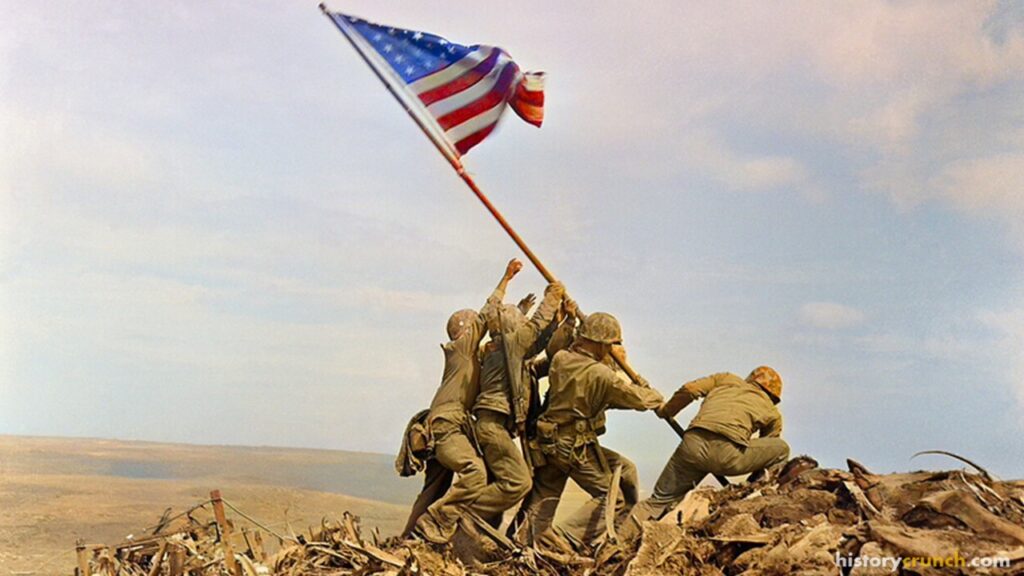
'Raising the Flag on Iwo Jima' Photograph by Joe Rosenthal. (Colorized by historycrunch.com)
Source: US National Archives© factsthatcrunch.comMore World War II Facts →
World War IINotebook Definition
Facts that CrunchFactsthatCrunch
Kamikaze
(noun)
A kamikaze was a Japanese pilot in World War II who deliberately crashed his plane, loaded with explosives, into an Allied warship. The goal was to cause as much damage as possible by turning the aircraft itself into a weapon.
in a sentence: Kamikaze attacks sank or damaged hundreds of Allied ships during the Battle of Okinawa in 1945.
Source: National WWII Museum© factsthatcrunch.comMore World War II Facts →
World War IIRipple Effect
Facts that CrunchFactsthatCrunch
The Event

The Battle of Iwo Jima, which ended on March 26th, 1945, cost American forces about 6,800 killed and nearly 20,000 wounded in 36 days of fighting against roughly 21,000 entrenched Japanese defenders.

American commanders immediately reported to Washington that Japanese forces had fought almost to the last man, with only about 216 prisoners taken from the entire garrison.
The Joint Chiefs of Staff used Iwo Jima's casualty rate to revise projected losses for Operation Downfall, the planned invasion of the Japanese home islands, with staff estimates ranging from hundreds of thousands to over a million American casualties.
President Harry S. Truman received these revised casualty estimates in the summer of 1945 and cited them as a central reason for authorizing the use of atomic bombs against Japan rather than proceeding with a ground invasion.
Military planners also accelerated the training and buildup of forces in the Pacific through mid-1945, drawing lessons from Iwo Jima about the need for longer pre-invasion bombardment and closer air support.
The scale of losses at Iwo Jima strengthened the argument within the Truman administration that any conventional invasion of Japan's home islands would produce casualties far beyond what the American public or military could sustain, a judgment that shaped the overall strategy for ending the Pacific War.
Source: US National Archives© factsthatcrunch.comMore World War II Facts →
World War IIClaim
Facts that CrunchFactsthatCrunch
The Claim

The Battle of Iwo Jima's cost in American lives may not have been justified by the island's actual military value to the United States.

Evidence
American forces suffered about 6,800 killed and nearly 19,000 wounded taking Iwo Jima in 36 days of fighting in early 1945.
The island was meant to serve as an emergency landing strip for B-29 bombers returning from raids on Japan, but historians debate how often it was actually used for that purpose.
Some researchers argue that Iwo Jima's value as a fighter escort base was limited because P-51 Mustangs flying from the island rarely escorted B-29 missions over Japan as planned.
Others counter that the island did provide a forward base for air-sea rescue operations and that its capture denied Japan a position from which to launch attacks on the B-29 bombing campaign.
Source: Smithsonian Institution© factsthatcrunch.comMore World War II Facts →
World War IIColorizedInteractive
Facts that CrunchFactsthatCrunch
'Raising the Flag on Iwo Jima' Photograph by Joe Rosenthal. (Colorized by historycrunch.com)
Black & whiteColour
'Raising the Flag on Iwo Jima' Photograph by Joe Rosenthal. (Colorized by historycrunch.com)
Colorized by: historycrunch.com© factsthatcrunch.comMore World War II Facts →
Test Yourself
World War II

Which factor most explains why Japanese defenders on Iwo Jima caused such high American casualties despite being heavily outnumbered?

Tap an option.
ExplanationGeneral Tadamichi Kuribayashi ordered his roughly 21,000 defenders to build about 11 miles (18 kilometers) of underground tunnels connecting hundreds of concrete bunkers and gun positions. American naval bombardment and air strikes destroyed very little of this network, so defenders could hold protected positions and force U.S. Marines to clear each position at close range.
Source: National Museum of the Marine Corps© factsthatcrunch.comFacts that Crunch

At the Battle of Iwo Jima in World War II, did each of these figures, weapons, and tactics belong to the American side or the Japanese side?

Read the item in the dashed box, then tap the column where it belongs.
SORT THIS ITEM1 / 10
Holland Smith, commanding general
Sherman tank use
Naval gunfire support
LSTank landing craft
M1 Flamethrower
Suicide counterattacks
Tunnel defense network
Tadamichi Kuribayashi, commanding general
Blockhouse fortifications
Type 99 magnetic mine
Sort all 10 to see your score
Holland Smith, commanding generalSuicide counterattacksSherman tank useTunnel defense networkNaval gunfire supportTadamichi Kuribayashi, commanding generalLSTank landing craftM1 FlamethrowerBlockhouse fortificationsType 99 magnetic mine
ExplanationGeneral Tadamichi Kuribayashi ordered Japanese forces to build more than 11 miles (18 kilometers) of tunnels under Iwo Jima, replacing traditional beach defense with deep underground positions that made every yard of the island costly for advancing American Marines.
Source: National WWII Museum© factsthatcrunch.comFacts that Crunch

Sources

Explore More Topics

Battle of Okinawa

By the spring of 1945, American forces were close enough to Japan that planners were already estimating what an invasion of the home islands would cost. The fighting on Okinawa from April through June of 1945 provided concrete evidence of how fiercely Japanese forces would resist, and those estimates directly influenced the decisions made in Washington that summer.

World War IIEyewitness
Facts that CrunchFactsthatCrunch
Eyewitness account

There was probably 45 planes in the air. ... you knew that they were going to dive on you.

JCJohn Chapman, Gun captain on the destroyer USS Newcomb
Context

Chapman described the first mass kamikaze raid off Okinawa on April 6th, 1945, when five suicide planes struck his ship, the USS Newcomb.

Source: John Chapman, PBS American Experience interview (2005)© factsthatcrunch.comMore World War II Facts →
World War IINotebook Timeline
Facts that CrunchFactsthatCrunch
World War II
Battle of Okinawa: April to June 1945
April 1st, 1945: U.S. forces land on Okinawa's western beaches in the largest amphibious assault of the Pacific War.
April 6th, 1945: Japan launches the first mass kamikaze attack, sinking or damaging dozens of Allied ships.
April 7th, 1945: The Japanese battleship Yamato is sunk by U.S. aircraft before it can reach Okinawa.
May 4th, 1945: Japanese ground forces launch a major counterattack on U.S. positions in southern Okinawa but fail to break through.
June 18th, 1945: U.S. General Simon Buckner is killed by Japanese artillery, the highest-ranking American officer to die in combat in the war.
June 22nd, 1945: Organized Japanese resistance ends, with roughly 110,000 Japanese troops killed during the battle.
Source: National WWII Museum© factsthatcrunch.comMore World War II Facts →
4,907
U.S. Navy sailors killed during the Battle of Okinawa, April 1st to June 22nd, 1945, mostly by kamikaze attacks
Japanese kamikaze pilots flew roughly 1,900 suicide sorties against the Allied fleet during the battle, sinking 36 ships and damaging 368 more. The death toll made Okinawa the bloodiest battle of the entire war for the U.S. Navy, surpassing even the losses at Pearl Harbor.
Source: National WWII Museum© factsthatcrunch.comFacts that Crunch
World War IIRecord
Facts that CrunchFactsthatCrunch
LARGEST BATTLESHIP EVER BUILT

The Japanese battleship Yamato displaced nearly 72,000 long tons (73,000 metric tons) at full load, making her the heaviest battleship ever constructed.

Yamato carried nine 18.1-inch (460 mm) Type 94 guns, the largest naval guns ever mounted on a warship. Each three-gun turret weighed roughly 2,774 tons, more than most destroyers of the time. Her keel was laid at Kure Naval Arsenal on November 4th, 1937, under a canvas canopy to hide her from view, and she was commissioned on December 16th, 1941. On April 7th, 1945, U.S. carrier aircraft sank her during Operation Ten-Go, killing 2,498 of her 2,700 crew members.

Source: Library of Congress© factsthatcrunch.comMore World War II Facts →
World War IIStat
Facts that CrunchFactsthatCrunch
percent casualties in one regiment

During the Battle of Okinawa in the spring of 1945, the 29th Marine Regiment suffered roughly 80 percent of its men killed and wounded, the highest regimental loss rate for the American military since the Civil War.

The battle ran from April 1st to June 22nd, 1945, and cost the U.S. Tenth Army more than 49,000 total casualties. American ground forces faced strongly fortified Japanese defensive lines across Okinawa's southern end, and fighting for those positions ground down whole units. The 29th Marine Regiment's loss rate shows how concentrated and relentless the combat was at the regimental level.

Source: US National Archives© factsthatcrunch.comMore World War II Facts →
World War IIFlow ChartInteractive
Facts that CrunchFactsthatCrunch
In orderHow was a kamikaze attack planned and carried out during the Battle of Okinawa?

Follow the chain from top to bottom. Tap any step to read what happened.

Pilots Selected and BriefedJapanese commanders at Okinawa chose volunteer pilots, many of them young and recently trained, for kamikaze missions. Officers explained the target type, the flight route, and the goal of crashing into American warships to cause maximum damage to the hull and crew.
Aircraft Loaded and ArmedGround crews fitted the aircraft, often a Zero fighter or a Nakajima Ki-43, with a bomb fixed to the fuselage or wings. The bomb could not be dropped in flight, so the plane itself became the weapon on impact.
Flight Path PlannedMission planners chose a route that used low altitude or cloud cover to avoid radar detection by American picket destroyers stationed around Okinawa. Pilots were directed toward the radar picket line first because those destroyers were the early warning system protecting the invasion fleet.
Takeoff from Kyushu AirfieldsPilots launched from airfields in southern Kyushu, Japan, roughly 350 miles (560 kilometers) from Okinawa. Some missions were organized into coordinated waves called kikusui, with dozens or even hundreds of aircraft attacking at once to overwhelm American anti-aircraft defenses.
Approach and Final DivePilots descended steeply toward a target ship, aiming for the deck, the bridge, or the waterline. American gunners and combat air patrols shot down a large share of incoming aircraft, but enough reached their targets to sink or damage hundreds of Allied vessels during the battle.
Impact and Damage AssessedWhen a kamikaze struck a ship, damage teams fought fires and flooding while commanders radioed results back to Japanese headquarters. Japan used those reports to plan follow-on kikusui waves, continuing the campaign from April 6th, 1945, until the fighting at Okinawa ended in late June 1945.
Step 1 of 6
Source: Library of Congress© factsthatcrunch.comMore World War II Facts →
World War IIMind Map BoardInteractive
Facts that CrunchFactsthatCrunch
Kamikazes
Japanese pilots flew about 1,900 kamikaze missions during the battle, sinking 36 Allied ships and damaging nearly 400 more.
Civilian Deaths
An estimated 100,000 to 150,000 Okinawan civilians died during the fighting, a large share of the island's total population.
Operation Iceberg
The American invasion plan was called Operation Iceberg, and it involved more than 1,300 ships, the largest naval force ever assembled in the Pacific.
General Simon Bolivar Buckner Jr.
U.S. ground commander General Simon Bolivar Buckner Jr. was killed by enemy artillery fire on June 18th, 1945, making him the highest-ranking American officer killed in action during World War II.
Japanese Defense Plan
Japanese commander General Mitsuru Ushijima ordered his forces to fight a slow defensive battle from underground tunnels and caves, aiming to inflict maximum casualties on American troops.
Battle Length
The fighting on Okinawa lasted 82 days, from April 1st through June 22nd, 1945, making it the longest land battle of the Pacific War.
Battle of Okinawa, 1945
Tap a node to explore it.
Source: National WWII Museum© factsthatcrunch.comMore World War II Facts →
Test Yourself
World War IIImage QuestionInteractive
Facts that CrunchFactsthatCrunch
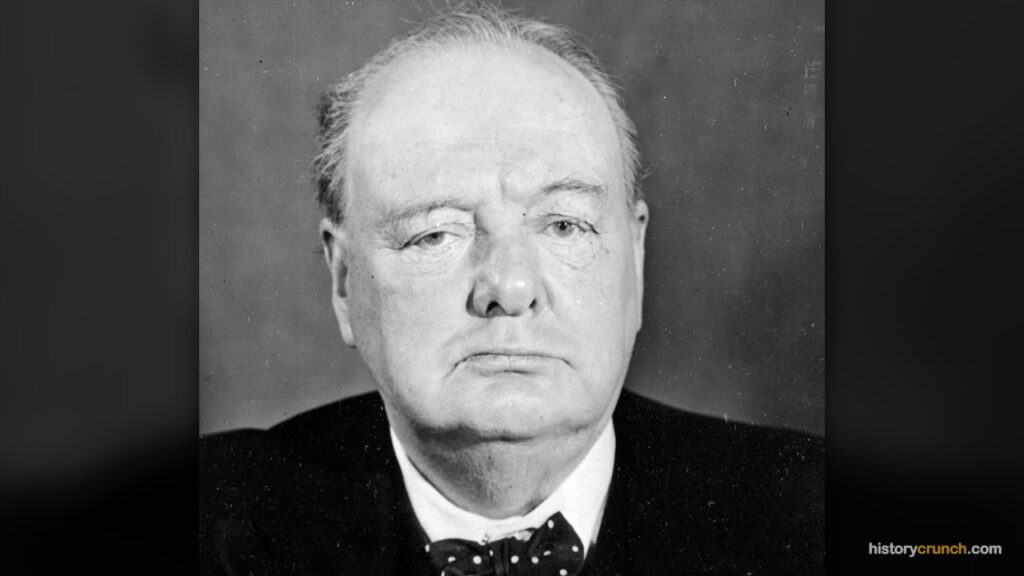
Winston Churchill served as Prime Minister of the United Kingdom during World War II and worked closely with Allied leaders to shape the war effort and postwar plans.

In this portrait of Winston Churchill during World War II, what does the formal dark suit and bow tie he is wearing, rather than a military uniform, reveal about how he held power?

Tap an option.
ExplanationChurchill served as Prime Minister, an elected civilian office, not as a military commander. His civilian dress reflects that Britain fought the war under parliamentary government, with Churchill directing grand strategy through political authority rather than a military commission. He worked closely with generals and Allied leaders, but his power came from his civilian role, not a rank.
Source: US National Archives© factsthatcrunch.comMore World War II Facts →
World War IIDecision PointInteractive
Facts that CrunchFactsthatCrunch
DECISION POINT

It is late March 1945, and you are General Simon Bolivar Buckner Jr., commander of the U.S. Tenth Army during World War II in the Pacific. Your forces are about to land on Okinawa, a densely populated Japanese island roughly 340 miles (550 kilometers) from the Japanese home islands, on April 1st, 1945. Intelligence reports warn that Japanese defenders plan to draw civilians into the fighting, and planners estimate that tens of thousands of Okinawan civilians may die if the battle proceeds as expected.

History turned on this choice. What would you have done?
Should you proceed with the invasion of Okinawa as planned?
Choose a path. Each choice opens a different future.
Your move
Pick option A, B, or C to walk down that path.
If you choose A
The battle proceeds, but civilian deaths reach catastrophic levels as Japanese forces use caves, tunnels, and the civilian population as part of their defense.
If you choose B
The delay gives Japan time to reinforce the island and may cost more American and Japanese military lives, with no guarantee civilians will be protected.
If you choose C
Allied forces lose a critical staging base for any invasion of the Japanese home islands, extending the war significantly and shifting the overall Allied strategy in the Pacific.
What really happened
Buckner proceeded with the invasion on April 1st, 1945, and the Battle of Okinawa lasted until late June 1945. Estimates put Okinawan civilian deaths between 40,000 and 150,000, roughly one quarter to one third of the island's prewar population, making it the deadliest battle for civilians in the Pacific theater. The island became the main Allied staging base planned for Operation Downfall, the proposed invasion of Japan's home islands, though that invasion never happened after Japan surrendered in August 1945.
Source: National WWII Museum© factsthatcrunch.comMore World War II Facts →

Sources

Explore More Topics

Atomic Bombing of Japan

The atomic bombings of Hiroshima on August 6th, 1945 and Nagasaki on August 9th, 1945 introduced a new category of weapon to warfare. The cards in this section cover the military and political decisions behind those bombings, which remain among the most debated choices any government made during the entire war.

World War IIScale
Facts that CrunchFactsthatCrunch

The Tokyo Firebombing in World War II Killed About 100,000 People in a Single Night, More Than Any Other Air Raid in History

Tokyo firebombing, March 9th–10th, 1945
100,000Hiroshima atomic bomb, immediate deaths, August 6th, 1945
70,000Nagasaki atomic bomb, immediate deaths, August 9th, 1945
40,000Bombing of Dresden, February 1945
25,000

Operation Meetinghouse sent about 300 B-29 bombers over Tokyo on the night of March 9th, 1945, dropping 1,665 tons of incendiary bombs including napalm. The Japanese government's official count recorded 83,793 deaths, while most historians place the total at close to 100,000. That single-night toll was higher than the immediate death count from either atomic bomb dropped five months later.

Source: UNESCO© factsthatcrunch.comMore World War II Facts →
World War IITimelineInteractive
Facts that CrunchFactsthatCrunch

What happened day by day during the atomic bombing of Japan in August 1945?

August 2nd, 1945August 6th, 1945August 8th, 1945August 9th, 1945August 10th, 1945August 12th, 1945August 15th, 1945
August 2nd, 1945 — Potsdam Order Signed General Carl Spaatz received written orders authorizing the use of the atomic bomb against Japan. The order named Hiroshima, Kokura, Niigata, and Nagasaki as target cities.
August 6th, 1945 — Hiroshima Bombed At 8:15 AM local time, the B-29 bomber Enola Gay, piloted by Colonel Paul Tibbets, dropped a uranium bomb called Little Boy on Hiroshima. The blast killed an estimated 70,000 people instantly and destroyed roughly 4.7 square miles (12 square kilometers) of the city.
August 8th, 1945 — Soviet Union Declares War The Soviet Union declared war on Japan and launched an invasion of Japanese-held Manchuria early on August 9th. This fulfilled a promise Joseph Stalin had made to the Allied leaders at the Yalta Conference in February 1945.
August 9th, 1945 — Nagasaki Bombed A B-29 named Bockscar, commanded by Major Charles Sweeney, dropped a plutonium bomb called Fat Man on Nagasaki at 11:02 AM local time. The explosion killed an estimated 40,000 people immediately.
August 10th, 1945 — Japan Offers to Surrender The Japanese government sent a message through neutral Switzerland offering to surrender, on the condition that Emperor Hirohito keep his position. The Allies replied that the emperor could remain but must answer to the Allied Supreme Commander.
August 12th, 1945 — Allies Send Final Terms The United States, Britain, the Soviet Union, and China formally transmitted their reply to Japan, confirming the surrender terms. Allied bombing missions over Japan were briefly paused while Japan's leaders debated the offer.
August 15th, 1945 — Emperor Announces Surrender Emperor Hirohito made a recorded radio address to the Japanese people at noon local time, announcing that Japan would accept the Allied surrender terms. It was the first time most Japanese citizens had ever heard his voice.
August 2nd, 1945 — Potsdam Order SignedGeneral Carl Spaatz received written orders authorizing the use of the atomic bomb against Japan. The order named Hiroshima, Kokura, Niigata, and Nagasaki as target cities.
August 6th, 1945 — Hiroshima BombedAt 8:15 AM local time, the B-29 bomber Enola Gay, piloted by Colonel Paul Tibbets, dropped a uranium bomb called Little Boy on Hiroshima. The blast killed an estimated 70,000 people instantly and destroyed roughly 4.7 square miles (12 square kilometers) of the city.
August 8th, 1945 — Soviet Union Declares WarThe Soviet Union declared war on Japan and launched an invasion of Japanese-held Manchuria early on August 9th. This fulfilled a promise Joseph Stalin had made to the Allied leaders at the Yalta Conference in February 1945.
August 9th, 1945 — Nagasaki BombedA B-29 named Bockscar, commanded by Major Charles Sweeney, dropped a plutonium bomb called Fat Man on Nagasaki at 11:02 AM local time. The explosion killed an estimated 40,000 people immediately.
August 10th, 1945 — Japan Offers to SurrenderThe Japanese government sent a message through neutral Switzerland offering to surrender, on the condition that Emperor Hirohito keep his position. The Allies replied that the emperor could remain but must answer to the Allied Supreme Commander.
August 12th, 1945 — Allies Send Final TermsThe United States, Britain, the Soviet Union, and China formally transmitted their reply to Japan, confirming the surrender terms. Allied bombing missions over Japan were briefly paused while Japan's leaders debated the offer.
August 15th, 1945 — Emperor Announces SurrenderEmperor Hirohito made a recorded radio address to the Japanese people at noon local time, announcing that Japan would accept the Allied surrender terms. It was the first time most Japanese citizens had ever heard his voice.

Tap a point to read its detail.

Source: Library of Congress© factsthatcrunch.comMore World War II Facts →
World War IIEyewitness
Facts that CrunchFactsthatCrunch
Eyewitness account

In 1945, I was 16 years old. On the morning of August 9, I was riding my bicycle 1.8 kilometers north of what was to become the epicenter of the explosion of the atomic bomb. When the bomb exploded, I was burned on my entire back by the intense heat rays of 3,000 to 4,000 degrees Celsius, and also exposed to invisible radiation. The next moment, together with my bike I was blown about 4 meters... with the skin hanging from it like a tattered rag.

STSumiteru Taniguchi, 16-year-old mail carrier in Nagasaki, later an anti-nuclear activist
Context

Taniguchi gave this testimony at the United Nations in New York in 2010, recalling the moment the atomic bomb exploded over the Urakami district of Nagasaki while he delivered mail about 1.1 miles (1.8 kilometers) from the hypocenter.

Source: Sumiteru Taniguchi, Statement to the NPT Review Conference (2010)© factsthatcrunch.comMore World War II Facts →
World War IIDate
Facts that CrunchFactsthatCrunch
1
June 1945

Why Did the US Drop the Atomic Bomb? The Interim Committee Recommends Its Use on Japan

On June 1st, 1945, a secret US government panel called the Interim Committee met in Washington and agreed that the atomic bomb should be used against Japan as soon as possible, without prior warning. Secretary of War Henry Stimson had created the committee in May 1945, with members drawn from government, science, and industry, to advise President Harry Truman on how and whether to use the new weapon. Their recommendation, along with a supporting report from a Scientific Panel that included physicists J. Robert Oppenheimer and Enrico Fermi, set the formal process in motion that led directly to the bombing of Hiroshima on August 6th, 1945.
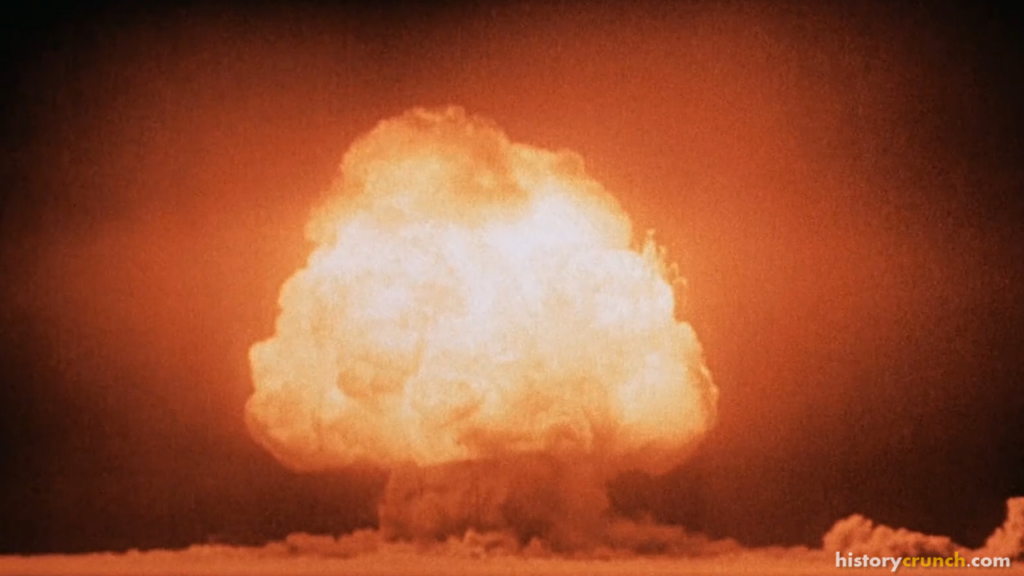
Image of the Mushroom cloud of the 'Gadget' during the Trinity Test. (July 16th, 1945)
Source: Library of Congress© factsthatcrunch.comMore World War II Facts →
World War IIScale
Facts that CrunchFactsthatCrunch

How Big Was the Hiroshima Atomic Bomb's Destruction Zone in World War II? Fire Wiped Out 4.4 Square Miles in Seconds

Hiroshima fire destruction zone: 4.4 sq mi (11.4 sq km)
100Heavy blast damage radius: 3 mi (4.8 km) wide
68Central Park, New York City: 1.3 sq mi (3.4 sq km)
30National Mall, Washington D.C.: 0.14 sq mi (0.36 sq km)
3

The bomb called Little Boy detonated over Hiroshima on August 6th, 1945, and the resulting firestorm burned out roughly everything within a 4.4-square-mile (11.4 sq km) circle in a matter of minutes. The Manhattan Engineer District's post-war survey confirmed that heavy damage extended outward to a radius of 3 miles (4.8 km) from the blast point. By comparison, all of Central Park fits about three times inside that fire zone, and the full length of the National Mall in Washington, D.C. sat well within the range where glass broke.

Source: US National Archives© factsthatcrunch.comMore World War II Facts →
World War IIComparison
Facts that CrunchFactsthatCrunch
Firebombing of Tokyo
U.S. Army Air Forces carried out the raid, not the Navy
Over 300 B-29 Superfortress bombers took part in the main attack on the night of March 9th to 10th, 1945
Incendiary bombs were used, designed to burn wooden buildings across densely packed neighborhoods
The raid killed an estimated 80,000 to 100,000 people in a single night and destroyed about 16 square miles (41 square kilometers) of the city
Atomic Bombings of Japan
Each attack used a single aircraft carrying one bomb, flown by the 509th Composite Group
Hiroshima was struck on August 6th, 1945, and Nagasaki was struck on August 9th, 1945
Nuclear fission released enormous energy in a single explosion, causing blast, heat, and radiation effects
The two bombs together killed an estimated 110,000 to 210,000 people over weeks and months, including deaths from radiation sickness
VS

The firebombing of Tokyo used large numbers of conventional incendiary weapons delivered by a large bomber fleet, while the atomic bombings achieved mass destruction with just one bomb per city. Both campaigns targeted Japanese cities and caused enormous civilian casualties, but they relied on completely different technologies and force sizes.

Source: Library of Congress© factsthatcrunch.comMore World War II Facts →
World War IIQ&A
Facts that CrunchFactsthatCrunch
Q

Why Did Japan Surrender in World War II?

A

Japan's Emperor Hirohito announced his country's surrender on August 15th, 1945, citing the atomic bombings of Hiroshima on August 6th and Nagasaki on August 9th as a key reason the war could not continue. The Soviet Union's declaration of war against Japan on August 8th, 1945, also played a major role, because it eliminated any hope that the Soviets might help broker a negotiated peace. Japan signed the formal surrender documents aboard the USS Missouri on September 2nd, 1945, ending World War II.

Source: Smithsonian Institution© factsthatcrunch.comMore World War II Facts →
World War IIEyewitness
Facts that CrunchFactsthatCrunch
Eyewitness account

From my window, I have a wonderful view down the valley to the edge of the city. Suddenly--the time is approximately 8:14--the whole valley is filled by a garish light which resembles the magnesium light used in photography, and I am conscious of a wave of heat. I jump to the window to find out the cause of this remarkable phenomenon, but I see nothing more than that brilliant yellow light. ... On the way from the window, I hear a moderately loud explosion which seems to come from a distance and, at the same time, the windows are broken in with a loud crash.

FJFather John A. Siemes, German Jesuit priest and professor living at a novitiate just outside Hiroshima
Context

Siemes wrote this account in 1945 at Nagatsuke, about 1.2 miles (2 kilometers) from Hiroshima, describing the moment the atomic bomb exploded over the city on the morning of August 6th, 1945.

Source: John A. Siemes, eyewitness account (1945), US National Archives© factsthatcrunch.comMore World War II Facts →
V-J Day
Japan surrenders, war ends
V-J Day, short for Victory over Japan Day, marks the date when Japan announced its surrender in World War II, ending the war in the Pacific. Japan's Emperor Hirohito broadcast the surrender announcement on August 15th, 1945, and the formal signing took place aboard the USS Missouri in Tokyo Bay on September 2nd, 1945.
Source: National World War II Museum© factsthatcrunch.comFacts that Crunch
World War IIRecord
Facts that CrunchFactsthatCrunch
LARGEST EXPLOSIVE YIELD FROM LEAST FISSIONED MATERIAL

The Little Boy bomb dropped on Hiroshima on August 6th, 1945, held 141 pounds (64 kg) of enriched uranium, yet less than 1 kilogram (2.2 pounds) of that uranium actually fissioned to produce a blast equal to roughly 15,000 tons of TNT.

The bomb used a gun-type design in which one piece of uranium was fired down a barrel into a second piece, combining them into a critical mass. Despite its deep inefficiency, the energy released leveled most of Hiroshima and left a mushroom cloud rising above 40,000 feet (12 km). It was the first nuclear weapon ever used in combat.

Source: US National Archives© factsthatcrunch.comMore World War II Facts →
World War IIThen and Now
Facts that CrunchFactsthatCrunch
Then

After the atomic bomb detonated over Hiroshima on August 6th, 1945, the city's Hiroshima Peace Memorial, then known as the Hiroshima Prefectural Industrial Promotion Hall, was left standing as a skeletal ruin roughly 490 feet (150 meters) from the explosion's center. The building had been a busy commercial and exhibition space before the bombing, and its dome-topped frame became one of the few structures near the hypocenter that did not collapse completely. In the years immediately after the war, debate continued over whether to demolish the ruin or preserve it.

Now

Today the building stands as the Atomic Bomb Dome and was designated a UNESCO World Heritage Site on December 5th, 1996, making it a permanent reminder of nuclear destruction. Hiroshima itself has grown into a city of about 1.2 million people, with rebuilt neighborhoods, universities, and a busy port along the Ota River delta. The Hiroshima Peace Memorial Museum, which opened in 1955, receives hundreds of thousands of visitors each year from around the world.

The preserved ruin at the hypocenter and the rebuilt city around it together show how a place can carry both the memory of destruction and the reality of recovery at the same time.

Source: Smithsonian Institution© factsthatcrunch.comMore World War II Facts →
World War IINotebook T-Chart
Facts that CrunchFactsthatCrunch
Dropping the Atomic Bombs on Japan, 1945: Arguments For and Against
Arguments For
A land invasion of Japan was expected to cause hundreds of thousands of American casualties.
Japan had not surrendered after firebombing campaigns destroyed dozens of its cities.
Military planners estimated the war could last well into 1946 without a new strategy.
The bombs ended the war quickly, stopping daily Allied losses across the Pacific.
Secretary Stimson and other leaders believed no other option would force a fast surrender.
Arguments Against
Hiroshima and Nagasaki together killed an estimated 110,000 to 210,000 civilians.
Critics argued Japan was close to surrender because Soviet entry into the war changed the situation.
General Eisenhower and some other commanders said the bombs were not needed to end the war.
Radiation sickness caused deaths and illness for decades after the blasts, beyond the immediate toll.
The bombings set a precedent for nuclear weapons as tools of war that still affects global policy.
Source: National Archives© factsthatcrunch.comMore World War II Facts →
World War IIIcebergInteractive
Facts that CrunchFactsthatCrunch

What do most students know about the atomic bombing of Japan in 1945, and what facts are harder to find?

Most People Know Two Bombs Were Dropped on Japan in August 1945, Ending World War II in the Pacific. The B-29 bomber that dropped the Hiroshima bomb was named Enola Gay, piloted by Colonel Paul Tibbets, who named the plane after his mother. The flight took off from Tinian Island in the Pacific.
The Bombs Used Different Designs. The Hiroshima bomb, Little Boy, used uranium-235. The Nagasaki bomb, Fat Man, used plutonium and a different internal design called implosion. Scientists had enough confidence in Little Boy's design to skip a full test.
A Practice Mission Flew the Same Route. On July 31st, 1945, American crews flew a rehearsal mission over Japan carrying pumpkin-shaped conventional bombs of the same weight and shape as the atomic bombs, to train pilots and ground crews.
Japan's Supreme War Council Was Split. After the Hiroshima bombing, Japan's six-member Supreme War Council voted three to three on surrender. Only the personal intervention of Emperor Hirohito on August 10th, 1945, broke the deadlock in favor of accepting Allied terms.
A Third Bomb Was Being Prepared. A third plutonium bomb was being readied and could have been available by late August 1945. Secretary of War Henry Stimson halted further atomic strikes on August 10th, 1945, pending a direct order from President Truman.
Tap a layer to read its detail.
Most People Know Two Bombs Were Dropped on Japan in August 1945, Ending World War II in the Pacific.The B-29 bomber that dropped the Hiroshima bomb was named Enola Gay, piloted by Colonel Paul Tibbets, who named the plane after his mother. The flight took off from Tinian Island in the Pacific.
The Bombs Used Different Designs.The Hiroshima bomb, Little Boy, used uranium-235. The Nagasaki bomb, Fat Man, used plutonium and a different internal design called implosion. Scientists had enough confidence in Little Boy's design to skip a full test.
A Practice Mission Flew the Same Route.On July 31st, 1945, American crews flew a rehearsal mission over Japan carrying pumpkin-shaped conventional bombs of the same weight and shape as the atomic bombs, to train pilots and ground crews.
Japan's Supreme War Council Was Split.After the Hiroshima bombing, Japan's six-member Supreme War Council voted three to three on surrender. Only the personal intervention of Emperor Hirohito on August 10th, 1945, broke the deadlock in favor of accepting Allied terms.
A Third Bomb Was Being Prepared.A third plutonium bomb was being readied and could have been available by late August 1945. Secretary of War Henry Stimson halted further atomic strikes on August 10th, 1945, pending a direct order from President Truman.
Source: Library of Congress© factsthatcrunch.comMore World War II Facts →
Test Yourself
World War IIDecision PointInteractive
Facts that CrunchFactsthatCrunch
DECISION POINT

It is the morning of August 6th, 1945, and you are President Harry S. Truman, leader of the United States at the final stage of World War II in the Pacific. The Manhattan Project has successfully tested an atomic bomb, and your military advisors have told you that a land invasion of Japan could cost hundreds of thousands of American lives and potentially millions of Japanese lives. You must decide right now whether to authorize the use of the atomic bomb against Hiroshima, a major Japanese military and industrial city, knowing that no weapon like it has ever been used in war and that civilian casualties will be enormous.

History turned on this choice. What would you have done?
As President Truman on August 6th, 1945, what do you do?
Choose a path. Each choice opens a different future.
Your move
Pick option A, B, or C to walk down that path.
If you choose A
The city will be devastated and tens of thousands of civilians will die instantly, but Japan may surrender quickly, avoiding a land invasion.
If you choose B
The war could drag on for months or years, causing large casualties on both sides, with no guarantee Japan surrenders before a ground invasion is needed.
If you choose C
Japan might accept, ending the war without atomic casualties, but military advisors warn Japan's leaders have so far refused to surrender and may treat the offer as weakness.
What really happened
Truman authorized the bombing, and the B-29 Enola Gay dropped the first atomic bomb on Hiroshima on August 6th, 1945, killing an estimated 70,000 to 80,000 people immediately and tens of thousands more in the following months. A second bomb was dropped on Nagasaki on August 9th, 1945, and Japan announced its surrender on August 15th, 1945, formally signing surrender documents on September 2nd, 1945. Historians continue to debate whether the bombings were necessary to end the war or whether other options, including a negotiated peace that preserved the emperor's role, might have worked.
Source: National Archives© factsthatcrunch.comMore World War II Facts →
World War II

Which factor most directly caused Japan to announce its surrender on August 15th, 1945?

Tap an option.
ExplanationEmperor Hirohito's recorded surrender address on August 15th, 1945, cited the sudden and cruel bomb and the new war situation, but Japanese government records and postwar testimony show that the Soviet declaration of war on August 8th, 1945, shattered Japan's last hope of negotiating peace through Moscow, pushing the emperor and his council to accept surrender. The naval blockade, the firebombing, and the fall of Okinawa had all weakened Japan severely but had not produced a surrender decision on their own.
Source: National Archives and Records Administration© factsthatcrunch.comFacts that Crunch

Sources

Explore More Topics
Explore More Topics