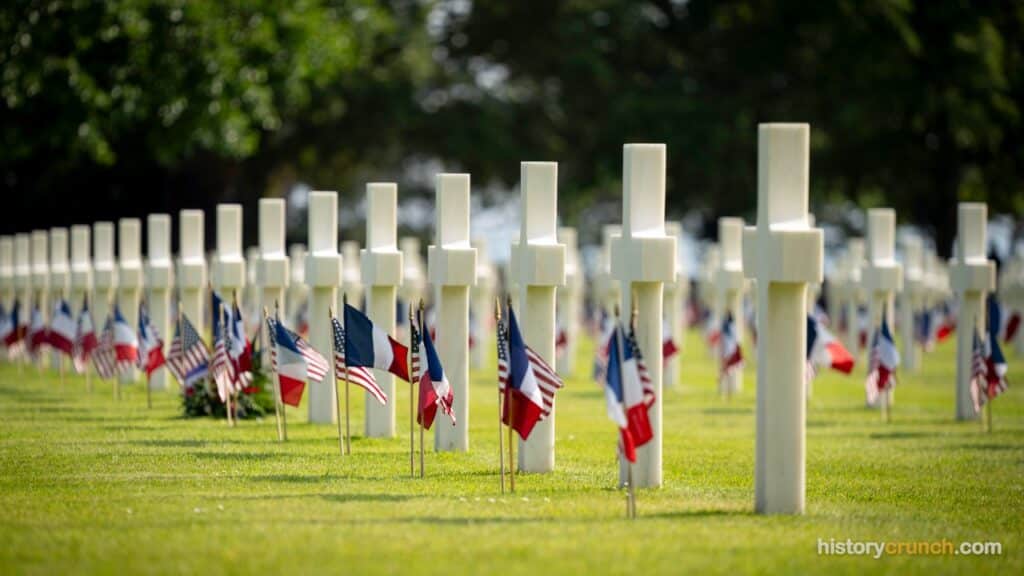
European Theater of World War II Facts

Quick facts on the European Theater of World War II, covering key battles and turning points from Poland to the Battle of the Bulge.

The European Theater of World War II shaped the political and physical map of Europe more than any other conflict in the 20th century. The fights covered here, from Germany's invasion of Poland in 1939 to the last major German offensive in the winter of 1944 to 1945, show how the war shifted in scale and momentum over six years. These cards give the key facts on each major event so students can study or review quickly without sorting through a long article. Related: Causes of World War II and Battle of the Bulge.

Invasion of Poland

Germany's attack on Poland on September 1st, 1939 brought Britain and France into the war and set the military and political terms that shaped the entire European conflict. Poland was divided between Germany and the Soviet Union within weeks, establishing the pattern of rapid territorial conquest that would define the war's early years. The speed and coordination of the German assault also showed the rest of Europe what modern mechanized warfare could do.

World War IIPrimary Source
Facts that CrunchFactsthatCrunch

You can imagine what a bitter blow it is to me that all my long struggle to win peace has failed. Yet I cannot believe that there is anything more or anything different that I could have done and that would have been more successful.

Neville Chamberlain · Cabinet Room, 10 Downing Street, London · September 3rd, 1939

British Prime Minister Neville Chamberlain spoke these words in a radio broadcast at 11:15 a.m. on the 3rd of September, 1939, two days after Germany invaded Poland. Earlier that morning, Britain had demanded that Germany pull its troops out of Poland, and Germany gave no answer, so Britain was now at war. In this passage Chamberlain admits that his years of work to keep the peace, including his policy of appeasement, had failed.

Source: BBC radio broadcast, September 3rd, 1939© factsthatcrunch.comMore World War II Facts →
World War IIScale
Facts that CrunchFactsthatCrunch

What Share of Its Population Did Poland Lose in World War II? About 1 in 6 Polish Citizens Died, the Highest Rate in Europe

Poland (~17%)
5.6–6M of 35.1M peopleSoviet Union (~14%)
~27M of ~194M peopleGermany (~10%)
~7.4M of ~70M peopleFrance (~1.5%)
~600K of ~40M peopleUnited States (~0.3%)
~420K of ~132M people

Scholars estimate that between 5.5 and 6 million Polish citizens died during World War II, out of a prewar population of about 35.1 million. More than 90 percent of those deaths were civilian, not military. Poland's losses as a share of its total population were higher than those of any other European country.

Source: Smithsonian Institution© factsthatcrunch.comMore World War II Facts →
World War IIDate
Facts that CrunchFactsthatCrunch
1
September 1939

Germany Sends 60 Divisions Into Poland, Opening World War II in Europe

Germany launched its invasion of Poland before dawn on September 1st, 1939, deploying 60 divisions and close to 1.5 million soldiers along the border. The attacking force included more than 2,000 tanks and nearly 900 bombers, which struck Polish airfields and cities from the first hours of the assault. Poland's army was not fully mobilized and was heavily outnumbered, and its air force of roughly 300 planes was largely destroyed within the first few days of fighting.
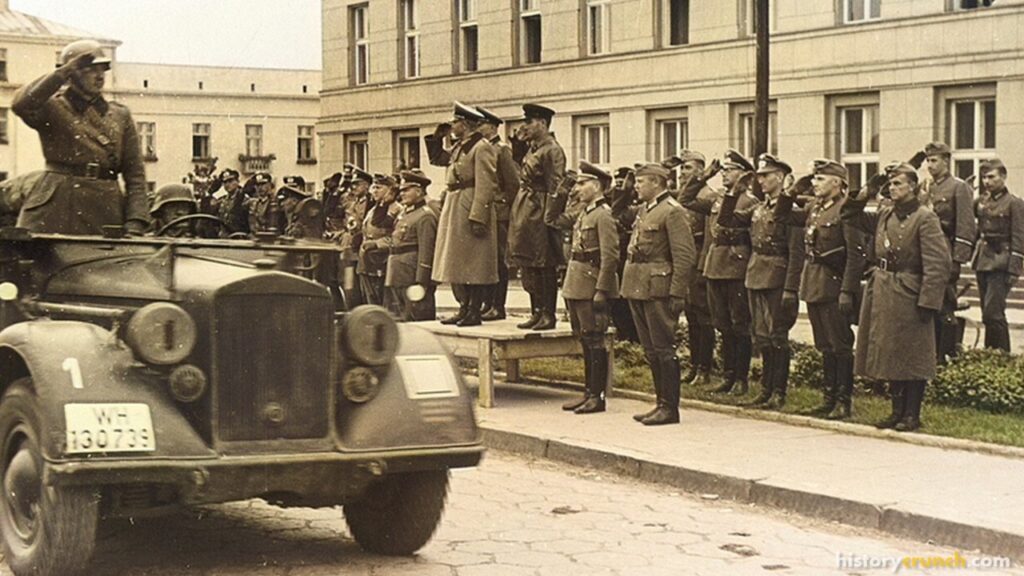
German and Soviet troops hosting a joint parade following the invasion of Poland. (Colorized by historycrunch.com)
Source: UNESCO© factsthatcrunch.comMore World War II Facts →
World War IINotebook Definition
Facts that CrunchFactsthatCrunch
Wehrmacht
(noun)
The Wehrmacht was the unified armed forces of Nazi Germany from 1935 to 1945, made up of the army, navy, and air force under a single command. It replaced the older Reichswehr when Adolf Hitler publicly restored military conscription in March 1935.
in a sentence: The Wehrmacht invaded Poland on September 1st, 1939, starting the war in Europe.
Source: National WWII Museum© factsthatcrunch.comMore World War II Facts →
World War IICorkboard Timeline
Facts that CrunchFactsthatCrunch
How World War II Started in Europe
1933 to 1939
1935
February 16th, 1935
Germany publicly announced the existence of the Luftwaffe, its air force, breaking a key military limit set by the Versailles Treaty.
1935
March 16th, 1935
Hitler brought back military conscription in Germany, rebuilding the army to a size the Versailles Treaty had forbidden.
1936
March 29th, 1936
German voters approved Hitler's remilitarization of the Rhineland in a national referendum, with the government reporting over 98 percent in favor.
1938
September 30th, 1938
Britain, France, Italy, and Germany signed the Munich Agreement, giving Germany the Sudetenland region of Czechoslovakia in exchange for a promise of no further territorial demands.
1939
March 15th, 1939
German forces occupied the remainder of Czechoslovakia, breaking the promise Hitler had made at Munich six months earlier.
1939
August 25th, 1939
Britain and Poland signed a formal mutual defense treaty, committing Britain to defend Poland if it was attacked.
A timeline pinned to the board.
Source: National Archives© factsthatcrunch.comMore World War II Facts →
World War IIPhoto Analysis
Facts that CrunchFactsthatCrunch
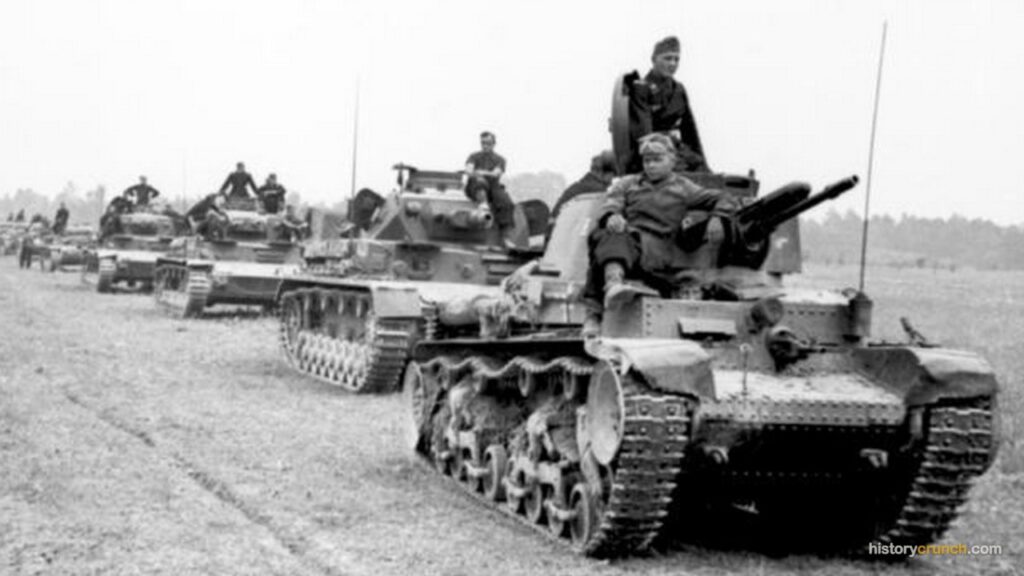
A column of German Panzer tanks advances along a dirt road during World War II, with crew members riding on top of the vehicles and infantry soldiers visible on the left side of the road.
German Panzer Column on the Move, World War II
Look closely
The photo shows a column of German Panzer tanks moving in single file along a flat dirt road.
Crew members sit on top of the hulls rather than inside the vehicles.
Infantry soldiers are visible along the left side of the road, marching alongside the tanks.
The context
German armored columns like this one were a central part of the Blitzkrieg method Germany used from 1939 onward.
Tanks, infantry, and motorized units moved together at speed to break through enemy lines and encircle opposing forces.
This approach allowed Germany to overrun Poland in September 1939, then France and the Low Countries by June 1940.
What it tells us
Crew members riding on the outside of their tanks rather than inside them suggests the column was moving through territory that was not under active fire, since open hatches and exposed riders would be dangerous in combat.
The mix of tanks and foot soldiers in the same frame shows how Panzer operations depended on combined arms, not tanks alone.
Photos like this were often used in German military newspapers and newsreels to project an image of speed and strength to both German citizens and enemy nations.
Source: National WWII Museum© factsthatcrunch.comMore World War II Facts →
World War IIComparison
Facts that CrunchFactsthatCrunch
Blitzkrieg
Germany used fast-moving armor, motorized infantry, and air support together to break through enemy lines quickly.
Panzer divisions advanced dozens of miles in a single day, bypassing strongpoints rather than stopping to fight them.
The goal was to surround and cut off enemy forces before they could regroup or resupply.
Germany used Blitzkrieg to defeat France in about six weeks in May and June 1940.
Trench Warfare
Armies on the Western Front in World War I dug networks of trenches stretching roughly 440 miles (708 kilometers) from Belgium to Switzerland.
Both sides faced each other across a narrow strip called no man's land, often only a few hundred yards wide.
Attacking forces crossed open ground under machine gun and artillery fire, gaining very little ground at enormous cost.
Front lines barely moved for months or years at a time, making the conflict a slow war of attrition.
VS

Trench warfare locked World War I into a nearly static stalemate where territory was measured in yards. Blitzkrieg was developed partly in response to that experience, using speed and coordination to prevent a static front from forming at all.

Source: US National Archives© factsthatcrunch.comMore World War II Facts →
World War IIDefinition
Facts that CrunchFactsthatCrunch
Blitzkrieg
German for 'lightning war'

Blitzkrieg was a military method used by Germany in World War II that combined fast-moving tanks, motorized infantry, and close air support to break through enemy lines quickly. The goal was to move so fast that the enemy could not organize a defense or move troops in time. Germany used this method to defeat Poland in about five weeks in 1939 and France in about six weeks in 1940.

"When German forces swept into France in May 1940, the speed and coordination of Blitzkrieg left Allied commanders unable to respond before large parts of the French army were cut off."
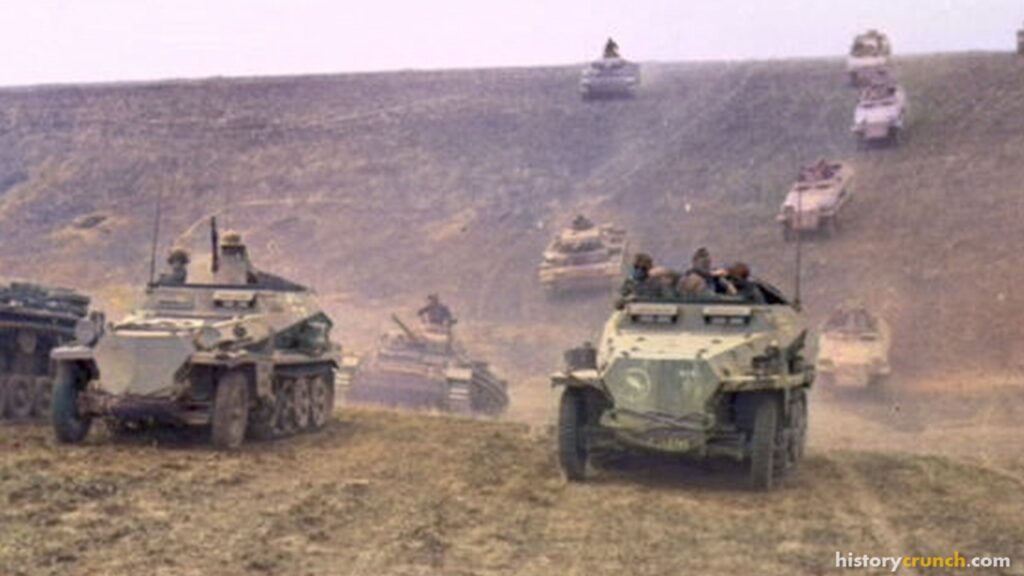
Tanks and mechanized infantry of the 24th Panzer Division advancing through Ukraine in June of 1942. (Colorized by historycrunch.com)
Source: UNESCO© factsthatcrunch.comMore World War II Facts →
World War IITurning Point
Facts that CrunchFactsthatCrunch
Germany's Invasion of Poland, September 1st, 1939
What Happened

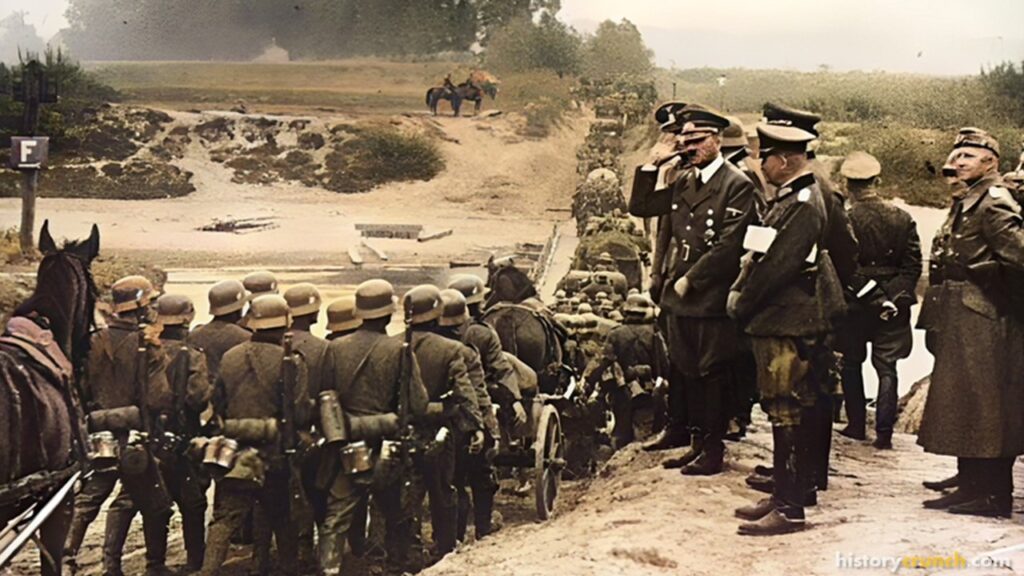
At 4:45 a.m. on September 1st, 1939, German forces crossed the Polish border along multiple fronts, and two days later Britain and France declared war on Germany, turning a regional attack into a full European war.

Before

Germany had seized territory through threats and diplomacy; no European power had yet declared war on it

After

A state of war existed between Germany and the major Western European powers, making large-scale armed conflict unavoidable
Source: Library of Congress© factsthatcrunch.comMore World War II Facts →
Test Yourself
World War IIMatchingInteractive
Facts that CrunchFactsthatCrunch

Which definition fits each Battle of the Bulge term?

Tap a term, then tap its match.
Source: UNESCO© factsthatcrunch.comMore World War II Facts →
World War IIWhat Happened NextInteractive
Facts that CrunchFactsthatCrunch
What happened next?

In the European Theater of World War II, German forces surrounded the city of Leningrad in September 1941 and began a siege that had ground on for nearly 900 days. By early January 1944, Soviet forces under General Kirill Meretskov had massed armies along the southern shore of Lake Ladoga and were preparing a massive offensive to push the Germans back from the city. The Soviet troops were in position, the attack orders had been issued, and the fate of Leningrad's starving population hung on what happened in the next few days.

Three futures. One is real. Tap your call.
What actually happenedThe Leningrad-Novgorod Offensive, launched on January 14th, 1944, succeeded rapidly. Soviet forces shattered German Army Group North's front lines and fully lifted the siege by January 27th, 1944, ending nearly 900 days of blockade that had killed roughly 800,000 civilians through starvation and bombardment. The victory secured the city and allowed Soviet forces to advance toward the Baltic states.
Source: Saint Petersburg State Museum of the History of Saint Petersburg© factsthatcrunch.comMore World War II Facts →

Sources

Explore More Topics

Phoney War

After Britain and France declared war on Germany in September of 1939, almost no large-scale fighting took place on the Western Front for about eight months. Both sides positioned forces and prepared, but neither launched a major ground offensive. That period of waiting shaped how Allied commanders thought about the war, and its abrupt end in May of 1940 caught them badly off guard.

World War IIQ&A
Facts that CrunchFactsthatCrunch
Q

What Was the Phoney War in World War II?

A

The Phoney War was a period of about eight months, from September 1939 to May 1940, when Britain and France were officially at war with Germany but almost no major fighting happened on the Western Front. After Germany invaded Poland, the Western Allies declared war but held back from launching large attacks, and Germany focused on securing Poland rather than pushing west. The quiet period ended in April and May 1940 when Germany invaded Denmark, Norway, the Netherlands, Belgium, and France in quick succession.
Source: Smithsonian Institution© factsthatcrunch.comMore World War II Facts →
Maginot Line
French border defense wall
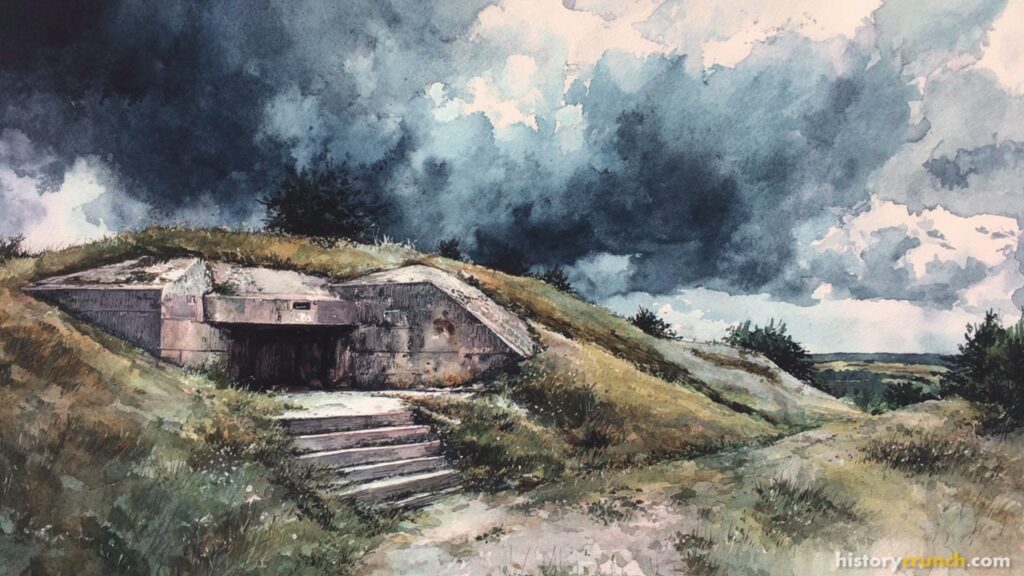
The Maginot Line was a long system of concrete forts, bunkers, and underground tunnels that France built along its border with Germany during the 1930s. France spent heavily to construct it after the losses of World War I, but Germany bypassed it in May 1940 by sending troops through Belgium and the Ardennes forest instead.
The Maginot Line was a World War II era line of defenses in France, intended to protect the country from a potential German attack.
Source: National World War II Museum© factsthatcrunch.comFacts that Crunch
World War IINotebook T-Chart
Facts that CrunchFactsthatCrunch
The Phoney War in World War II: What Each Side Did and Did Not Do
Allied Side
Britain and France declared war on Germany on September 3rd, 1939, but sent no major ground attack.
The RAF dropped millions of leaflets over Germany, choosing propaganda over bombs in the early weeks.
France mobilized troops along the Maginot Line but ordered them to hold position and not advance.
Britain sent the British Expeditionary Force to France, yet it saw almost no combat through early 1940.
Allied commanders spent the winter planning defensive positions rather than pressing any offensive.
German Side
Germany held its forces in the west after Poland fell, avoiding a large two-front ground war right away.
The Kriegsmarine attacked Allied shipping in the Atlantic, making the sea far more dangerous than the land front.
Germany used the quiet months to rest and refit its armies after the fast and costly Polish campaign.
The Luftwaffe flew reconnaissance flights over France and Britain but launched no sustained air campaign.
By April 1940, Germany ended the quiet period by invading Denmark and Norway, breaking the stalemate.
Source: Imperial War Museums© factsthatcrunch.comMore World War II Facts →
Test Yourself
World War IISequenceInteractive
Facts that CrunchFactsthatCrunch

In what order did these key events of the Phoney War unfold?

Use the arrows to put these in the right order, then tap Check order.
123456
Britain and France declare war on Germany but launch no major land offensive
Britain and France agree to send aid to Finland through Scandinavia
Britain lands troops in Norway but is forced to withdraw
The Soviet Union invades Finland, starting the Winter War
Germany launches its full invasion of France and the Low Countries
Germany invades Denmark and Norway
Source: UNESCO© factsthatcrunch.comMore World War II Facts →
World War II

During the Phoney War, Britain and France did nothing to prepare for combat while Germany focused entirely on Poland.

Myth or fact? Tap your call.
The truthBritain and France spent the Phoney War period expanding their armies and increasing war production, and Germany itself used the months after Poland fell to regroup, resupply, and plan its western offensive before attacking France and the Low Countries in May 1940.
Source: Imperial War Museums© factsthatcrunch.comFacts that Crunch

Sources

Explore More Topics

Battle of France

Germany's campaign against France, Belgium, and the Netherlands in the spring of 1940 overturned assumptions that France's military and fortified borders could hold back a German advance. The fall of France in June of 1940 left Britain as the only major Allied power still fighting in Western Europe. That shift placed enormous strain on British resources and forced a complete rethinking of Allied strategy.
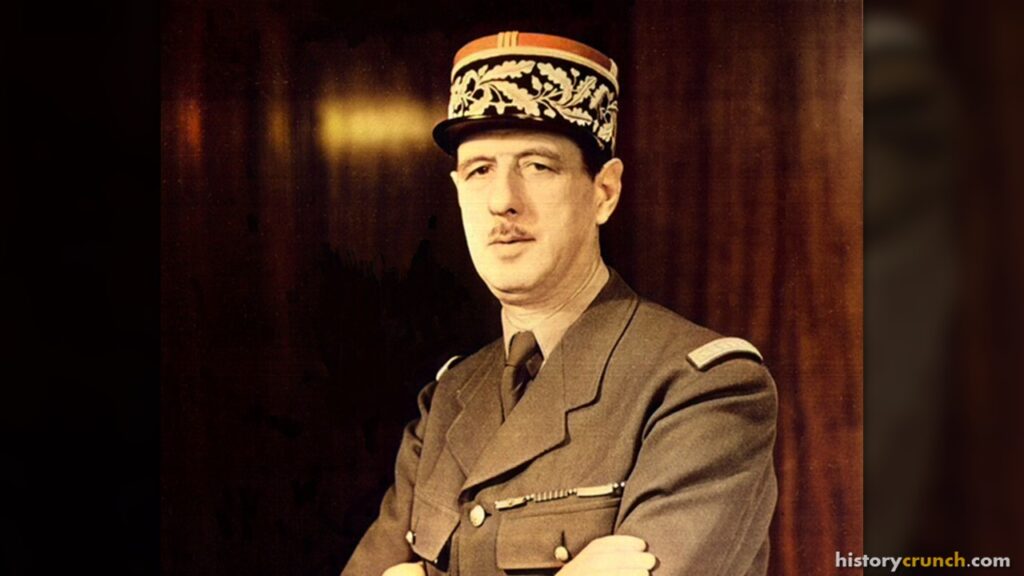
But has the last word been said? Must hope disappear? Is defeat final? No! Whatever happens, the flame of the French resistance must not be extinguished and will not be extinguished.
Charles de Gaulle
French general, BBC radio broadcast from London, June 18th, 1940
German forces had just defeated France, and the new French government under Marshal Petain was asking for an armistice. De Gaulle, a little-known general who had escaped to Britain, used this radio appeal to urge the French to keep fighting, and it became the founding moment of the Free French movement.
Charles de Gaulle in 1942. (Colorized by historycrunch.com)
Source: Imperial War Museums© factsthatcrunch.com
World War IIDefinition
Facts that CrunchFactsthatCrunch
Panzer
German word meaning 'armor' or 'armored'

Panzer is a German term used in World War II to describe armored fighting vehicles, especially tanks, and the military units built around them. Germany organized its tanks into panzer divisions, which combined tanks, motorized infantry, artillery, and support troops into fast-moving strike forces. These divisions were designed to break through enemy lines quickly and keep moving before defenders could regroup.

"During the invasion of France in May 1940, German panzer divisions crossed the Ardennes region and reached the English Channel in less than two weeks, cutting off Allied forces in the north."
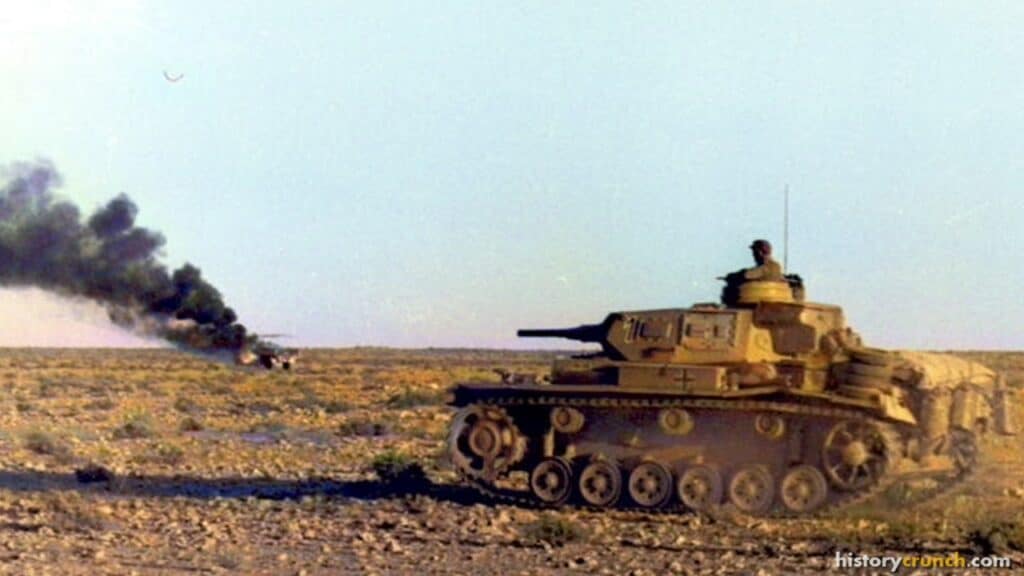
German Panzer during Operation Sonnenblume in April of 1941 in the North African Theater of World War II. (Colorized by historycrunch.com)
Source: Smithsonian Institution© factsthatcrunch.comMore World War II Facts →
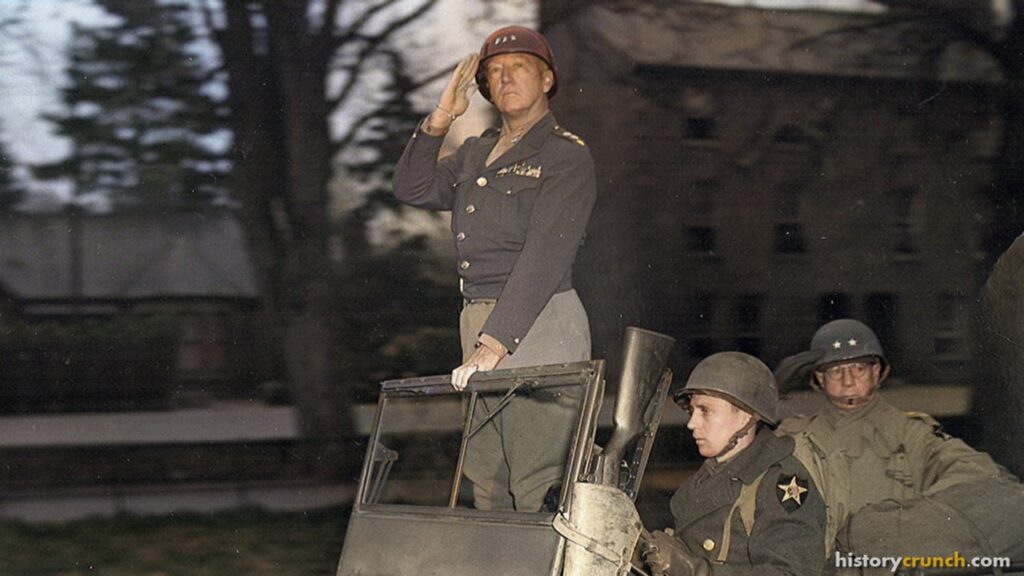
Fixed fortifications are monuments to the stupidity of man. If mountain ranges and oceans can be overcome, anything made by man can be overcome.
General George S. Patton
U.S. Army general, in his memoir War As I Knew It, published 1947
France built the Maginot Line, a chain of concrete forts along its border with Germany, but in May 1940 German forces simply went around it through the Ardennes forest and Belgium. Patton pointed to that failure to argue that armies win by moving fast, not by hiding behind walls.
George S. Patton standing in an army jeep in April of 1944. (Colorized by historycrunch.com)
Source: National WWII Museum© factsthatcrunch.com
World War IIBulletin Board BioInteractive
Facts that CrunchFactsthatCrunch
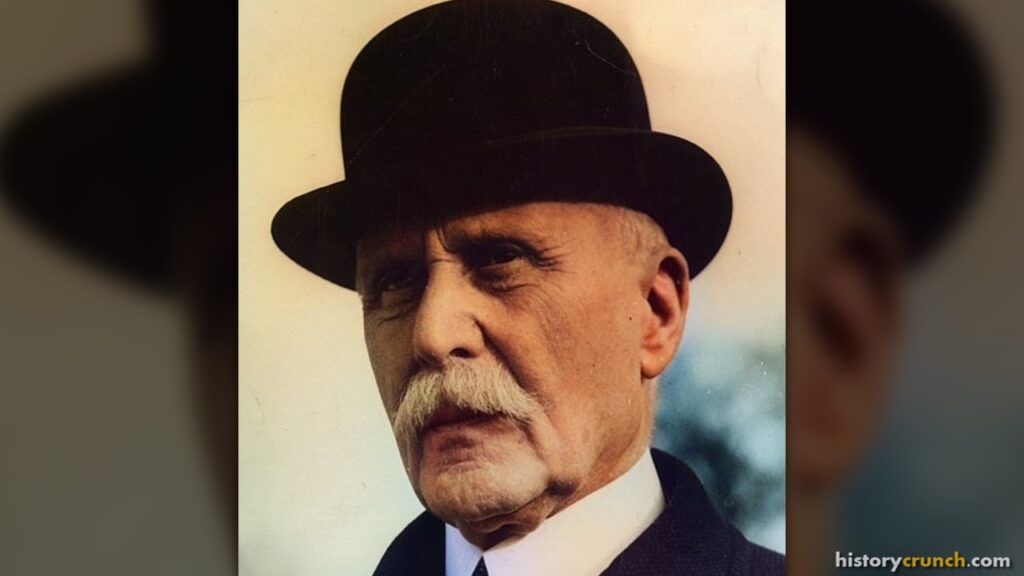
Philippe Pétain in 1940. (Colorized by historycrunch.com)
Philippe Petain
At a Glance
BornApril 24th, 1856, in Cauchy-a-la-Tour, Pas-de-Calais, France
DiedJuly 23rd, 1951, on the Ile d'Yeu, Vendee, France
RoleFrench military hero of World War I and head of the Vichy French government during World War II
Tap a heading to open the note.
World War I Hero
Petain became a national hero in France after commanding the successful defense of Verdun in 1916, one of the longest battles of World War I.
Armistice with Germany
After Germany defeated France in June 1940, Petain signed an armistice on June 22nd, 1940, that divided France into an occupied zone under German control and an unoccupied zone governed from the city of Vichy.
Head of Vichy France
The French National Assembly voted on July 10th, 1940, to give Petain full governing powers, making him head of state of what became known as Vichy France.
Collaboration Policy
Petain's government cooperated with Nazi Germany, including helping to round up Jewish people in France for deportation to German camps.
Trial and Sentence
After the war ended, a French court found Petain guilty of treason on August 15th, 1945, and sentenced him to death. General Charles de Gaulle commuted the sentence to life in prison because of Petain's age.
Final Years in Prison
Petain was held at the Fort du Portalet and later on the Ile d'Yeu, where he died on July 23rd, 1951, at the age of 95.
Source: National WWII Museum© factsthatcrunch.comMore World War II Facts →
I would say to the House, as I said to those who have joined this Government: I have nothing to offer but blood, toil, tears and sweat.
Winston Churchill
Prime Minister of the United Kingdom, first speech to the House of Commons, May 13th, 1940
Churchill became prime minister on May 10th, 1940, the same day Germany invaded France, Belgium, the Netherlands, and Luxembourg. Three days later he gave this speech asking Parliament to back his new government, and it set an honest, determined tone for Britain's fight.
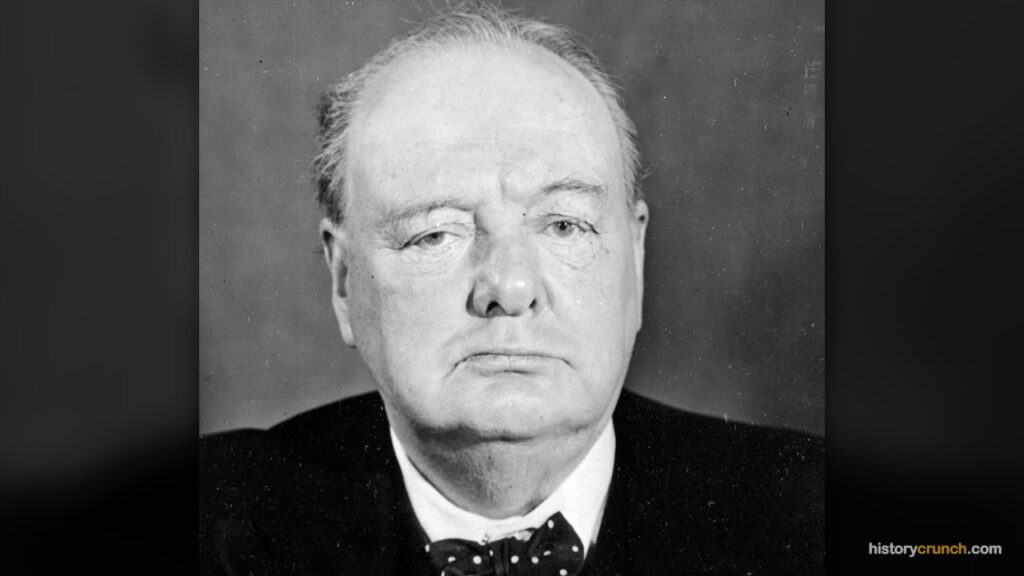
Winston Churchill served as Prime Minister of the United Kingdom during World War II and worked closely with Allied leaders to shape the war effort and postwar plans.
Source: Imperial War Museums© factsthatcrunch.com
World War IIQuote
Facts that CrunchFactsthatCrunch

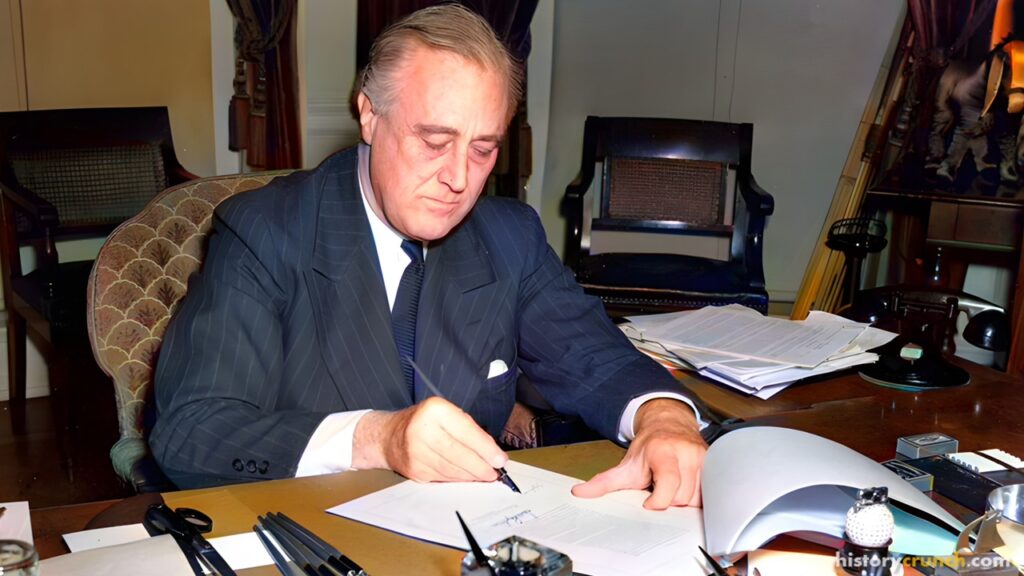
On this tenth day of June, 1940, the hand that held the dagger has struck it into the back of its neighbor. On this tenth day of June, 1940, in this University founded by the first great American teacher of democracy, we send forth our prayers and our hopes to those beyond the seas who are maintaining with magnificent valor their battle for freedom.

FD
Franklin D. RooseveltPresident of the United States, 1933 to 1945, June 10th, 1940, commencement address at the University of Virginia, hours after Italy declared war on France
Why it matters

Speaking live on national radio, Roosevelt condemned Mussolini's attack on a collapsing France and rallied Americans behind a new policy of sending material aid to the nations fighting the Axis, a clear step away from strict neutrality.
Source: Address at the University of Virginia, 1940, FDR Presidential Library© factsthatcrunch.comMore World War II Facts →
On this tenth day of June, 1940, the hand that held the dagger has struck it into the back of its neighbor. On this tenth day of June, 1940, in this University founded by the first great American teacher of democracy, we send forth our prayers and our hopes to those beyond the seas who are maintaining with magnificent valor their battle for freedom.
Franklin D. Roosevelt
President of the United States, commencement speech at the University of Virginia, June 10th, 1940
That same day, Italy under Benito Mussolini declared war on France while German armies were already overrunning the country. Roosevelt's dagger image condemned Italy's attack and showed the United States moving away from strict neutrality toward open support for the Allies.
President Franklin D. Roosevelt signs the Lend-Lease bill to give aid to Britain and China. (March of 1941) (Colorized by historycrunch.com)
Source: Franklin D. Roosevelt Presidential Library© factsthatcrunch.com
Maginot Line
About 280 miles (450 km) of fortifications built from 1930 to 1936 along France's border with Germany, costing roughly 3 billion French francs
VS
Atlantic Wall
About 1,670 miles (2,685 km) of coastal defenses built from 1942 to 1944 along Western Europe's Atlantic coast, using an estimated 17 million cubic yards (13 million cubic meters) of concrete
The Maginot Line held where it stood, but Germany bypassed it through Belgium in May 1940, making its fixed design irrelevant. The Atlantic Wall covered far more coastline yet was thinly manned in many sectors, and Allied deception operations helped direct the main D-Day landings toward a gap in its defenses at Normandy on June 6th, 1944.
Source: National WWII Museum© factsthatcrunch.comFacts that Crunch
World War IIQ&A
Facts that CrunchFactsthatCrunch
Q

Why Did France Fall So Quickly in 1940?

A

France fell in roughly six weeks because Germany bypassed the heavily defended Maginot Line by sending armored divisions through the Ardennes forest, a route French commanders had considered nearly impassable. This attack, launched on May 10th, 1940, cut off Allied forces in Belgium and trapped them near the English Channel. French military planning relied on a slow, defensive style of war from World War I, so commanders could not respond fast enough to Germany's rapid armored advance.

Source: Library of Congress© factsthatcrunch.comMore World War II Facts →
World War IIBulletin Board BioInteractive
Facts that CrunchFactsthatCrunch
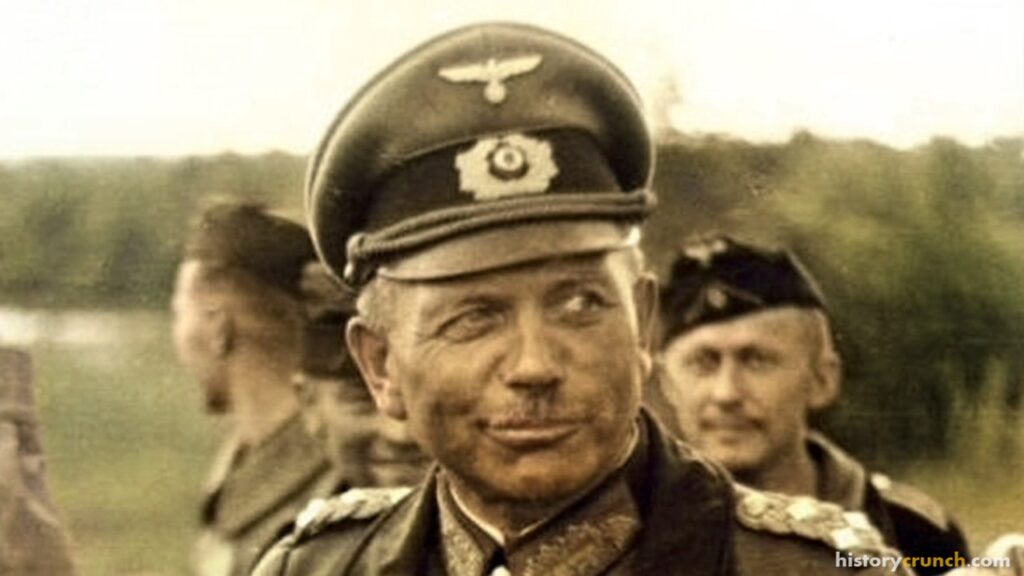
Heinz Guderian in July of 1941. (Colorized by historycrunch.com)
Heinz Guderian
At a Glance
BornJune 17th, 1888, in Kulm, West Prussia, German Empire (present-day Chelmno, Poland)
DiedMay 14th, 1954, in Schwangau, Bavaria, West Germany
RoleGerman General and Pioneer of Armored Warfare
Tap a heading to open the note.
Early Career
Guderian served as a signals officer in World War I, and his experience with communications shaped his later ideas about fast, coordinated tank attacks.
Blitzkrieg Architect
Guderian developed and promoted the theory of armored warfare in the 1930s, arguing that tanks should mass together and strike fast rather than support infantry slowly.
France 1940
During the invasion of France in May 1940, Guderian's panzer corps crossed the Meuse River at Sedan and drove to the English Channel in about ten days, splitting Allied forces in two.
Operation Barbarossa
In the summer of 1941, Guderian commanded the 2nd Panzer Group during the invasion of the Soviet Union and drove hundreds of miles east in the opening weeks of the campaign.
Relieved of Command
Hitler relieved Guderian of command in December 1941 after Guderian ordered a retreat near Tula without permission, a decision Hitler refused to accept.
Memoirs
After the war, Guderian wrote a memoir titled 'Panzer Leader,' published in 1950, which became a widely read account of armored warfare on the Eastern and Western Fronts.
Source: National Archives and Records Administration© factsthatcrunch.comMore World War II Facts →
World War IICorkboard Timeline
Facts that CrunchFactsthatCrunch
Fall of France in World War II
May to June 1940
1940
May 13th, 1940
German armored forces crossed the Meuse River at Sedan, breaking through French defenses and opening a path into northern France.
1940
May 20th, 1940
German tank columns reached the English Channel coast near Abbeville, cutting off Allied forces in Belgium from the rest of France.
1940
May 26th, 1940
The British began Operation Dynamo, evacuating Allied troops from the beaches at Dunkirk; the operation ran until June 4th and rescued about 338,000 soldiers.
1940
June 5th, 1940
Germany launched Fall Rot, the second phase of its offensive, driving south into France with roughly 140 divisions.
1940
June 14th, 1940
German troops entered Paris; the French government had already left the city and moved south to Bordeaux.
1940
June 22nd, 1940
France signed an armistice with Germany at Compiegne, in the same railway car used for the 1918 armistice, ending organized French military resistance.
A timeline pinned to the board.
Source: National Army Museum, London© factsthatcrunch.comMore World War II Facts →
World War IIComparison Table
Facts that CrunchFactsthatCrunch

German and Allied forces entered the Battle of France in May 1940 with different strengths in command approach, armor use, air support, and troop numbers.

GermanyAllied Forces (France, Britain, Belgium)
Tanks availableabout 2,439about 3,384
Armor strategyconcentrated in fast-moving groups (Panzer divisions)spread across infantry units
Air supportLuftwaffe closely coordinated with ground troopslimited coordination between air and ground
Command structureunified under OKW, fast decisionssplit among French, British, and Belgian commands
Troops committedabout 3 millionabout 3.3 million
Campaign length46 days (May 10th to June 25th, 1940)46 days before armistice
Germany
Tanks available
about 2,439
Armor strategy
concentrated in fast-moving groups (Panzer divisions)
Air support
Luftwaffe closely coordinated with ground troops
Command structure
unified under OKW, fast decisions
Troops committed
about 3 million
Campaign length
46 days (May 10th to June 25th, 1940)
Allied Forces (France, Britain, Belgium)
Tanks available
about 3,384
Armor strategy
spread across infantry units
Air support
limited coordination between air and ground
Command structure
split among French, British, and Belgian commands
Troops committed
about 3.3 million
Campaign length
46 days before armistice
Source: US National Archives© factsthatcrunch.comMore World War II Facts →
World War IIBy the Numbers
Facts that CrunchFactsthatCrunch

The Battle of France lasted only 46 days, yet it ended with France defeated, Paris occupied, and the entire Allied position in Western Europe collapsed.

46 Days
Duration of the battle
~90,000
French troops killed
~1.8 Million
French troops captured
~27,000
German troops killed
2,233
Allied aircraft lost
1,236
German aircraft lost
Germany launched its attack on May 10th, 1940, and France signed an armistice on June 22nd, 1940. In those 46 days, Germany lost roughly one killed soldier for every three French soldiers killed, yet France ended the battle with nearly 1.8 million men captured or missing.
Source: US National Archives© factsthatcrunch.comMore World War II Facts →
World War IIRipple Effect
Facts that CrunchFactsthatCrunch
The Event

France signed an armistice with Germany on June 22nd, 1940, ending French resistance and leaving Germany in control of most of the country.

Germany immediately occupied northern France and the Atlantic coastline, giving the Luftwaffe and German Navy bases close to Britain and the Atlantic shipping lanes.
Britain lost its main Allied partner on the European continent, forcing Prime Minister Winston Churchill to commit to fighting on alone and shifting British strategy toward defending the home islands and the Atlantic.
The armistice created the Vichy government under Marshal Philippe Petain, which controlled southern France and French colonial territories. Vichy officials chose cooperation with Germany rather than continued resistance, giving Germany access to French resources and empire.
The fall of France alarmed the United States government and moved President Franklin D. Roosevelt to push Congress to pass the Lend-Lease Act in March 1941, allowing the U.S. to supply Britain with weapons and materials without requiring immediate payment.
General Charles de Gaulle's refusal to accept the armistice and his announcement from London on June 18th, 1940 established the Free French movement, which kept French forces fighting on the Allied side for the rest of the war and shaped France's postwar political identity.
Source: Library of Congress© factsthatcrunch.comMore World War II Facts →
Test Yourself
World War IIImage QuestionInteractive
Facts that CrunchFactsthatCrunch
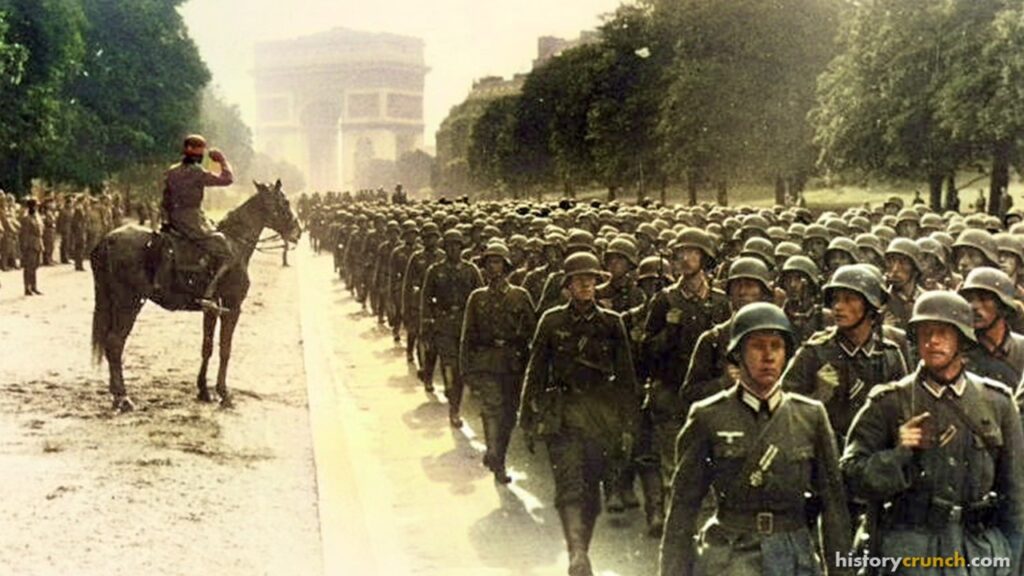
Nazi German soldiers march through Paris, near the Arc de Triomphe, in June of 1940. (Colorized by historycrunch.com)

In this colorized photograph, German troops march in tight, uniform columns down a wide Parisian boulevard toward the Arc de Triomphe, while a mounted officer on horseback watches from the side. What does the choice of this specific route reveal about the purpose of the march?

Tap an option.
ExplanationThe Champs-Elysees leading to the Arc de Triomphe is the central ceremonial avenue of France, closely tied to French national pride and military victory parades. By marching their forces down that exact route in June 1940, German commanders made a deliberate political statement: France had been defeated and its most powerful national symbols now stood under German control. This kind of display was a standard tool of occupation, designed to signal total military dominance to both the French population and the wider world.
Source: Smithsonian Institution© factsthatcrunch.comMore World War II Facts →
World War II

The French government signed the armistice ending the Battle of France on June 22nd, 1940, in the same railway car where Germany had surrendered in 1918.

Tap an option.
ExplanationFrance signed the armistice with Germany on June 22nd, 1940, in the Forest of Compiegne. Hitler chose the same railway car used for the 1918 Armistice that ended World War I, deliberately reversing the symbolism of Germany's earlier defeat.
Source: Imperial War Museums© factsthatcrunch.comFacts that Crunch

How many tons of bombs did Allied air forces drop during the strategic bombing campaign in the European Theater of World War II?

Take your best guess. Tap a range.
The real numberabout 2.7 million tonsAllied bombers flew roughly 1,440,000 bomber sorties and 2,680,000 fighter sorties to deliver that weight of explosives. The scale of the bombing campaign destroyed millions of German homes, wrecked key factories, and pushed Germany's war production into steep decline by 1944.
Source: National WWII Museum© factsthatcrunch.comFacts that Crunch

Sources

Explore More Topics

Dunkirk Evacuation

When German forces cut off Allied troops at the French coast in late May of 1940, a large-scale naval and civilian rescue operation became necessary to preserve what remained of the British Expeditionary Force. The operation removed hundreds of thousands of soldiers from a situation that had seemed likely to end in total capture. Those troops formed the core of the army Britain would need for later campaigns.
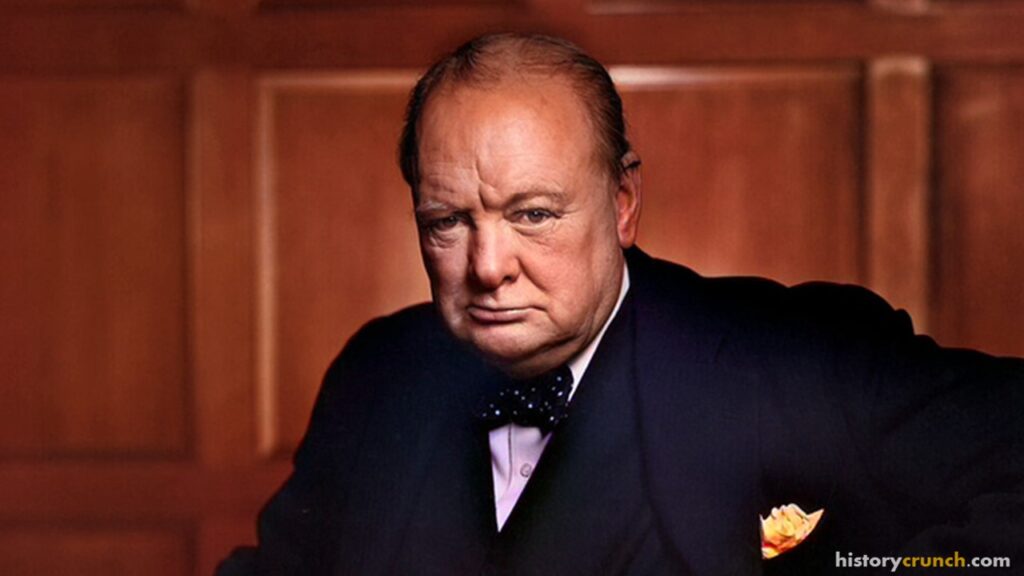
Wars are not won by evacuations.
Winston Churchill
Prime Minister of the United Kingdom, House of Commons, June 4th, 1940
Churchill said this the day the Dunkirk evacuation ended, after ships had carried about 338,000 Allied soldiers from France to Britain. He wanted people to feel relief at the rescue but to remember that the army had left its weapons and vehicles behind and that the fight against Germany was far from over.
Winston Churchill in December of 1941. (Colorized by historycrunch.com)
Source: Imperial War Museums© factsthatcrunch.com
World War IIBy the Numbers
Facts that CrunchFactsthatCrunch

Operation Dynamo was planned to save far fewer men than it actually did, and the precise breakdown by nationality, rescue point, and loss tells a fuller story.

198,229
British troops rescued
139,997
French and Belgian troops rescued
68,014
Troops rescued on the single busiest day, May 31st
98,671 / 239,555
Troops rescued from beaches vs. harbor
~240
Vessels lost during the operation
~90,000
Allied troops left behind as prisoners
British planners originally expected to save only 20,000 to 45,000 men, but the final Admiralty count reached 338,226. About 90,000 Allied soldiers were left behind and captured, and the British Expeditionary Force also left behind more than 2,000 artillery pieces and 85,000 motor vehicles on the beaches.
Source: Smithsonian Institution© factsthatcrunch.comMore World War II Facts →
We shall fight on the beaches, we shall fight on the landing grounds, we shall fight in the fields and in the streets, we shall fight in the hills; we shall never surrender.
Winston Churchill
Prime Minister of the United Kingdom, House of Commons, June 4th, 1940
Churchill spoke these words just as the Dunkirk evacuation ended and more than 338,000 Allied troops had escaped from France. He wanted Britain to keep fighting even if Germany invaded, and the speech helped steady the country during a very dangerous time.
Winston Churchill in December of 1941. (Colorized by historycrunch.com)
Source: Imperial War Museums© factsthatcrunch.com
World War IIEyewitness
Facts that CrunchFactsthatCrunch
Eyewitness account

The beach was one vast sea of bodies. I had never seen so much dejection.

CHCorporal Henry Palmer, British soldier, 1/7th Battalion, Queen's Royal Regiment
Context

Palmer described the crowded Dunkirk beaches, where he waited for rescue during the evacuation in late May 1940, in an oral history interview recorded after the war.

Source: Max Arthur, Forgotten Voices of the Second World War (2004)© factsthatcrunch.comMore World War II Facts →
World War IIQuote
Facts that CrunchFactsthatCrunch

Even repeated by the announcer, it sent shivers (not of fear) down my spine.

VS
Vita Sackville-WestEnglish writer and poet, wife of member of Parliament Harold Nicolson, June 4th, 1940
Why it matters

Churchill did not repeat the speech on live radio that evening, so a BBC newsreader read extracts on the news broadcast, and this reaction in a letter to her husband shows how the words reached listeners at home.

Source: Letter to Harold Nicolson, June 4th, 1940© factsthatcrunch.comMore World War II Facts →
World War IIRecord
Facts that CrunchFactsthatCrunch
LARGEST MILITARY EVACUATION IN HISTORY

Operation Dynamo, run from May 26th to June 4th, 1940, rescued 338,226 Allied troops from the beaches and harbor of Dunkirk, France, making it the largest military evacuation ever carried out.

British and Allied planners had expected to save no more than 20,000 to 30,000 men before German forces closed in. The final total included roughly 198,000 British soldiers and about 140,000 French and Belgian troops. Because most trained Allied soldiers were brought home safely, Britain was able to keep fighting and rebuild its army for the rest of the war.

Source: Library of Congress© factsthatcrunch.comMore World War II Facts →
World War IIBy the Numbers
Facts that CrunchFactsthatCrunch

Operation Dynamo at Dunkirk ran for nine days and left behind precise, striking numbers that show how close the rescue came to failing completely.
7,669
First-day rescues, May 27th, 1940
68,014
Best single-day rescues, May 31st, 1940
~1,000
Vessels taking part, including roughly 700 civilian craft
240
Ships and vessels lost during the operation
90,000
British troops left behind as prisoners
239,555 Vs. 98,671
Allied troops rescued from the harbor mole vs. beaches
British planners had expected to rescue at most 45,000 men before German forces closed in. The final count of 338,226 soldiers rescued meant that Britain kept enough trained troops to fight on through the rest of the war.
Source: Smithsonian Institution© factsthatcrunch.comMore World War II Facts →
World War II
Dunkirk Evacuation
Used about 861 vessels, including roughly 700 small civilian boats, to lift troops off the beach under constant air attack over 9 days in May and June 1940
VS
D-Day Invasion
Deployed about 5,000 ships and landing craft, 11,590 aircraft, and roughly 156,000 troops crossing the Channel in a single assault on June 6th, 1944
Dunkirk saved an army that had already been defeated and surrounded, while D-Day put a rebuilt Allied force back onto the European continent from a position of strength. The difference in fleet size and air cover shows how much Allied industrial and military power had grown in four years.
Source: Imperial War Museums© factsthatcrunch.comFacts that Crunch
World War IIBiography
Facts that CrunchFactsthatCrunch
Winston Churchill
Prime Minister of the United Kingdom, 1940 to 1945 and 1951 to 1955
Born: November 30th, 1874, Blenheim Palace, Oxfordshire, England
Became Prime Minister: May 10th, 1940
Lost Election: July 26th, 1945
Returned as Prime Minister: October 26th, 1951
Died: January 24th, 1965, London, England

Churchill led Britain through its most difficult years of World War II, refusing to negotiate with Nazi Germany after France fell in June 1940. His speeches and decisions helped hold the Allied coalition together until victory in Europe was secured in May 1945.

Prime Minister of the United KingdomWorld War II Allied LeaderNobel Prize in Literature, 1953Royal Military Academy, Sandhurst
Winston Churchill in December of 1941. (Colorized by historycrunch.com)
Source: Library of Congress© factsthatcrunch.comMore World War II Facts →
World War IICause & Effect
Facts that CrunchFactsthatCrunch
Cause

Germany's rapid armored advance through the Ardennes in May 1940 split Allied forces in two, trapping the British Expeditionary Force and large French and Belgian units against the English Channel coast near Dunkirk.

Effects
Britain launched Operation Dynamo on May 26th, 1940, sending naval vessels and hundreds of civilian boats across the Channel to lift troops off the beaches.
About 338,000 Allied soldiers were rescued over nine days, preserving the core of the British army to fight on.
Prime Minister Winston Churchill warned Parliament on June 4th, 1940 that the rescue was 'a deliverance' but not a victory, and Britain prepared for a possible German invasion.
The survival of so large a trained force allowed Britain to remain an active fighting power and later support Allied operations in North Africa and Europe.

The Dunkirk evacuation ran from May 26th to June 4th, 1940, after German forces outflanked the Allies and cut off their retreat by land. The rescue kept Britain in the war at a moment when a total military collapse on the Western Front seemed possible.

Source: Library of Congress© factsthatcrunch.comMore World War II Facts →
World War IIRedacted FileInteractive
Facts that CrunchFactsthatCrunch
TOP SECRET
Operation Dynamo: Rearguard Action and Vessel Losses, Dunkirk 1940
During the Dunkirk evacuation of late May and early June 1940, the British Admiralty called on hundreds of small civilian vessels alongside Royal Navy warships to lift Allied troops from the beaches of northern France. The operation ran for nine days and removed approximately 338,000 British, French, and Belgian soldiers before the perimeter collapsed. The Royal Navy lost six destroyers sunk during the operation, with a further nineteen destroyers damaged by German air and sea attack. French forces, including units of the French First Army, held the Dunkirk perimeter on the southern and eastern sides, buying time for the main evacuation. The last Allied soldiers were lifted from the harbor on June 4th, 1940, after which German forces entered the town.
Tap the black bars to declassify.
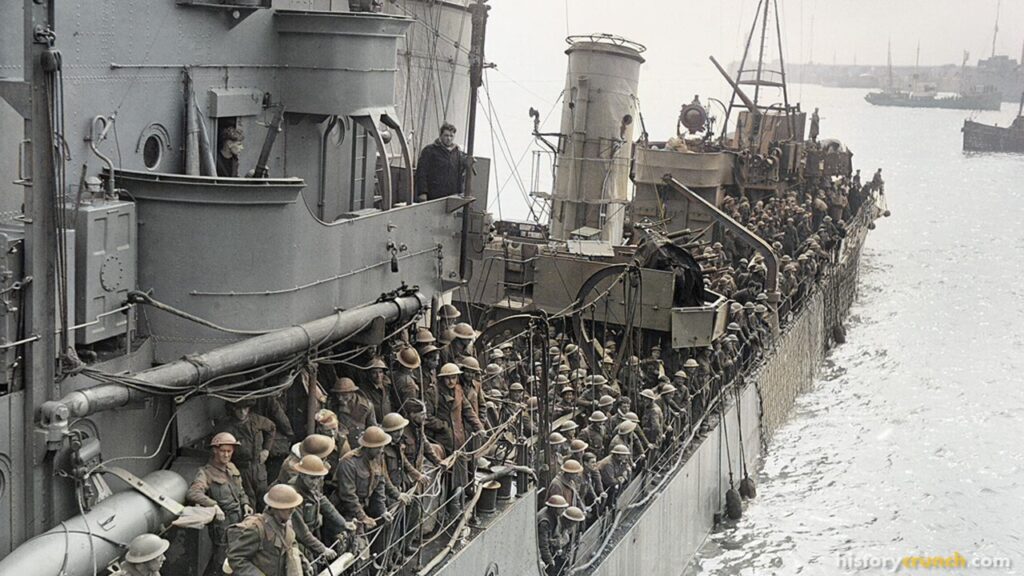
Troops evacuated from Dunkirk on a destroyer on May 31st, 1940. (Colorized by historycrunch.com)Evidence Photo
Rearguard sacrifice by French units is often overlooked; nearly 40,000 French troops were left behind and captured.
Evidence Tag
SubjectOperation Dynamo: Rearguard Action and Vessel Losses, Dunkirk 1940
File No.FTC-3580
Class.TOP SECRET
SourceNational Archives
Source: National Archives© factsthatcrunch.comMore World War II Facts →
Test Yourself
World War IIDecision PointInteractive
Facts that CrunchFactsthatCrunch
DECISION POINT

It is late May 1940, and you are Winston Churchill, the new Prime Minister of Britain during World War II. The German army has trapped over 300,000 Allied troops on the beaches of Dunkirk, France, and Britain has no major ally ready to help. Your War Cabinet is divided: Foreign Secretary Lord Halifax believes Britain should ask Mussolini to broker peace talks with Hitler, while others want to fight on. The choice you make in the next few days will decide whether Britain stays in the war or accepts terms that Hitler will control.

History turned on this choice. What would you have done?
Should Britain continue fighting Germany or seek peace terms through Mussolini?
Choose a path. Each choice opens a different future.
Your move
Pick option A, B, or C to walk down that path.
If you choose A
Britain would reject any negotiation and commit to a long war, but risk further military losses with no guarantee of American support or eventual victory.
If you choose B
An approach through Italy might stop the immediate fighting, but Germany would almost certainly dictate harsh terms that limited British independence and military power.
If you choose C
Stalling could buy time but might leave Britain in a weaker position if the evacuation failed and Germany pressed for surrender on worse terms.
What really happened
Churchill persuaded his War Cabinet to reject peace talks on May 28th, 1940, arguing that any terms Hitler offered would reduce Britain to a dependent state and that no reliable guarantee would exist to enforce them. The evacuation at Dunkirk rescued about 338,000 Allied troops by June 4th, 1940, giving Britain a fighting force to continue the war. Churchill's decision kept Britain in the conflict and made it the main base from which the Western Allies eventually launched the campaigns that defeated Germany.
Source: Imperial War Museums© factsthatcrunch.comMore World War II Facts →
World War II

What did the Dunkirk evacuation reveal about Allied strategy in 1940?

Tap an option.
ExplanationThe evacuation from Dunkirk, completed by June 4th, 1940, showed that the Allied plan to defend Belgium had failed entirely. German armored forces had broken through at Sedan, cut off Allied armies from the south, and driven them to the coast, forcing a retreat rather than a defense of French territory.
Source: Imperial War Museums© factsthatcrunch.comFacts that Crunch

Sources

Explore More Topics

Battle of Britain

After France fell, Germany needed air superiority over Britain before any invasion could be attempted. The air campaign that followed in the summer and autumn of 1940 was the first major military test fought entirely in the air, and its outcome determined whether Germany could press its advantage westward. Britain's ability to sustain its air defenses over several months altered the overall direction of German planning.
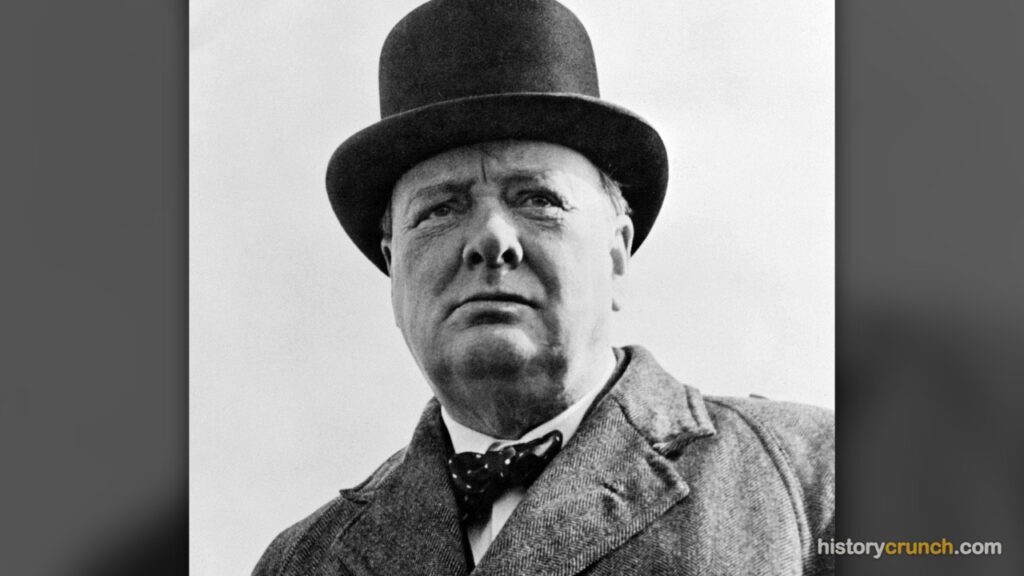
Never in the field of human conflict was so much owed by so many to so few. All hearts go out to the fighter pilots, whose brilliant actions we see with our own eyes day after day.
Winston Churchill
Prime Minister of the United Kingdom, House of Commons, August 1940
Churchill said this during the Battle of Britain, when German air attacks were trying to knock Britain out of the war. The "few" were the roughly 3,000 Royal Air Force airmen who defended the country against the much larger Luftwaffe, and they have been known as "the Few" ever since.
Winston Churchill, who served as Prime Minister of the United Kingdom during World War II.
Source: Imperial War Museums© factsthatcrunch.com
World War IIQ&A
Facts that CrunchFactsthatCrunch
Q

Why Did Britain Win the Battle of Britain?

A

Britain won the Battle of Britain in 1940 mainly because the Royal Air Force successfully defended British skies against the German Luftwaffe by using a coordinated radar warning system called Chain Home, which gave British pilots advance notice of incoming German aircraft. Germany also made a key mistake in early September 1940 when it shifted its bombing targets from RAF airfields to British cities, giving the RAF time to recover its strength. Britain's aircraft factories kept producing new planes faster than Germany had expected, and the English Channel made a German ground invasion impossible without air superiority.

Source: Smithsonian Institution© factsthatcrunch.comMore World War II Facts →
But if we fail, then the whole world, including the United States, including all that we have known and cared for, will sink into the abyss of a new Dark Age, made more sinister, and perhaps more protracted, by the lights of perverted science.
Winston Churchill
Prime Minister of the United Kingdom, Finest Hour speech to the House of Commons, June 1940
France was collapsing, and Britain expected Germany to attack it next. In this speech Churchill warned lawmakers what defeat would mean, telling them the coming Battle of Britain would decide whether the free world survived.
Winston Churchill served as Prime Minister of the United Kingdom during World War II and worked closely with Allied leaders to shape the war effort and postwar plans.
Source: Churchill Archives Centre© factsthatcrunch.com
World War IIEyewitness
Facts that CrunchFactsthatCrunch
Eyewitness account

I felt a terrific explosion which knocked the control stick from my hand, and the whole machine quivered like a stricken animal. In a second, the cockpit was a mass of flames: instinctively, I reached up to open the hood. It would not move. I tore off my straps and managed to force it back; but this took time, and when I dropped back into the seat and reached for the stick in an effort to turn the plane on its back, the heat was so intense that I could feel myself going.

RHRichard Hillary, RAF Spitfire pilot, No. 603 Squadron
Context

Hillary described the moment a Messerschmitt Bf 109 shot down his Spitfire over the Kent coast on September 3rd, 1940, leaving him badly burned before he escaped by parachute into the North Sea.

Source: Richard Hillary, The Last Enemy (1942)© factsthatcrunch.comMore World War II Facts →
World War IITimelineInteractive
Facts that CrunchFactsthatCrunch

How did the Battle of Britain unfold week by week during the summer and fall of 1940?

July 10th, 1940July 19th, 1940August 1st, 1940August 13th, 1940August 15th, 1940August 18th, 1940August 24th, 1940
July 10th, 1940 — Battle Begins The Luftwaffe launched major attacks on British shipping convoys in the English Channel. The Royal Air Force Fighter Command, led by Air Chief Marshal Hugh Dowding, scrambled fighters to intercept.
July 19th, 1940 — Hitler's Peace Offer Hitler made a public speech to the German Reichstag offering Britain a chance to end the war on German terms. Prime Minister Winston Churchill's government rejected the offer within hours.
August 1st, 1940 — Luftwaffe Targeting Shifts German commanders shifted attacks toward RAF airfields and radar stations along the English coast and southeast England. This phase aimed to destroy British air defenses before any invasion.
August 13th, 1940 — Adlertag Launched The Luftwaffe launched Adlertag, or Eagle Day, sending over 1,400 sorties to knock out RAF Fighter Command in a single day. The RAF shot down 45 German aircraft while losing 13 of its own.
August 15th, 1940 — Heaviest Single Day The Luftwaffe flew its largest number of sorties of the entire battle, attacking targets across southern England and northeast England simultaneously. German losses reached 75 aircraft, the highest single-day total for the Luftwaffe in the battle.
August 18th, 1940 — Hardest Day for RAF Both sides suffered their heaviest combined aircraft losses of the battle on this date. The RAF lost 27 pilots killed, a rate that was becoming very difficult to replace.
August 24th, 1940 — German Bombers Hit London German bombers accidentally dropped bombs on central London during a night raid aimed at oil storage targets. This error prompted the RAF to bomb Berlin the following night.
July 10th, 1940 — Battle BeginsThe Luftwaffe launched major attacks on British shipping convoys in the English Channel. The Royal Air Force Fighter Command, led by Air Chief Marshal Hugh Dowding, scrambled fighters to intercept.
July 19th, 1940 — Hitler's Peace OfferHitler made a public speech to the German Reichstag offering Britain a chance to end the war on German terms. Prime Minister Winston Churchill's government rejected the offer within hours.
August 1st, 1940 — Luftwaffe Targeting ShiftsGerman commanders shifted attacks toward RAF airfields and radar stations along the English coast and southeast England. This phase aimed to destroy British air defenses before any invasion.
August 13th, 1940 — Adlertag LaunchedThe Luftwaffe launched Adlertag, or Eagle Day, sending over 1,400 sorties to knock out RAF Fighter Command in a single day. The RAF shot down 45 German aircraft while losing 13 of its own.
August 15th, 1940 — Heaviest Single DayThe Luftwaffe flew its largest number of sorties of the entire battle, attacking targets across southern England and northeast England simultaneously. German losses reached 75 aircraft, the highest single-day total for the Luftwaffe in the battle.
August 18th, 1940 — Hardest Day for RAFBoth sides suffered their heaviest combined aircraft losses of the battle on this date. The RAF lost 27 pilots killed, a rate that was becoming very difficult to replace.
August 24th, 1940 — German Bombers Hit LondonGerman bombers accidentally dropped bombs on central London during a night raid aimed at oil storage targets. This error prompted the RAF to bomb Berlin the following night.

Tap a point to read its detail.

Source: Library of Congress© factsthatcrunch.comMore World War II Facts →
What General Weygand called the Battle of France is over. I expect that the Battle of Britain is about to begin... Let us therefore brace ourselves to our duties, and so bear ourselves that, if the British Empire and its Commonwealth last for a thousand years, men will still say, 'This was their finest hour.'
Winston Churchill
Prime Minister of the United Kingdom, House of Commons, June 18th, 1940
France was days from surrender, and Britain expected a German attack next. Churchill used this speech to prepare the country to fight on alone, and it gave the coming air battle its name, the Battle of Britain.
Winston Churchill in December of 1941. (Colorized by historycrunch.com)
Source: Imperial War Museums© factsthatcrunch.com
World War IICorkboard Timeline
Facts that CrunchFactsthatCrunch
Battle of Britain
Key Dates, July to October 1940
1940
July 10th, 1940
The Luftwaffe began large attacks on British shipping in the English Channel, marking the official start of the Battle of Britain.
1940
August 13th, 1940
Germany launched Adlertag, or Eagle Day, sending over 1,400 aircraft sorties against RAF airfields and radar stations across southern England.
1940
August 24th, 1940
German bombers accidentally struck central London, and the RAF responded by bombing Berlin the following night, shifting the focus of the campaign.
1940
September 7th, 1940
Germany shifted its main bombing effort to London itself, giving RAF Fighter Command time to recover its badly damaged airfields.
1940
September 15th, 1940
The RAF defeated a massive German daylight raid, shooting down 56 Luftwaffe aircraft. This day is now marked as Battle of Britain Day.
1940
October 31st, 1940
The Battle of Britain officially ended. The Luftwaffe had failed to gain air superiority over Britain, and Germany postponed its invasion plan, Operation Sea Lion.
A timeline pinned to the board.
Source: Imperial War Museums© factsthatcrunch.comMore World War II Facts →
RAF Fighter Command
About 544 pilots killed during the battle, July 10th to October 31st, 1940, drawn from Britain, the Commonwealth, and occupied Europe
VS
Luftwaffe Fighter Arm
Messerschmitt Bf 109 pilots had roughly 20 to 30 minutes of flying time over southern England before fuel forced them to turn back
The fuel range of the Bf 109 was the central structural problem for the Luftwaffe. RAF pilots who survived being shot down could rejoin their squadrons the same day, while German pilots shot down over England became prisoners.
Source: Imperial War Museums© factsthatcrunch.comFacts that Crunch
World War IIStat
Facts that CrunchFactsthatCrunch
RAF Fighter Command aircrew wounded

During the Battle of Britain from July 10th to October 31st, 1940, 422 Royal Air Force Fighter Command aircrew were wounded in addition to the 544 who were killed.

Fighter Command flew day after day against a Luftwaffe force that outnumbered it in both aircraft and pilots. Wounded pilots often returned to flying duties within days because replacements were so short. By mid-August 1940, new pilot losses were coming in faster than training schools could produce replacements.

Source: UNESCO© factsthatcrunch.comMore World War II Facts →
World War IIImage ExplorerInteractive
Facts that CrunchFactsthatCrunch
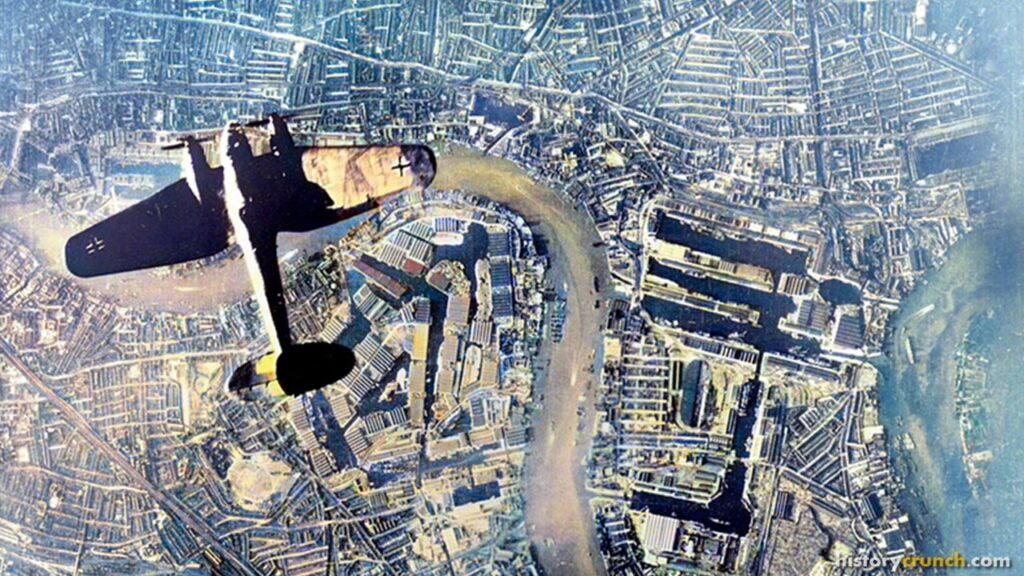
Nazi German bomber flying over London, England during the events of the Battle of Britain in September of 1940. (Colorized by historycrunch.com)
German Balkenkreuz marking The black cross on the aircraft wing is the German military symbol used on Luftwaffe planes. Its presence here identifies this as a German bomber flying over enemy territory, confirming this is an aerial attack mission over Britain during World War II.
River Thames bend The wide, curved river below matches the distinctive bend of the Thames running through London's East End docklands. German bombers used the river as a navigation guide to locate targets during the Blitz bombing campaign that began in September 1940.
Docklands and warehouses The dense rows of large industrial buildings and dock structures visible along the riverbank were major targets for German bombers. Destroying London's port facilities was a key German goal because the docks handled supplies vital to Britain's war effort.
Bomber position directly over the city The aircraft is framed with the entire urban area spread out below it at high altitude. This overhead angle shows how German crews photographed raids to assess bomb placement and plan future attacks on specific districts.
Nazi German bomber flying over London, England during the events of the Battle of Britain in September of 1940. (Colorized by historycrunch.com)
Source: Smithsonian Institution© factsthatcrunch.comMore World War II Facts →
Test Yourself
World War IISource QuestionInteractive
Facts that CrunchFactsthatCrunch
Churchill spoke to Parliament on August 20th, 1940, while the Battle of Britain was still being fought and a German invasion of Britain remained a real threat, to recognize the RAF pilots who were holding the Luftwaffe back.

The gratitude of every home in our Island, in our Empire, and indeed throughout the world, except in the abodes of the guilty, goes out to the British airmen who, undaunted by odds, unwearied in their constant challenge and mortal danger, are turning the tide of the World War by their prowess and by their devotion. Never in the field of human conflict was so much owed by so many to so few.

Winston Churchill · House of Commons, London · August 20th, 1940

What does Churchill's claim that the pilots were 'turning the tide of the World War' reveal about the wider importance of the Battle of Britain in 1940?

Tap an option.
ExplanationChurchill's words placed the RAF's air defense at the center of the entire war effort, not just British survival. Stopping the Luftwaffe denied Germany air supremacy, which was required before any invasion could happen, making the Battle of Britain a turning point for the Allied cause as a whole.
Source: Churchill, "The Few," House of Commons, August 20th, 1940 (Hansard)© factsthatcrunch.comMore World War II Facts →
World War II

Can you put these key turning points in the Battle of Britain in the correct order, from earliest to latest?

Use the arrows to put these in the right order, then tap Check order.
12345
Germany shifts to bombing RAF airfields and radar stations
Hitler postpones Operation Sea Lion indefinitely
Germany switches to bombing London and other cities
Lufwaffe's heaviest single attack fails on Battle of Britain Day
Luftwaffe opens attacks on British shipping and ports
Source: Imperial War Museums© factsthatcrunch.comFacts that Crunch

Sources

Explore More Topics

The Blitz

Germany's sustained bombing campaign against British cities, which ran from September of 1940 into May of 1941, was aimed at breaking civilian support for the war and disrupting industrial production. The campaign caused serious destruction across London and other cities, yet British war production continued and the government remained stable. The results shaped how military planners on both sides evaluated strategic bombing for the rest of the war.
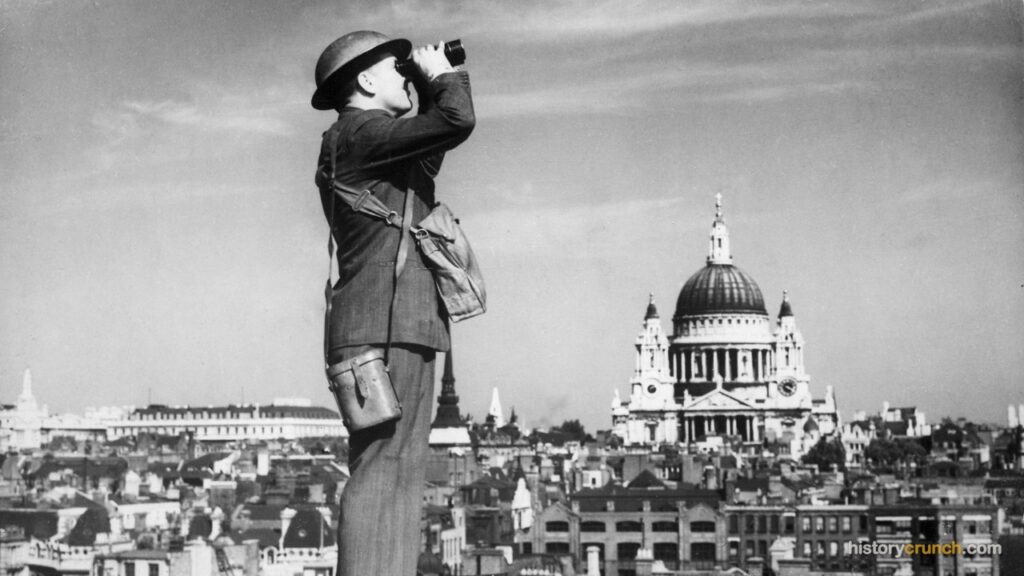
A British spotter scans the sky over London with binoculars from a rooftop during World War II, with St. Paul's Cathedral visible in the background.
London Rooftop Aircraft Spotter During the Blitz, World War II
LOOK CLOSELY
A uniformed British spotter stands on a rooftop and holds binoculars to his eyes, scanning the sky. He wears a steel Brodie helmet and carries a shoulder bag and a cylindrical case at his side. The dome of St. Paul's Cathedral is clearly visible in the background against a pale sky.
THE CONTEXT
Germany launched a sustained bombing campaign against British cities beginning in the autumn of 1940, targeting London night after night for weeks. Britain's Royal Observer Corps relied on trained volunteers and part-time spotters posted across rooftops, fields, and coastal stations to track incoming enemy aircraft by sight and sound. These spotters phoned reports to control centers, helping anti-aircraft gun crews and RAF fighter controllers respond quickly.
THE DETAIL
The cylindrical case hanging at the spotter's hip is a respirator, or gas mask, carrier. Spotters were required to keep gas masks with them at all times during duty, since a chemical attack remained a serious concern throughout the war.
WHY IT MATTERS
This photo shows that civilian and part-time military personnel played a direct role in London's air defense, not just professional soldiers. St. Paul's Cathedral in the background became a symbol of London's survival during the bombing campaign, making it a recognizable landmark that gives the image its lasting meaning.
1 / 4
Source: Imperial War Museums© factsthatcrunch.com
World War IICorkboard Timeline
Facts that CrunchFactsthatCrunch
The Blitz in World War II
Key Dates, 1940 to 1941
1940
September 7th, 1940
Germany launched the first major daylight bombing raid on London, striking the East End docks and killing around 430 civilians.
1940
September 15th, 1940
The Luftwaffe sent its largest wave of bombers over London, and the RAF shot down 56 German aircraft, marking a turning point in the air campaign.
1940
November 14th, 1940
German bombers destroyed much of Coventry city center overnight, killing around 568 people and leveling the medieval cathedral.
1940
December 29th, 1940
A German incendiary raid on the City of London caused firestorms that destroyed or damaged eight Christopher Wren churches and much of the surrounding area.
1941
March 13th, 1941
German bombers hit Clydeside in Scotland over two nights in what became known as the Clydebank Blitz, killing around 528 people and destroying or damaging nearly every home in the town of Clydebank.
1941
May 10th, 1941
Germany carried out its heaviest single raid on London, killing around 1,436 people and damaging the House of Commons chamber, marking the effective end of the Blitz.
A timeline pinned to the board.
Source: Imperial War Museums© factsthatcrunch.comMore World War II Facts →
Total War
war that uses a whole country
Total war is a type of conflict in which a government directs nearly all of its country's people, factories, farms, and money toward fighting. In World War II, countries like the United States, Britain, Germany, and the Soviet Union each shifted their entire economies to war production, with millions of civilians working in weapons factories and governments controlling food, fuel, and raw materials at home.
Source: National World War II Museum© factsthatcrunch.comFacts that Crunch
World War IIQ&A
Facts that CrunchFactsthatCrunch
Q

What Was the Blitz in World War II?

A

The Blitz was a sustained German bombing campaign against British cities that lasted from September 7th, 1940, to May 11th, 1941. Germany targeted London and other cities such as Coventry, Birmingham, and Liverpool, aiming to break British morale and damage its ability to produce war supplies. The bombing killed about 43,000 civilians and left more than a million people in London without homes.

Source: US National Archives© factsthatcrunch.comMore World War II Facts →
World War IIEyewitness
Facts that CrunchFactsthatCrunch
Eyewitness account

The greatest of all the fires was directly in front of us. Flames seemed to whip hundreds of feet into the air. ... St. Paul's was surrounded by fire, but it came through. It was like a picture of some miraculous figure that appears before peace-hungry soldiers on a battlefield.

EPErnie Pyle, American war correspondent reporting from London
Context

Pyle wrote this dispatch on December 30th, 1940, after watching the great German fire raid on London from a balcony the night before, when about 1,500 fires burned in the city and St. Paul's Cathedral survived 28 incendiary bombs.

Source: Ernie Pyle, Ernie Pyle in England (1941)© factsthatcrunch.comMore World War II Facts →
World War IIThen and Now
Facts that CrunchFactsthatCrunch
Then

During the Blitz, German aircraft bombed London on 57 consecutive nights beginning on September 7th, 1940. The raids destroyed or damaged more than one million homes across Greater London, killed about 30,000 Londoners, and left whole neighborhoods in rubble. Areas such as the East End and the docklands around Stepney and Bermondsey suffered some of the heaviest damage.

Now

Today, many of the streets and buildings that survived the Blitz still stand alongside modern structures built on cleared bomb sites. The Museum of London documents the bombing campaign through photographs, personal accounts, and recovered objects. Dozens of city parks and open spaces that Londoners recognize today were formerly bomb sites left empty after the war and later converted for public use.

The visible mix of Victorian, postwar, and modern architecture across London is a direct result of which buildings the Blitz destroyed and which it left standing.
Source: Library of Congress© factsthatcrunch.comMore World War II Facts →
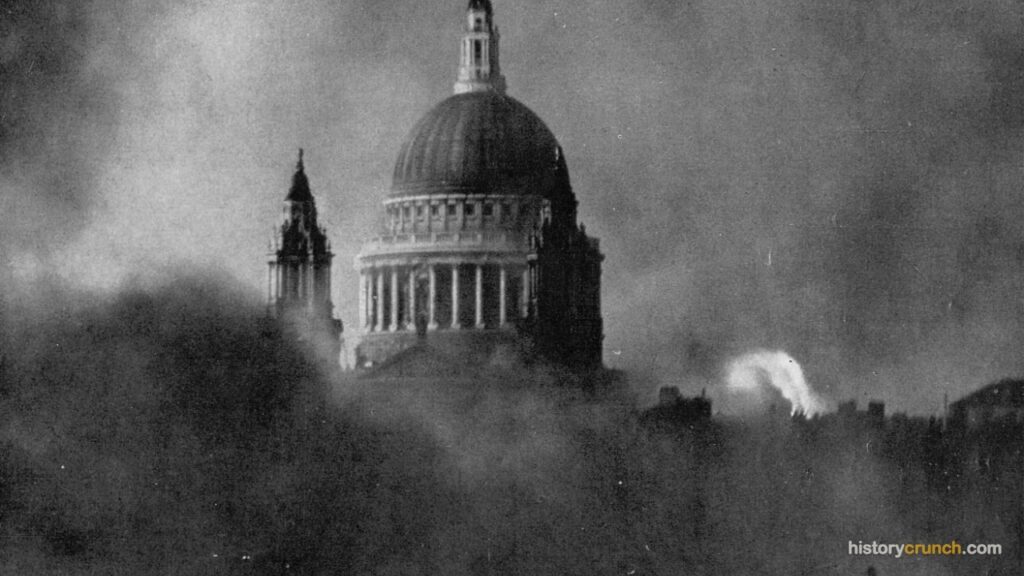
Smoke surrounds St. Paul's Cathedral in London during a German bombing raid on the city in World War II.
St. Paul's Cathedral During the London Blitz, World War II
LOOK CLOSELY
The photo shows the large dome and columned upper walls of St. Paul's Cathedral rising above a thick mass of smoke that fills the lower half of the frame. The image is black and white, and a bright flash of fire is visible to the right of the building. The sky around the cathedral is hazy with smoke on all sides.
THE CONTEXT
German aircraft bombed London repeatedly from September 7th, 1940, through May 11th, 1941, in a campaign British people called the Blitz. On the night of December 29th, 1940, German bombers dropped large numbers of incendiary bombs on the City of London, starting fires across a wide area around St. Paul's Cathedral. The cathedral survived that night largely intact, though many surrounding buildings were destroyed.
THE DETAIL
A bright white flash of fire burns to the right of the cathedral, showing that at least one fire was still active very close to the building when this photo was taken.
WHY IT MATTERS
This photo became widely known in Britain because St. Paul's Cathedral standing amid the smoke came to represent the fact that London was still functioning even under heavy attack. It was shared in newspapers and gave many people a concrete image of what the city was enduring.
1 / 4
Source: Imperial War Museums© factsthatcrunch.com
World War IIComparison
Facts that CrunchFactsthatCrunch
Battle of Britain
German side: Luftwaffe, led by Reich Marshal Hermann Goering, with about 2,600 aircraft in the summer of 1940
British side: Royal Air Force Fighter Command, led by Air Chief Marshal Hugh Dowding
Germany aimed to destroy the RAF to clear the way for a naval invasion called Operation Sea Lion
Lufwaffe crews included German, Italian, and some allied pilots flying Bf 109 fighters and He 111 bombers
The Blitz
German side: Luftwaffe bomber fleets targeting civilian areas, with Goering directing the campaign from France
British side: Anti-Aircraft Command, the Home Guard, and Civil Defence Service protecting cities and civilians
Germany shifted its goal from defeating the RAF to breaking civilian morale and wrecking industry
Britain relied on radar stations, barrage balloons, and blackout rules rather than fighter-to-fighter combat
VS

The Battle of Britain was an air fight between the Luftwaffe and the RAF, where both sides sent military aircraft against each other. The Blitz was a bombing campaign in which Germany targeted British cities while Britain defended its civilian population rather than engaging in large air-to-air battles.

Source: US National Archives© factsthatcrunch.comMore World War II Facts →
Over 43,500
civilians killed across Britain during the Blitz, September 7th, 1940 to May 16th, 1941
German aircraft bombed London, Liverpool, Coventry, and other British cities in a campaign that lasted about nine months. London suffered nearly half of all Blitz civilian deaths, with the city's East End and its docks hit hardest.
Source: Imperial War Museums© factsthatcrunch.comFacts that Crunch
Luftwaffe
noun
The Luftwaffe was the air force of Nazi Germany during World War II. Germany had been forbidden to have an air force under the Treaty of Versailles, so it rebuilt the Luftwaffe in secret during the 1930s before Hermann Goering announced it publicly in 1935. The Luftwaffe carried out bombing campaigns against cities, supported ground troops, and fought Allied air forces across Europe and North Africa.
Source: National Air and Space Museum© factsthatcrunch.com
World War IIMind Map BoardInteractive
Facts that CrunchFactsthatCrunch
Evacuation of Children
The British government evacuated about 1.5 million children and mothers from London and other cities to rural areas beginning in September 1939, well before the Blitz began, and the program expanded when bombing intensified in 1940.
Night Bombing Campaign
Germany bombed London for 57 consecutive nights starting on September 7th, 1940, then shifted attacks to cities including Coventry, Liverpool, Birmingham, and Plymouth.
Coventry, November 14th, 1940
The Luftwaffe dropped around 500 tons of bombs on Coventry in a single night, destroying the city center and its medieval cathedral and killing about 568 people.
Public Shelters and the Underground
Thousands of Londoners sheltered nightly in Underground stations, and the government also built Anderson shelters for back gardens and Morrison shelters for use indoors to protect families.
Civilian Deaths and Damage
The Blitz killed about 43,000 British civilians and left more than a million homes damaged or destroyed across Britain by May 1941.
Strategic Response
The Blitz led the British government to accelerate dispersal of war factories away from city centers, increase anti-aircraft gun production, and expand the radar and Observer Corps network that had already helped defeat the Luftwaffe in daylight during the summer of 1940.
The Blitz: Civilian Life, Morale, and Strategy
Tap a node to explore it.
Source: Imperial War Museums© factsthatcrunch.comMore World War II Facts →
Test Yourself

During the Blitz in World War II, was each of these a cause of the bombing campaign or an effect it produced?

Read the item in the dashed box, then tap the column where it belongs.
SORT THIS ITEM1 / 10
Widespread homelessness in London
Germany's plan to break British morale
Goering promising to defeat Britain by air
RAF resisting Luftwaffe in summer 1940
Hitler ordering attacks on British cities
Britain refusing to surrender after Dunkirk
Widespread homelessness in London
British war production slowed but continued
Over 43,000 British civilians killed
Children evacuated to the countryside
Underground stations used as shelters
Sort all 10 to see your score
Widespread homelessness in LondonBritish war production slowed but continuedOver 43,000 British civilians killedGermany's plan to break British moraleGoering promising to defeat Britain by airRAF resisting Luftwaffe in summer 1940Hitler ordering attacks on British citiesChildren evacuated to the countrysideUnderground stations used as sheltersBritain refusing to surrender after Dunkirk
ExplanationThe Blitz ran from September 1940 to May 1941 and killed more than 43,000 British civilians, yet it failed to break British morale or stop war production, which undermined Germany's core reason for launching the campaign.
Source: Imperial War Museums© factsthatcrunch.comFacts that Crunch

Sources

Explore More Topics

Normandy Invasion (D-Day)

On June 6th, 1944, Allied forces launched a massive amphibious assault on the beaches of Normandy in northern France. The operation involved American, British, Canadian, and other Allied troops crossing the English Channel to push German forces out of Western Europe. It was the largest seaborne invasion in history and marked a turning point in the European Theater.
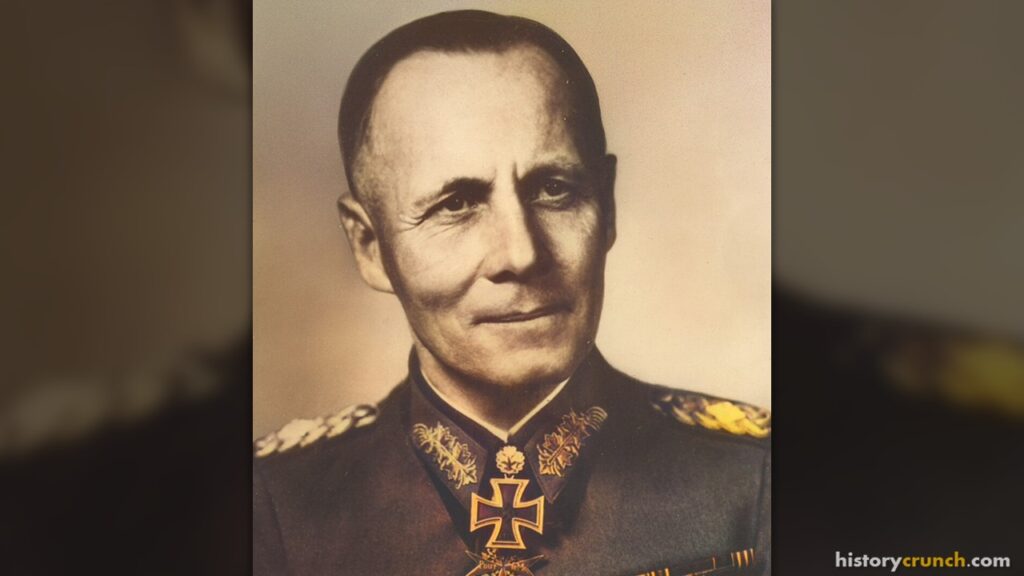
The war will be won or lost on the beaches. We'll have only one chance to stop the enemy and that's while he's in the water. The first twenty-four hours of the invasion will be decisive. For the Allies, as well as Germany, it will be the longest day.
Erwin Rommel
German field marshal, commander of Army Group B, speaking to his aide Hellmuth Lang in April 1944
Rommel was in charge of German defenses along the coast of France and believed an Allied invasion could only be stopped right at the shoreline, before troops moved inland. His prediction failed when the Allies broke through the beach defenses on D-Day, and his phrase gave that invasion its famous nickname, the longest day.
Erwin Rommel in 1941. (Colorized by historycrunch.com)
Source: National WWII Museum© factsthatcrunch.com
World War IIMini Timeline
Facts that CrunchFactsthatCrunch
The opening phase of the Battle of Normandy began on June 6th, 1944, when Allied forces landed on five beaches along the coast of France.
This first stage covered the initial landings and the hard fighting to secure a foothold on shore.
Allied commanders needed to move inland quickly before German forces could push them back into the sea.
June 6th, 1944
Allied Forces Land on Five BeachesAmerican, British, and Canadian troops came ashore at Utah, Omaha, Gold, Juno, and Sword beaches in the largest seaborne invasion in history.
June 7th, 1944
Beaches Linked TogetherAllied units pushed inland and connected most of the five landing zones into one continuous front along the Norman coast.
June 12th, 1944
Carentan CapturedAmerican forces took the town of Carentan, joining the Utah and Omaha beachheads into a single solid line stretching about 50 miles (80 kilometers).
June 13th, 1944
German Panzer Attack Stopped at Villers-BocageBritish and Commonwealth forces ran into a strong German armored counterattack near Villers-Bocage, slowing the push toward Caen.
June 27th, 1944
Cherbourg Falls to American ForcesU.S. troops captured the port city of Cherbourg after several days of street fighting, giving the Allies their first large harbor in France.
156,000
Allied troops landed on D-Day, June 6th, 1944
5
beaches stormed in the opening assault, spanning roughly 50 miles (80 km) of coastline
4,413
confirmed Allied dead on June 6th, 1944, according to the National World War II Museum
Source: Library of Congress© factsthatcrunch.comMore World War II Facts →
World War IIEyewitness
Facts that CrunchFactsthatCrunch
Eyewitness account

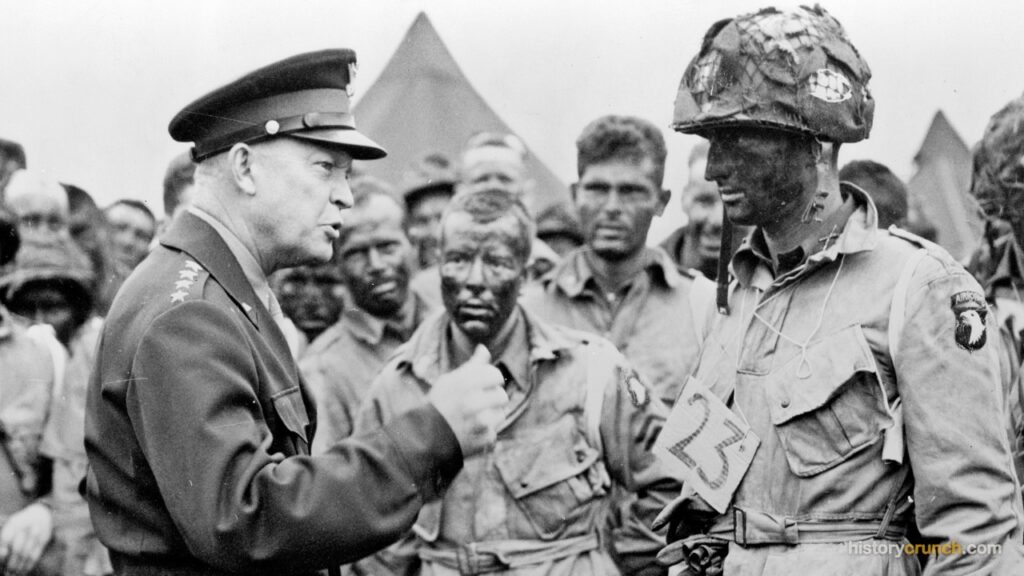
"As our boat touched sand and the ramp went down, I became a visitor to hell. I shut everything out and concentrated on following the men in front of me down the ramp and into the water."

HPHarry Parley, US Army private first class, flamethrower operator, 116th Infantry Regiment, 29th Infantry Division
Context

Parley described the moment his landing craft reached Omaha Beach on the morning of June 6th, 1944, in an account he gave to historian Stephen Ambrose.
Source: Stephen Ambrose, D-Day June 6, 1944 (1994)© factsthatcrunch.comMore World War II Facts →
The eyes of the world are upon you. The hopes and prayers of liberty-loving people everywhere march with you. In company with our brave Allies and brothers-in-arms on other fronts, you will bring about the destruction of the German war machine, the elimination of Nazi tyranny over the oppressed peoples of Europe, and security for ourselves in a free world.
General Dwight D. Eisenhower
Supreme Commander, Allied Expeditionary Force
Eisenhower put these words in his Order of the Day, a printed message handed to Allied troops just before they crossed the English Channel to invade Normandy. The order told the soldiers, sailors, and airmen why their mission mattered, and it is still read today as a record of what the Allies believed they were fighting for.
General Dwight D. Eisenhower speaks with a soldier of the 101st Airborne Division, whose face is painted for a night combat mission, while other paratroopers stand in the background.
Source: Eisenhower Presidential Library© factsthatcrunch.com
World War IIMini Timeline
Facts that CrunchFactsthatCrunch
D-Day opened with hours of action before a single landing craft touched the beaches of Normandy.
Allied forces began the operation in the dark, well before sunrise on June 6th, 1944.
The first troops to enter occupied France arrived by air, not by sea.
12:15 AM
British Glider AssaultBritish glider troops of the 6th Airborne Division landed near the Orne River to seize Pegasus Bridge, cutting German movement in the area.
1:30 AM
American Paratroopers DropThe 82nd and 101st Airborne Divisions parachuted into the Cotentin Peninsula, though heavy cloud and enemy fire scattered many units miles from their targets.
3:00 AM
Bomber Raids BeginAllied bombers began striking German coastal defenses and transport routes behind the beaches to weaken resistance before the sea landings.
5:00 AM
Naval Bombardment OpensAllied warships opened fire on German gun positions along the Normandy coast, with the bombardment intensifying as landing craft formed up offshore.
6:30 AM
First Waves Hit the BeachesAmerican troops landed at Utah and Omaha beaches at 6:30 AM, while British and Canadian forces landed at Gold, Juno, and Sword beaches shortly after.
156,000
Allied troops landed on June 6th, 1944
5
Normandy beaches assaulted that morning
822
Aircraft used in the 82nd and 101st Airborne drops
Source: Smithsonian Institution© factsthatcrunch.comMore World War II Facts →
World War IIHead to Head
Facts that CrunchFactsthatCrunch
Eisenhower (Supreme Allied Commander)VSRommel (Army Group B Commander)
~156,000~50,000 defending the assault beaches
Allied troops landed on D-Day (June 6th, 1944)
~11,590~570 (Luftwaffe, Normandy sector)
Allied aircraft available for the Normandy campaign
~6,939 ships and craft~3 small torpedo boats at sea
Allied naval vessels supporting the landings
~1,500 tanks and vehicles~160 tanks (21st Panzer, committed that day)
Allied armored vehicles landed in first 24 hours
~23,4000 (no German airborne response mounted)
Allied airborne troops deployed the night of June 5th–6th
Source: National WWII Museum© factsthatcrunch.comMore World War II Facts →
World War IIDate
Facts that CrunchFactsthatCrunch
6
June 1944

When Was D-Day? Allied Airborne Troops Begin the Normandy Invasion Just After Midnight

D-Day was first set for June 5th, 1944, but RAF Group Captain James Martin Stagg warned General Dwight D. Eisenhower that a storm was moving in over the English Channel, and Eisenhower postponed the invasion by 24 hours. Just after midnight on June 6th, 1944, thousands of American, British, and Canadian airborne troops dropped behind German lines in Normandy to secure roads and bridges ahead of the beach landings. The amphibious assault on five beaches, Utah, Omaha, Gold, Juno, and Sword, followed at 6:30 in the morning, with Allied forces suffering around 10,300 total casualties that day.
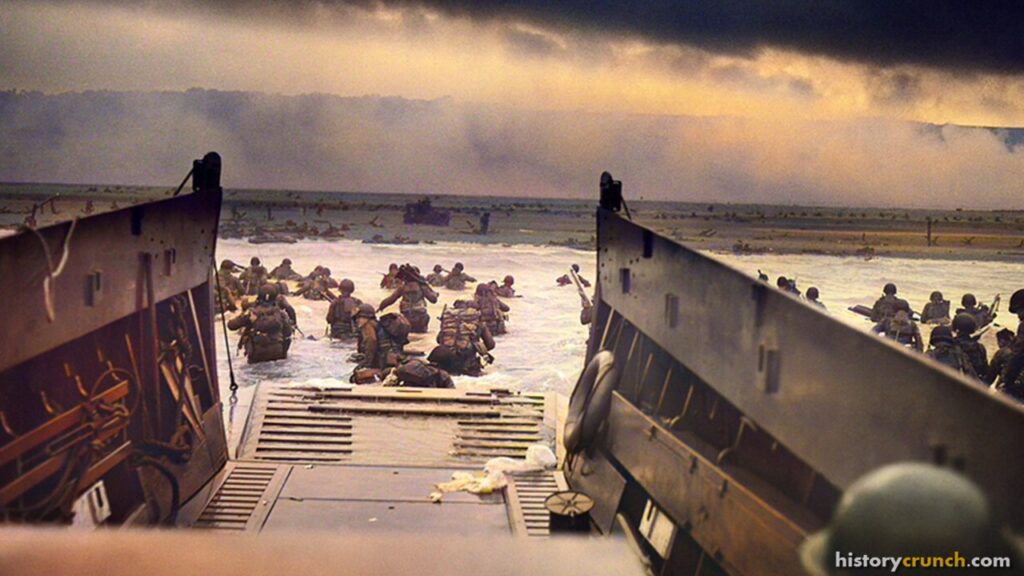
American troops during the Normandy Invasion of World War II. (Colorized by historycrunch.com)
Source: Library of Congress© factsthatcrunch.comMore World War II Facts →
World War IIBy the Numbers
Facts that CrunchFactsthatCrunch

On the night of June 5th to 6th, 1944, Allied airborne forces dropped behind German lines with precise, striking numbers that set the stage for the D-Day beach landings.

13,100
American paratroopers dropped (82nd and 101st Airborne Divisions)
4,000
Glider infantry sent in to reinforce the paratroopers on D-Day
23,000+
Allied troops landed by parachute or glider by midnight on June 6th
~925
C-47 aircraft used to carry American paratroopers to Normandy
2,499
American airborne casualties on D-Day
1 in 6
Paratroopers who landed on or near their planned drop zones
Three Allied airborne divisions took part: the U.S. 82nd and 101st Airborne Divisions and the British 6th Airborne Division. Despite heavy anti-aircraft fire scattering most men far from their targets, the airborne forces secured key roads and bridges that allowed the beach landings to succeed.
Source: Smithsonian Institution© factsthatcrunch.comMore World War II Facts →
Atlantic Wall
coastal defense built by Germany
The Atlantic Wall was a long system of bunkers, gun batteries, obstacles, and fortified positions that Nazi Germany built along the western coast of Europe, stretching roughly 1,670 miles (2,685 kilometers) from Norway to the south of France. Germany began construction in 1942 and continued adding to it through 1944, aiming to stop any Allied seaborne invasion from crossing the English Channel or landing along the Atlantic coast.
Source: Imperial War Museums© factsthatcrunch.comFacts that Crunch
World War IIPhoto Analysis
Facts that CrunchFactsthatCrunch
American and French flags stand beside white marble crosses at the Normandy American Cemetery in France, marking the graves of U.S. soldiers who died during the D-Day invasion and the campaign to liberate Western Europe in World War II. (Photo: Chairman of the Joint Chiefs of Staff, CC BY 2.0, via Wikimedia Commons)
Normandy American Cemetery, World War II: American and French Flags at the Graves
Look closely
Rows of white marble crosses stand in closely spaced lines across a wide, flat lawn.
Small American and French flags are placed at the base of the crosses in the foreground, their red, white, and blue colors standing out against the green grass.
The crosses stretch far into the background, giving a sense of the large number of graves at the site.
The context
The Normandy American Cemetery near Colleville-sur-Mer, France, holds the graves of 9,388 American service members, most of whom died during the D-Day landings on June 6th, 1944, or in the fighting that followed across Normandy.
The United States and France agreed to set aside the land permanently for the cemetery, and it was officially dedicated on July 18th, 1956.
The pairing of American and French flags at the graves reflects the close alliance between the two countries during the liberation of Western Europe.
What it tells us
The flags placed beside the crosses show that this photo was taken during a commemoration ceremony, not on an ordinary day, which means it records a public act of remembrance rather than the cemetery in its everyday state.
A student reading this image should ask why both national flags appear together, since that detail points to the shared cost and shared purpose of the Allied campaign in France.
The photograph is used by educators and governments to connect present-day audiences to the scale of American losses in the campaign to end the German occupation of Western Europe.
Source: American Battle Monuments Commission© factsthatcrunch.comMore World War II Facts →
World War IIQuote
Facts that CrunchFactsthatCrunch

D-Day was the pivot point of the 20th century. Everything that went before it can be said to have led up to it; all that followed came about because of what happened that day.

SE
Stephen E. AmbroseAmerican historian and D-Day scholar, 2002
Why it matters

Ambrose's verdict echoed the warning Field Marshal Erwin Rommel gave his aide Helmuth Lang on April 22nd, 1944, that the invasion would be decided in its opening day, the remark that gave Cornelius Ryan's 1959 book The Longest Day its title.

Source: To America: Personal Reflections of an Historian, 2002© factsthatcrunch.comMore World War II Facts →
World War IIEyewitness
Facts that CrunchFactsthatCrunch
Eyewitness account

"The bullets tore holes in the water around me, and I made for the nearest steel obstacle."

RCRobert Capa, Combat photographer for Life magazine
Context

Capa wrote these words in his 1947 memoir, recalling how he waded ashore under German fire with the first wave of American troops on the Easy Red sector of Omaha Beach during the D-Day landing in Normandy.

Source: Robert Capa, Slightly Out of Focus (1947)© factsthatcrunch.comMore World War II Facts →
World War IINotebook Timeline
Facts that CrunchFactsthatCrunch
World War II
D-Day Hour by Hour
12:15 AM, June 6th, 1944: American and British paratroopers began landing behind German lines in Normandy.
3:00 AM, June 6th, 1944: Allied bombers struck German coastal defenses along the Normandy beaches.
5:30 AM, June 6th, 1944: Naval guns opened fire on German positions from over 1,000 Allied warships offshore.
6:30 AM, June 6th, 1944: U.S. troops hit Omaha and Utah beaches, facing the heaviest German resistance of the day.
7:25 AM, June 6th, 1944: British and Canadian forces landed at Gold, Juno, and Sword beaches to the east.
12:00 PM, June 6th, 1944: Allied troops had secured enough ground to begin moving inland from most beaches.
Source: National WWII Museum© factsthatcrunch.comMore World War II Facts →
World War IIPrimary Source
Facts that CrunchFactsthatCrunch

You are about to embark upon the Great Crusade, toward which we have striven these many months. The eyes of the world are upon you.

General Dwight D. Eisenhower · Order of the Day, Supreme Headquarters Allied Expeditionary Force · June 6th, 1944

Eisenhower was the Supreme Commander of the Allied Expeditionary Force, and he began drafting this printed Order of the Day in February 1944. The order was distributed to the 175,000-member expeditionary force on the eve of the invasion of Normandy. A pre-recorded voice version of the message was also broadcast to audiences in both England and the United States on the day of the landings.

General Dwight D. Eisenhower speaks with a soldier of the 101st Airborne Division, whose face is painted for a night combat mission, while other paratroopers stand in the background.
Source: Order of the Day, 1944, Eisenhower Presidential Library© factsthatcrunch.comMore World War II Facts →
World War IIQ&A
Facts that CrunchFactsthatCrunch
Q

What Does the D in D-Day Stand for?

A

The D in D-Day simply stands for 'Day.' The term was standard U.S. military shorthand used to mark the date an operation was set to begin, without naming the actual calendar date in orders or communications. The Normandy invasion on June 6th, 1944, became so famous that 'D-Day' is now linked almost entirely to that landing, but American forces used the same term for other operations throughout the war.

Source: UNESCO© factsthatcrunch.comMore World War II Facts →
World War IIBiography
Facts that CrunchFactsthatCrunch
Dwight D. Eisenhower
Supreme Allied Commander, Europe (World War II); 34th President of the United States
Born: October 14th, 1890, Denison, Texas
Appointed Supreme Commander: February 11th, 1943, North Africa
D-Day Command: June 6th, 1944, Normandy, France
Died: March 28th, 1969, Washington, D.C.

Eisenhower commanded Allied forces in North Africa and Europe, coordinating armies from multiple nations to defeat Nazi Germany. His leadership of Operation Overlord, the large-scale Allied invasion of Western Europe, proved central to ending the war on the European front.
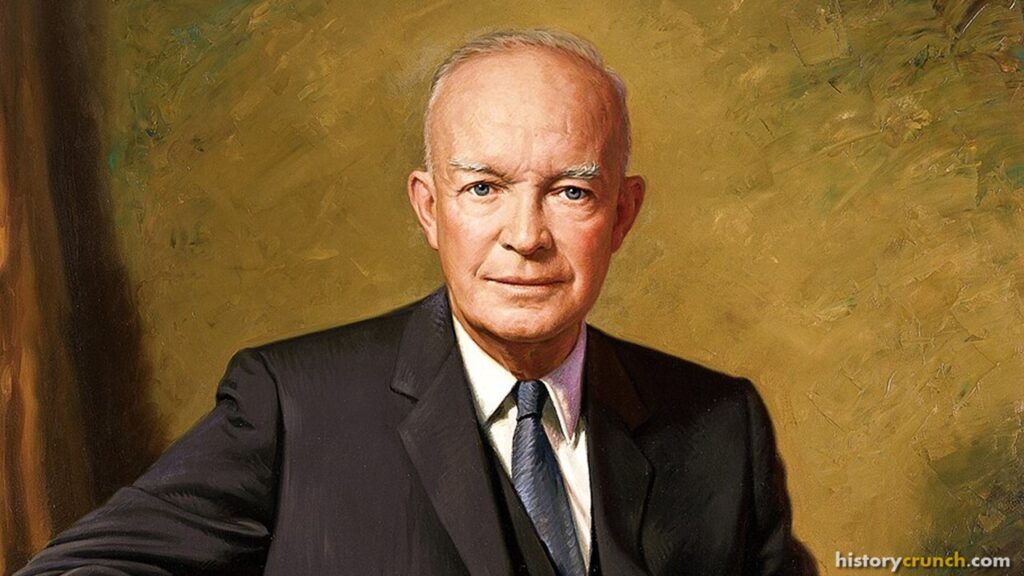
Supreme Allied CommanderOperation OverlordNorth Africa Campaign34th U.S. President
Dwight D. Eisenhower Official White House Portrait.
Source: UNESCO© factsthatcrunch.comMore World War II Facts →
World War IIScale
Facts that CrunchFactsthatCrunch

What Share of the D-Day Ground Troops Came from Each Allied Nation? Americans Made Up Nearly Half of the Force That Landed in Normandy on June 6th, 1944.

Americans (Omaha, Utah, airborne)
73,000British (Gold, Sword, airborne)
61,715Canadians (Juno Beach)
21,400Other Allied nations
~4,000

About 160,000 Allied troops landed in Normandy on June 6th, 1944, coming from the United States, Britain, Canada, and several other Allied nations including Norway, Poland, and Free France. Americans supplied the largest share, landing on two beaches and dropping two airborne divisions, yet the British contribution was close behind, covering two beaches plus their own airborne forces. Canada, though the smallest of the three main ground forces, took on one full beach at Juno entirely on its own.

Source: Library of Congress© factsthatcrunch.comMore World War II Facts →
World War IIDefinition
Facts that CrunchFactsthatCrunch
D-Day
from military usage: 'D' stands for the day an operation begins, keeping the exact date secret during planning

D-Day is a military code term for the first day of a planned attack or operation. Commanders used it so that orders could be written before a final date was chosen, since the calendar date was kept secret until close to the launch. The most famous D-Day in history was June 6th, 1944, when Allied forces landed on the beaches of Normandy, France, to begin the liberation of Western Europe from German control.

"Because planners used the term D-Day in their orders for the Normandy invasion, soldiers knew exactly when to move without the date being spelled out in documents that might fall into enemy hands."
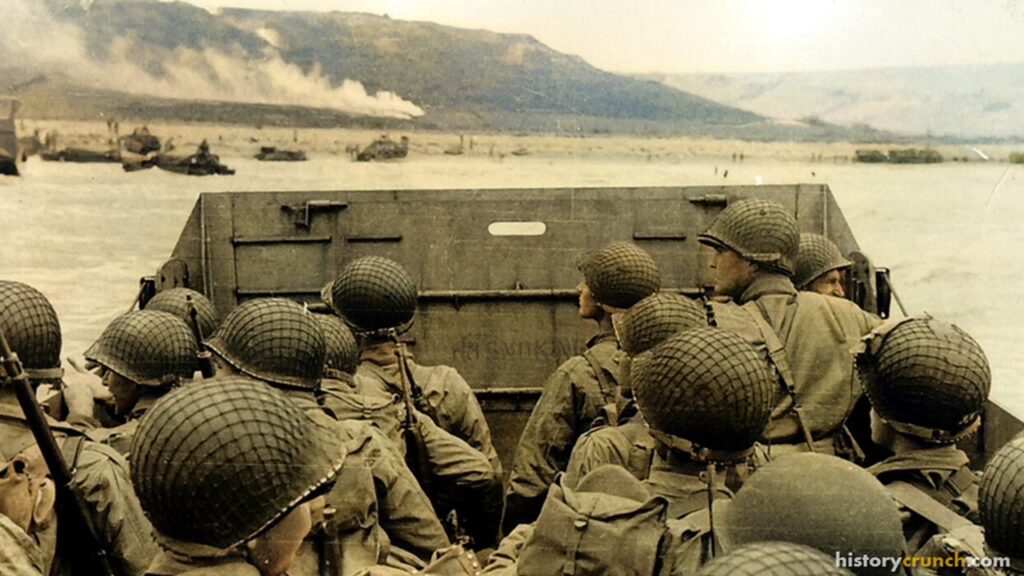
American troops approaching Omaha Beach during the events of the Normandy Invasion in June of 1944. (Colorized by historycrunch.com)
Source: US National Archives© factsthatcrunch.comMore World War II Facts →
World War IIRedacted FileInteractive
Facts that CrunchFactsthatCrunch
TOP SECRET / EYES ONLY
Operation Overlord: Supreme Commander's Execution Order, 1944
On April 12th, 1944, General Dwight D. Eisenhower received final authority as Supreme Allied Commander to execute Operation Overlord, the Allied invasion of Nazi-occupied France. The order designated Normandy as the landing zone and set five beaches as the assault sectors, code-named Utah, Omaha, Gold, Juno, and Sword. Eisenhower personally wrote a short note accepting full responsibility for the operation, stating that if the landings failed, the fault was his alone. The plan called for approximately 156,000 Allied troops to cross the English Channel on the first day of the assault. Eisenhower delayed the launch by 24 hours after his meteorologist, Group Captain James Stagg, forecast a narrow window of acceptable weather opening on the morning of June 6th, 1944.
Tap the black bars to declassify.
Source: National Archives© factsthatcrunch.comMore World War II Facts →
Test Yourself
World War IIImage QuestionInteractive
Facts that CrunchFactsthatCrunch
American and French flags stand beside white marble crosses at the Normandy American Cemetery in France, marking the graves of U.S. soldiers who died during the D-Day invasion and the campaign to liberate Western Europe in World War II. (Photo: Chairman of the Joint Chiefs of Staff, CC BY 2.0, via Wikimedia Commons)

In this photograph of the Normandy American Cemetery, both American and French flags stand beside the white marble crosses marking U.S. soldiers' graves. What does the placement of French flags at a U.S. military cemetery most directly reveal about the D-Day landings and their aftermath?

Tap an option.
ExplanationThe Normandy American Cemetery sits on French soil at Colleville-sur-Mer, donated permanently to the United States by France. French flags placed at American graves reflect France's acknowledgment that U.S. soldiers died liberating French territory from German control during the June 1944 campaign. The cemetery is actually maintained by the American Battle Monuments Commission, not the French government, and American forces, not French, made up the largest D-Day landing force.
Source: Library of Congress© factsthatcrunch.comMore World War II Facts →
World War IIMatchingInteractive
Facts that CrunchFactsthatCrunch

Which definition fits each D-Day term?

Tap a term, then tap its match.
Source: Smithsonian Institution© factsthatcrunch.comMore World War II Facts →

We shall never surrender.

Address to the House of Commons, London, June 4th, 1940
Who said it?
Tap a name.
ExplanationWinston Churchill said these words in his speech to the House of Commons on June 4th, 1940, during World War II in the European Theater. He was describing Britain's resolve after the evacuation of Allied troops from Dunkirk, France. The speech told the British people and the world that Britain would keep fighting Germany no matter the cost. It became one of the defining statements of Allied resistance in World War II.
Source: Imperial War Museums© factsthatcrunch.comFacts that Crunch

Sources

Explore More Topics

Battle of the Bulge

Germany's offensive through the Ardennes forest in December of 1944 was its last major attempt to reverse the Allied advance in the west. The attack pushed Allied lines back significantly before being contained, and the fighting stretched into January of 1945. The failure of the offensive left Germany without the reserves needed to mount another large-scale defense on the Western Front.

World War IIStat
Facts that CrunchFactsthatCrunch
German casualties at the Battle of the Bulge

The German High Command's own official figure listed 84,834 German soldiers killed, wounded, or captured during the Battle of the Bulge from December 16th, 1944 to January 25th, 1945.

Other estimates put German losses between 60,000 and 100,000. Germany committed over 410,000 men to the attack, so the casualties represented a major share of its remaining fighting strength in the West. Unlike the Allies, Germany could not replace these losses, and most surviving units retreated to the Siegfried Line in a badly weakened state.

Source: Library of Congress© factsthatcrunch.comMore World War II Facts →
World War IICorkboard Timeline
Facts that CrunchFactsthatCrunch
Battle of the Bulge in World War II
Week by Week, December 1944 to January 1945
1944
Week 1: December 16th to 22nd, 1944
Germany launched roughly 200,000 troops and about 600 tanks through the Ardennes forest, pushing the Allied front line back and creating a large bulge in the American lines.
1944
Week 2: December 23rd to 29th, 1944
Skies cleared on December 23rd, allowing Allied aircraft to fly again; U.S. planes struck German supply columns and helped relieve pressure on the surrounded 101st Airborne Division at Bastogne.
1944
Week 3: December 30th, 1944 to January 5th, 1945
General George S. Patton's Third Army pushed north from the south, while German forces made their last serious attempt to break through to the Meuse River and failed to reach it.
1945
Week 4: January 6th to 13th, 1945
British forces under Field Marshal Bernard Montgomery attacked from the north near Hotton and Marche, while U.S. forces continued pressing from the south, squeezing the bulge from both sides.
1945
Week 5: January 14th to 25th, 1945
American units from the north and south linked up near Houffalize, Belgium, on January 16th, cutting off large numbers of German troops and collapsing the center of the bulge.
1945
Week 6: January 26th to 28th, 1945
The Allied line was fully restored to where it had stood on December 16th, 1944; Germany had lost roughly 67,000 to 100,000 soldiers killed, wounded, or captured, and could not replace them.
A timeline pinned to the board.
Source: National WWII Museum© factsthatcrunch.comMore World War II Facts →
World War IIStat
Facts that CrunchFactsthatCrunch
American soldiers killed

During the Battle of the Bulge from December 16th, 1944 to January 25th, 1945, roughly 19,000 American soldiers were killed in action, making it the deadliest single battle for the U.S. Army in World War II.

According to the U.S. Army Center of Military History, total American casualties reached about 89,500, including roughly 47,500 wounded and more than 23,000 missing or captured. Germany lost an estimated 100,000 soldiers killed, wounded, or captured, losses the German military could not replace.
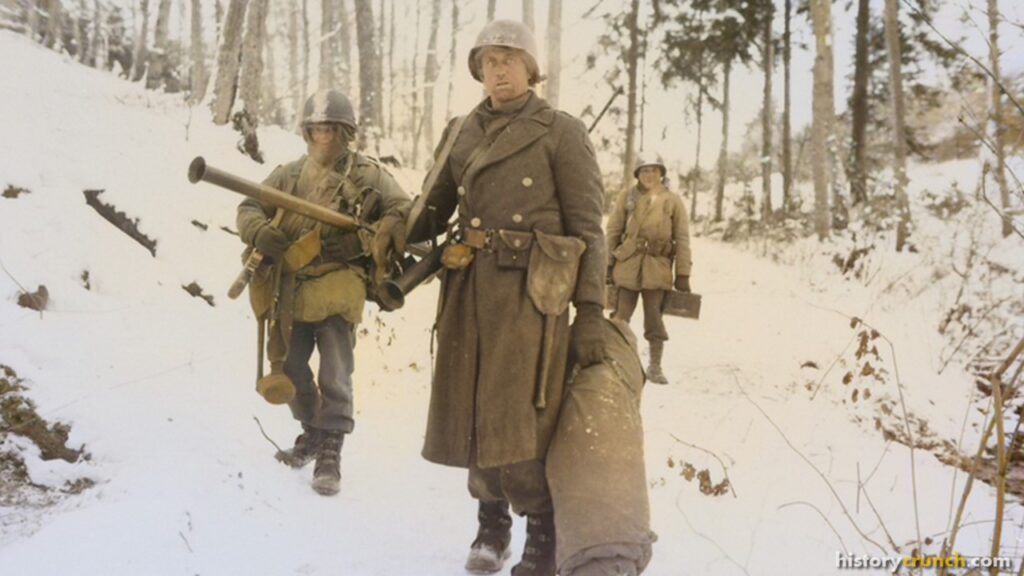
Americans of the 101st Engineers during the Battle of the Bulge. (Colorized by historycrunch.com)
Source: Library of Congress© factsthatcrunch.comMore World War II Facts →
World War IIFast Facts
Facts that CrunchFactsthatCrunch
Battle of the Bulge start dateDecember 16th, 1944
Battle of the Bulge end dateJanuary 25th, 1945
German troops committed to the offensiveAbout 410,000 soldiers
U.S. troops at the Battle of the BulgeAbout 610,000, the largest single U.S. engagement of World War II
U.S. casualties (killed, wounded, captured, or missing)About 75,000
German casualties (killed, wounded, or captured)About 60,000 to 100,000
Width of the German advance into Allied linesAbout 50 miles (80 kilometers) at its deepest point

Key takeaways

The Battle of the Bulge was Germany's last major offensive on the Western Front, and its failure left German forces too weakened to stop the Allied advance into Germany.

The United States suffered more casualties in this battle than in any other single engagement it fought in World War II.

After the German push was stopped by late January 1945, Allied forces crossed the Rhine River and pushed deep into Germany within weeks.

Source: Smithsonian Institution© factsthatcrunch.comMore World War II Facts →
World War IIDid You Know
Facts that CrunchFactsthatCrunch
Surprising fact

The term 'Battle of the Bulge' was coined not by generals or official military reports but by American war correspondent maps that showed a bulging westward dent in the Allied front line, and the U.S. Army never adopted it as a formal name.

When German forces launched their Ardennes offensive on December 16th, 1944, they pushed Allied lines outward in a shape that looked like a bulge on news maps printed back home. Reporters began using the phrase to describe that visual shape, and readers recognized it immediately. The official U.S. Army name for the campaign was the Ardennes-Alsace Campaign, a title almost no one uses today.
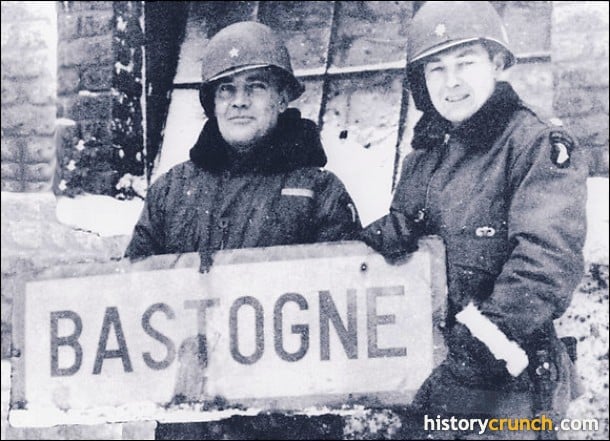
Source: UNESCO© factsthatcrunch.comMore World War II Facts →
Nuts!
Brigadier General Anthony McAuliffe
U.S. Army general leading the 101st Airborne Division at Bastogne, 1944
During the Battle of the Bulge, German forces surrounded the town of Bastogne in Belgium and demanded that the Americans surrender on December 22nd, 1944. McAuliffe sent back this one-word refusal, and his troops held the town until part of General Patton's Third Army broke through four days later.
Anthony C. McAuliffe, left, and then-Col. Harry W.O. Kinnard II at Bastogne · Wikimedia Commons / Unknown War photographer
Source: U.S. Army Center of Military History© factsthatcrunch.com
World War IICorkboard Timeline
Facts that CrunchFactsthatCrunch
Battle of the Bulge Day by Day
Final Push and Retreat, December 1944 to January 1945
1944
December 18th, 1944
German forces surrounded the town of Bastogne, Belgium, cutting off about 18,000 U.S. troops of the 101st Airborne Division and other units inside.
1944
December 22nd, 1944
German General Heinrich Luettwitz demanded the surrender of Bastogne; U.S. Brigadier General Anthony McAuliffe answered with a one-word reply: "NUTS!"
1944
December 23rd, 1944
Skies over Belgium cleared for the first time in days, allowing U.S. and Allied aircraft to drop supplies into Bastogne and attack German columns on the roads.
1944
December 26th, 1944
The 4th Armored Division of General George Patton's Third Army broke through German lines and reached Bastogne, ending the siege of the town.
1945
January 3rd, 1945
Allied forces launched a major counterattack from the north, with U.S. First Army pushing south to close the bulge from both sides.
1945
January 25th, 1945
German forces completed their withdrawal to their starting positions, ending the Battle of the Bulge after about six weeks of fighting.
A timeline pinned to the board.
Source: National WWII Museum© factsthatcrunch.comMore World War II Facts →
World War IIScale
Facts that CrunchFactsthatCrunch

How Were German Forces Split in the Battle of the Bulge? The 410,000-Troop Assault Force Was Divided Unequally Across Three Armies

6th SS Panzer Army (Dietrich)
~180,000 troops5th Panzer Army (von Manteuffel)
~150,000 troops7th Army (Brandenberger)
~80,000 troops

Germany's Army Group B under Field Marshal Walter Model launched the Battle of the Bulge on December 16th, 1944, with roughly 410,000 troops divided across three armies. Hitler gave the 6th SS Panzer Army the largest share and the best equipment, making it bigger than the other two armies combined. The 7th Army, the smallest force, had almost no tanks and relied on horses for supply, much as German forces had in 1914.

Source: UNESCO© factsthatcrunch.comMore World War II Facts →
World War IIBiography
Facts that CrunchFactsthatCrunch
George S. Patton
U.S. Army General, World War II
Born: November 11th, 1885, San Gabriel, California
Commanded: Seventh Army in Sicily, 1943
Commanded: Third Army across France, 1944 to 1945
Died: December 21st, 1945, Heidelberg, Germany

Patton led the U.S. Third Army in a rapid advance across France and into Germany after the breakout at Normandy in the summer of 1944, covering more ground in less time than almost any other Allied force in the war. He is remembered as one of the most aggressive and effective American field commanders of World War II, known for pushing his troops and armor fast to keep the enemy off balance.

U.S. Third ArmyNorth Africa and SicilyBattle of the Bulge reliefArmored warfare
George S. Patton standing in an army jeep in April of 1944. (Colorized by historycrunch.com)
Source: Smithsonian Institution© factsthatcrunch.comMore World War II Facts →
World War IIConnections
Facts that CrunchFactsthatCrunch
Battle of the Bulge (December 1944)
Liberation of Paris (August 1944)
The connection

Both happened in 1944 and together marked the turning point of the war in Western Europe: the liberation of Paris in August 1944 showed the Allied advance was unstoppable, and the failed German counteroffensive at the Bulge in December 1944 confirmed Germany had no realistic path to reversing Allied gains in the west.

After German forces were pushed back from the Bulge by late January 1945, the Western Allies crossed into Germany itself within weeks, and the war in Europe ended on May 8th, 1945.

Source: UNESCO© factsthatcrunch.comMore World War II Facts →
World War IITwo ViewsInteractive
Facts that CrunchFactsthatCrunch

How did the Battle of the Bulge look to American soldiers holding the line versus German commanders planning the attack?

American units were caught off guard when Germany struck through the Ardennes forest in December 1944. Troops at places like Bastogne found themselves surrounded and outnumbered, yet many held their positions through bitter cold and heavy snow while waiting for reinforcements. For American soldiers, the battle felt like a sudden crisis that demanded they stop a German breakthrough at almost any cost.
German commanders saw Operation Watch on the Rhine as a last real chance to split the Allied armies and capture the vital supply port of Antwerp. Hitler believed a large enough breakthrough would force the Western Allies to negotiate, buying Germany time on the western front. Most senior German officers, including Field Marshal Gerd von Rundstedt, privately doubted the plan could succeed given how few fuel and armored reserves Germany still had by late 1944.
Source: Library of Congress© factsthatcrunch.comMore World War II Facts →
World War IINotebook Cause and Effect
Facts that CrunchFactsthatCrunch
Battle of the Bulge: Causes and Effects
Causes
Hitler ordered the attack to split Allied supply lines running through Belgium.
German commanders concentrated about 200,000 troops in secret along a thinly held 85-mile front.
Thick winter fog grounded Allied aircraft and hid the German buildup in early December 1944.
American forces in the Ardennes were inexperienced or exhausted units rotated there to rest.
German Ardennes Offensive, 1944
Effects
The surprise assault created a large salient, or bulge, in Allied lines up to 50 miles deep.
The 101st Airborne Division held Bastogne under siege, blocking German access to key roads.
Allied forces counterattacked from north and south, and Germany's offensive collapsed by late January 1945.
Germany lost irreplaceable troops and armor, leaving its western defenses too weak to stop the Allied advance into Germany.
Source: National WWII Museum© factsthatcrunch.comMore World War II Facts →
Test Yourself
World War IIMultiple ChoiceInteractive
Facts that CrunchFactsthatCrunch

What was the German code name for the offensive that launched the Battle of the Bulge in December 1944?

Tap an option.
ExplanationGermany called the offensive Operation Autumn Mist (Unternehmen Herbstnebel). Hitler chose the Ardennes region to split Allied lines and recapture the port of Antwerp. Operations Barbarossa, Overlord, and Market Garden were all earlier 1941 to 1944 operations with no connection to the Ardennes attack.
Source: Library of Congress© factsthatcrunch.comMore World War II Facts →
World War IIBefore or AfterInteractive
Facts that CrunchFactsthatCrunch
Reference pointThe German breakthrough at Ardennes, opening the Battle of the Bulge (December 16th, 1944)

American forces at Bastogne held out against German encirclement during the Battle of the Bulge

ExplanationGerman armored units surrounded the Belgian town of Bastogne shortly after the offensive began. American forces of the 101st Airborne Division and attached units held the town despite the siege, and relief from General Patton's Third Army arrived on December 26th, 1944.
Source: US National Archives© factsthatcrunch.comMore World War II Facts →
Explore More Topics
Explore More Topics